SPECIAL Informat.ro / Romania, in the European press: The top topics from the last two weeks in the European press, about Romanians and Romania


Always see our news on Google
In the last two weeks, Romania and Romanians have made it onto the agenda of the European press primarily through cases with geopolitical stakes, such as security in the Black Sea and on the Danube, and the role in the budgetary architecture of the European Union, complemented by positive reflections on Romania as a tourist destination and a sports-cultural actor. The analysis, based on NewsVibe data for the period April 4-17, indicates 1,657 articles published in the European press, with most mentions coming from France, the United Kingdom, Italy, Greece, and Germany.
Russian Attacks on Izmail and Violation of Romanian Airspace
The most important geopolitical subject, with high visibility in the Western press, is the Russian drone attack on the Ukrainian port of Izmail on the Danube, and the confirmation from Bucharest that a drone entered Romanian airspace. France 24 reports on "a new Russian drone attack" on the largest Ukrainian port on the Danube, emphasizing that the railway and port infrastructure was damaged and that Romania confirmed the violation of airspace during this "large-scale offensive." The text explains that Izmail is located at the southwestern tip of Ukraine, at the border with Romania, and describes it as "an important logistical area" for grain exports circumventing the Russian blockade in the Black Sea, thus highlighting Romania's position as a direct neighbor of a conflict zone.
In the United Kingdom, tabloids like The Mirror headline that "Russian drones have violated the airspace of a NATO state" and quote the Romanian Ministry of Defense from Bucharest, which speaks of "a serious violation of international law." The text notes that the Romanian defense tracked two aerial targets in the Tulcea area and that one of them entered Romanian airspace, with radar contact being lost over an uninhabited area located 16 kilometers southeast of Chilia Veche. Daily Express uses a similar register, reporting that a "Russian drone would have entered Romanian airspace" and insisting that the ministry in Bucharest qualifies the incident as a serious violation of international law, which strengthens Romania's perception as a NATO member state under pressure.
In Greece, portals like Thestival and EfSyn write that a nighttime drone attack hit the port of Izmail again, and "a drone deviated from its trajectory and entered Romanian territory," a fact confirmed by Ukrainian and Romanian authorities. Thestival emphasizes that the port is "across from Romanian territory, on the other side of the Danube" and reminds that the port infrastructure in the area is the target of repeated strikes, which puts constant pressure on security at Romania's border. EfSyn speaks of "a new attack on a port on the Danube" and mentions that the entry of the drone into Romanian airspace triggered an alarm in Bucharest, without launching criticisms against Romania.
In all these materials, the tone is neutral-alarmist: the emphasis is on Russia's aggression and the risk of escalation in proximity to a NATO country, while Romania is presented as a potential victim and a responsible partner. The relationship with the states hosting these editorial offices is strengthened at the level of public perception, as Romania appears as an integral part of the Euro-Atlantic security architecture, being on the front line of the confrontation with Russia.
Romania and the EU Budget Post-2028 in the Italian Press
The second geopolitically charged file visible in the Italian press extensively quotes Romanian MEP Siegfried Mureșan in the context of negotiations for the future multiannual financial framework of the European Union. The Adnkronos agency publishes articles also taken up by Labitalia explaining that, on April 15, the European Parliament's budget committee voted on a position requesting "a budget richer by about 10%" compared to the Commission's proposal for the period 2028-2034. Mureșan is quoted stating that "we propose a European budget that is both adequate and predictable for beneficiaries, correcting the shortcomings of the Commission's initial proposal," while the texts detail that the Parliament aims for a total volume of 2.014 trillion euros and wishes to maintain the repayment of the NextGenerationEU debt outside the actual budget.
The tone of these materials is technical and neutral, focused on figures, budgetary mechanisms, and the balance of institutional forces between Parliament and the Commission. Romania is visible through the name of the MEP, defined as one of the two rapporteurs of a "delicate and extensive file," which projects the image of a country capable of managing complex files at the top of the EU's institutional architecture. In terms of bilateral relations, the fact that the Italian media widely takes up Mureșan's position confirms Romania's perception as a pro-integration actor, aligned with states that demand a sufficiently consistent budget to support both traditional policies and new security priorities, green transition, and digitalization.
Romania as a Destination and Sports-Cultural Actor in Germany, France, and Greece
The image of Romania as a tourist destination is very favorably outlined in the German technology and IT business press Boltwise, which publishes an article titled "Transfăgărășan: a masterpiece of engineering art in Romania." The text describes the Transfăgărășan as "one of the most spectacular mountain roads in the world," "a symbol of engineering art and connection with nature," highlighting the 90 kilometers of road through the Făgăraș Mountains and the fact that it attracts thousands of visitors annually. Journalists insist that the Transfăgărășan "is not just a road, but a symbol" that connects regions, history, and culture, projecting Romania as a memorable destination for the German-speaking public.
In France, the daily Le Télégramme mentions Romania in a sports context, in an article about Brest Bretagne Handball, which announces the official return of goalkeeper Cléopâtre Darleux as sports director and ambassador of the club. The text notes that the announcement is made "on the eve of the quarter-finals of the first leg of the Champions League against the Romanian club Gloria Bistrița," which confirms the presence of a Romanian team in the elite of European handball and places Romania in the top sports landscape. The tone is neutral-positive and focuses on the performance of the French club, but the fact that the opponent is Romanian contributes to normalizing Romania's image as a respected sports partner.
General Tone in the European Press:
Of the 1,657 articles, 1,300 (78%) have a neutral tone, 246 (15%) have a negative tone, and 111 (7%) have a positive tone.
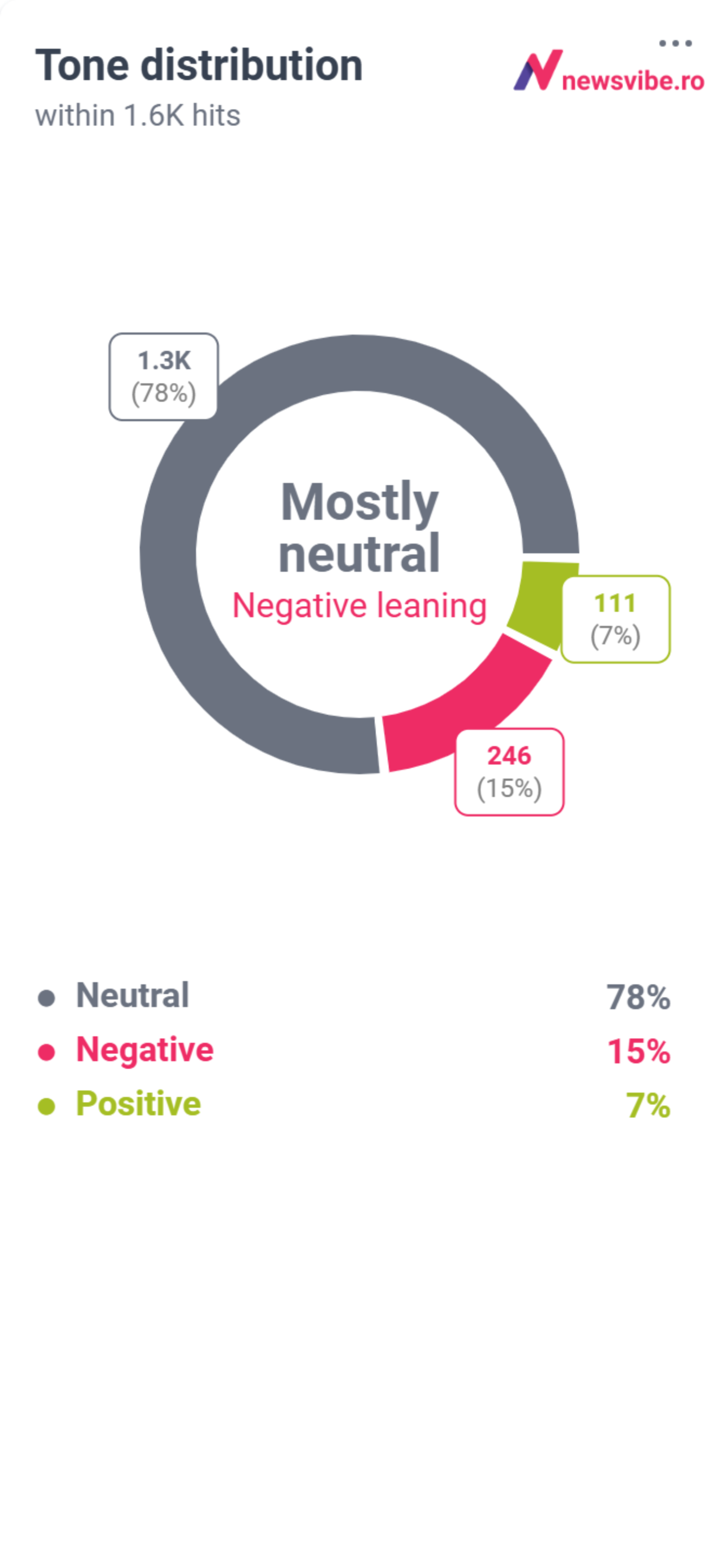
Graph: NewsVibe
****Summary made with the help of a data monitoring flow provided by the NewsVibe Romania media monitoring platform. The analysis, data, and images presented have been enhanced with the help of Machine Learning and Artificial Intelligence tools.
Latest News
20:10
19:55
19:45
19:43
19:43
See more news
NEWS ON THE SAME TOPICS