ANALYSIS What are Romania's chances at Eurovision 2026? Alexandra Căpitănescu and "Choke Me", under the scrutiny of betting houses



Always see our news on Google
With a week to go before the Eurovision 2026 final, Romania is starting from a good position, with "Choke Me" by Alexandra Căpitănescu rated in the 6-10 range, but with a clear gap compared to the big favorites Finland, Greece, and Denmark in the betting houses' rankings. The odds confirm a realistic scenario: a place in the final and a plausible chance at the top 10, but a potential triumph would depend on a massive public vote and how the controversy surrounding the song is perceived.
What position is Romania placed in, according to the betting houses' odds
The reference site Eurovisionworld, which aggregates the odds from several European betting houses daily, places Romania in the 7-8 positions in the ranking of chances to win the Eurovision 2026 trophy, while the song "Choke Me", performed by Alexandra Căpitănescu, has about a 3% chance of victory. In front of Romania is a clear block of favorites, led by Finland, which has an estimated winning percentage of 34%, followed by Greece (about 13% chance) and Denmark (about 11% chance). France and Australia complete the top 5, with approximately 7% chance each, while Israel and Italy fall into the 3-4% chance range.
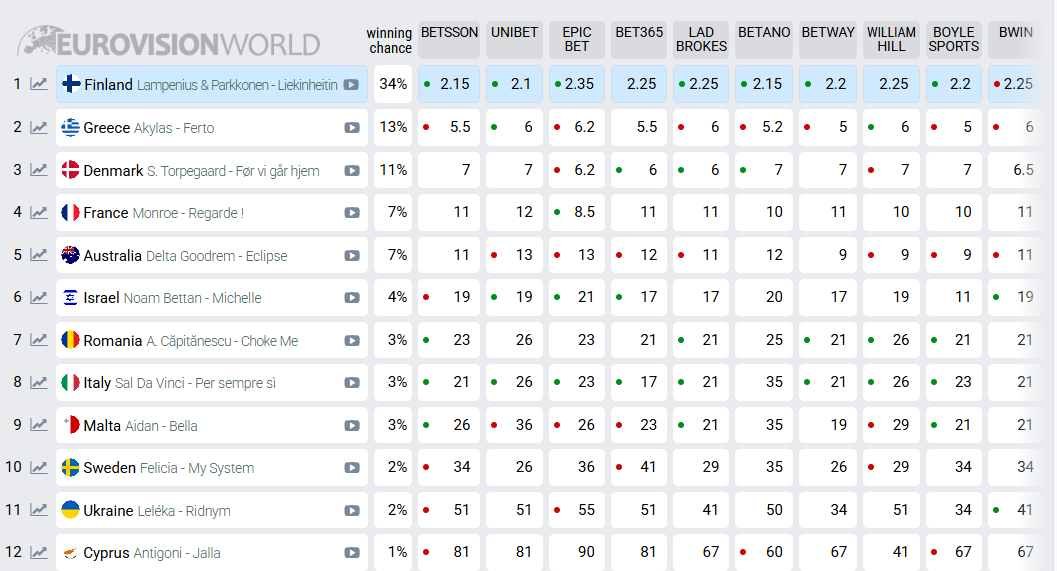
PHOTO: Screenshot eurovisionworld.com/odds
Romania's position vs. Finland, Moldova, and Ukraine
In the bookmakers' ranking, Romania is close to Italy (7th place) and Malta (9th place), being in the zone of teams considered "serious outsiders" – that is, artists who can rise in the ranking based on their live performance in the semifinals and final. The NewsVibe report reflects the same distribution: Romania does not enter the narrow circle of major favorites, but is shaping up to be one of the possible surprises of the final.
Moldova and Ukraine are ranked lower than Romania in the betting houses' hierarchy. Moldova, with "Viva, Moldova" performed by Satoshi, is rated around 14th place, with about 1% chance of victory, indicating that bookmakers see qualification for the final as plausible, but a title as very unlikely. Ukraine, with "Ridnym" by the band Lelėka, is around 11th place, with about 2% chance, suggesting that it can aspire to a good place in the final, but is not in the circle of the top five favorites.
The data is dynamic, but the overall picture is clear: Romania is in the first half of the odds ranking, but far from Finland's hegemony. In practical terms, this translates into a reasonably considered probability of qualifying for the final and a realistic battle for a top 10 place, rather than for the trophy.
Romania's chronology at Eurovision: peaks and breaks
Romania officially debuted at Eurovision in 1994, with Dan Bittman and "Dincolo de nori", and since then has participated 23 times up to 2023. The country has six top 10 finishes, all during the peak visibility period of the contest in Romania, between 2002 and 2017.
Years in which Romania finished in the top 10
According to the Eurovision database and historical summaries included in the NewsVibe report, Romania has finished in the top 10 in the following years:
2002 – Monica Anghel & Marcel Pavel – "Tell Me Why": 9th place in the final
2003: Nicola – "Don't Break My Heart" – 10th place
2005 – Luminița Anghel & Sistem – "Let Me Try": 3rd place
2006 – Mihai Trăistariu – "Tornerò": 4th place
2010 – Paula Seling & Ovi – "Playing With Fire": 3rd place
2017 – Ilinca & Alex Florea – "Yodel It!": 7th place
These results have solidified Romania's image as a country with a consistent contribution of competitive songs, with a mix of European pop and regional influences, designed to appeal to both the jury and the televote. However, after 2017, the trajectory has been downward: Romania missed qualification for the final in 2018, 2019, 2021, and 2023, which has weakened the brand of "safe presence" in the final stage.
Why Romania missed two consecutive years
After the failure in 2023, when Theodor Andrei did not score any points in the semifinal and did not reach the final, Romania has been absent from two consecutive editions, in 2024 and 2025. According to Eurovision archives and reports taken by NewsVibe, TVR withdrew from participation for financial and strategic reasons, amid low audiences, internal debates about the relevance of the contest, and the need to reorganize the selection process.
This was not the first major crisis in the relationship between TVR and EBU. In 2016, Romania was excluded from the contest by the European Broadcasting Union due to historical debts, and Ovidiu Anton's song "Moment of Silence" was withdrawn from the competition. The 2024-2025 break was, however, a voluntary one, officially presented as a "reevaluation of priorities and resources", and the return in 2026, with Alexandra Căpitănescu, was communicated by TVR as a "new beginning".
The "Choke Me" scandal: accusations, reactions, decision
"Choke Me", Romania's song for Eurovision 2026, became the subject of international scandal a few days after winning the national selection. The controversy started from the lyrics and the title of the song, criticized by feminist organizations and domestic violence experts as a supposed "glorification of sexual choking".
The Guardian reported that several activist groups explicitly called for the song's exclusion from the contest, arguing that such a message is incompatible with the values promoted by EBU and risks normalizing dangerous behavior in a sexual context. In Romania, the debate was widely reflected by television and news sites, including Digi24, which documented the calls from NGOs to ban the song.
TVR reacted with a statement defending the song, insisting that "Choke Me" is an artistic metaphor about toxic relationships and emotional dependency, not a plea for violence. The public broadcaster emphasizes that it supports "artistic freedom, EBU values, and the spirit of Eurovision", and that the lyrics were checked against the official contest regulations. Eurovision and EBU analyzed the complaints, but, according to reports included in the NewsVibe report and in the international press, they decided not to disqualify Romania, considering that the song does not explicitly violate the rules regarding incitement to violence or hatred. Instead, the organizers recommended that TVR and the artistic team clarify the public meaning of the message and emphasize the metaphorical interpretation, to limit the risk of misunderstandings among the general public.
In practice, the scandal had an ambivalent effect. On one hand, the notoriety of the song increased, being picked up by international media, from general sources to specialized publications, which may fuel the televoting. On the other hand, some Eurovision fans and commentators have pointed out that this type of controversy could erode the sympathy of a portion of the national juries, especially in countries sensitive to debates about gender violence.
The contest that cannot be separated from politics: Israel, boycotts, and the moral fracture of Eurovision
Far from the stage lights in Vienna, this year's edition of Eurovision is also played in a deeply political register, centered on Israel's participation and an unprecedented wave of calls for boycott. Over a thousand artists and cultural workers accuse the contest of "normalizing" the war in Gaza and demand Israel's exclusion or a boycott of the event, and four countries – Spain, the Netherlands, Ireland, and Slovenia – have decided not to participate or to broadcast the contest in Vienna, in protest against EBU's decision to keep Israel in the competition. While RTVE and AVROTROS cite the impossibility of ignoring the humanitarian crisis, EBU maintains that its mission is to protect "a common cultural space", turning Eurovision 2026 into a symbolic test of resilience: a show that aims to be "the biggest party in Europe", but to which part of the continent deliberately chooses not to come.
Who participates in Eurovision 2026 and the order of entry into the contest
The 2026 edition marks the 70th anniversary of Eurovision and will take place in Vienna, at the Wiener Stadthalle, following Austria's victory in 2025. The contest includes two semifinals, scheduled for May 12 and 14, and the grand final on May 16, 2026.
The list reproduces the usual structure of the contest: all participating countries must go through the semifinals, with the exception of the "Big-4" (France, Germany, Italy, the United Kingdom) and the host country Austria, which are qualified directly for the final, but also vote and perform in the semifinals.
In 2026, the order of entry in the semifinals was established by the organizers to create a balanced flow of genres and rhythms and was published by EBU and profile sites at the beginning of April. Romania competes in one of the two semifinals, alongside Bulgaria, Azerbaijan, Luxembourg, the Czech Republic, France, Armenia, Switzerland, Cyprus, and other countries in the region, according to the order communicated by the organizers and taken by Eurovisionfun and SBS.
Semifinal 1 – May 12, 2026
The order of entry in the first semifinal is:
1. Moldova – "Viva, Moldova!"
2. Sweden – "My System"
3. Croatia – "Andromeda"
4. Greece – "Ferto"
5. Portugal – "Rosa"
6. Georgia – "On Replay"
7. Finland – "Liekinheitin"
8. Montenegro – "Nova zora"
9. Estonia – "Too Epic to Be True"
10. Israel – "Michelle"
11. Belgium – "Dancing on the Ice"
12. Lithuania – "Sólo quiero más"
13. San Marino – "Superstar"
14. Poland – "Pray"
15. Serbia – "Kraj mene"
In this semifinal, Germany and Italy are qualified directly for the final, but perform as interval acts and vote (they do not enter in this specific order of the contest).
Semifinal 2 – May 14, 2026
The order of entry in the second semifinal is:
1. Bulgaria – "Bangaranga"
2. Azerbaijan – "Just Go"
3. Romania – Alexandra Căpitănescu – "Choke Me"
4. Luxembourg – "Mother Nature"
5. Czech Republic
6. Armenia
7. Switzerland
8. Cyprus
9. Latvia – "Ēnā"
10. Denmark – "Før vi går hjem"
11. Australia – "Eclipse"
12. Ukraine – "Ridnym"
13. Albania – "Nân"
14. Malta – "Bella"
15. Norway – "Ya Ya Ya"
Where to watch Eurovision 2026
Eurovision 2026 will be broadcast in Romania by TVR, on the public television channels and its online platforms, under the conditions in which TVR is a member of EBU and holds the broadcasting rights of the contest.
According to the schedule published by Eurovisionworld, the competition program is as follows: May 12, 2026 (Tuesday) – Semifinal 1
May 14, 2026 (Thursday) – Semifinal 2
May 16, 2026 (Saturday) – Grand final
In Romania, TVR will broadcast the shows live in the evening, during prime time, and the public television's online platforms will most likely also ensure parallel streaming, following the model of previous editions.
What are Romania's real chances for the trophy
From the perspective of the betting houses, Romania's chances of winning Eurovision are moderate, but cannot be ignored. A percentage of about 3% in a ranking with over 35 participants means that bookmakers consider Romania a player to be taken into account – but only if the live performance, staging, and public reaction exceed expectations. In Romania's favor plays, on one hand, the visibility generated by the "Choke Me" controversy and, on the other hand, the public's appetite for songs with emotional charge and strong performances that stand out in a crowded lineup. However, in terms of singing, the recent memory of fans and juries regarding poor results in recent years and the fact that Romania is no longer perceived as a "subscriber" to the final and top 10, as it was in the 2000-2010 years.
In relation to Finland, Greece, and Denmark – the favorite trio in 2026 – Romania clearly starts from the position of an outsider. Finland, with "Liekinheitin", has a consistent advantage in odds and in fan opinion polls, indicating a potential for a "runaway winner" if the live performance confirms expectations. At the same time, recent Eurovision experience shows that differences can be quickly eroded by the public's reaction in the semifinal: a memorable stage production, a viral moment, or a wave of regional support can radically reposition the odds between the semifinals and the final.
In this context, the realistic goal for Romania at Eurovision 2026 seems to be qualifying without emotion in the final and a fight to return to the top 10, which would rebuild the country's image after the two-year break and the qualification failures. An eventual podium or even a victory would represent a major surprise at the level of the betting houses, but not an impossible one in such a volatile format, where televoting can overturn seemingly solid hierarchies.
*****Summary made with the help of a data monitoring flow provided by the media monitoring platform NewsVibe Romania. The analysis, data, and images presented have been enhanced with the help of Machine Learning and Artificial Intelligence tools.
Latest News
23:00
22:55
22:47
22:39
22:33
See more news
NEWS ON THE SAME TOPICS

.webp)