SPECIAL Informat.ro / Sex, taxes and hypocrisy: what would the legalization of prostitution actually mean in Romania




Always see our news on Google
The legalization of prostitution would reconfigure an already present phenomenon in Romania, moving it (partially) from the legal gray area into the fiscal and regulatory sphere, with potential gains for the budget and public health, but also with risks regarding trafficking, stigma, and social resistance.
Where is Romania now
Until 2014, prostitution was a crime in the Penal Code, but the new Code eliminated this criminalization. However, the practice of prostitution remains sanctioned as an offense, while pimping and trafficking are crimes.
Reports from European institutions describe Romania as having a "partial decriminalization": selling sexual services is no longer a crime, but attracting clients in public spaces and related activities can be fined.
There is no licensing framework, health control, or fiscal regulation for sex work, which pushes the phenomenon into the underground economy and makes it difficult to quantify.
This state of "semi-legality" combines public hypocrisy (prostitution "does not exist" officially) with tacit tolerance and minimal legal protection for those involved.
Potential impact on public finances
International economic analyses regarding the legalization of prostitution show that bringing the industry out of the underground economy generates tax revenues through income taxation, social contributions, and local taxes.
Studies cite cases such as Nevada (USA), where licensed brothels generate significant tax revenues per worker (tens of thousands of dollars annually reported in the early 2000s), although the institutional context is very different.
For Romania, the direct budgetary effect would depend on: the actual size of the market (currently unknown), the choice of a restrictive or permissive model (licensed brothels, independent workers, special zoning), and the level of realistic tax compliance.
A legalization framework could, in theory, transform part of the informal revenues of pimps and networks into taxes collected by the state, but European experience shows that a consistent part of the market remains underground anyway, especially the segment controlled by organized crime or traffickers.
Public health: what would legalization change
A meta-analysis on the health of sex workers in wealthy countries shows that in legalization or decriminalization regimes, they have, on average, better health outcomes, increased access to medical services and testing, and a better awareness of risks.
In systems where prostitution remains criminalized (totally or partially, including in some countries with a "Nordic model"), access to health services is more difficult, fear of police discourages reporting abuses, and the prevalence of sexually transmitted diseases is higher.
Cited economic analyses in international debates argue that legalization, accompanied by health regulation (periodic checks, access to contraception and counseling), reduces the incidence of diseases and associated public spending, although the data is influenced by the local context.
For Romania, where some sex workers come from vulnerable backgrounds and have precarious access to the medical system, a legalization framework could be a gateway into the health system, provided it is designed without excessive barriers (costs, bureaucracy, official stigma).
Who opposes and who would benefit
Typical opposition comes from religious organizations, some abolitionist feminist NGOs, and conservative segments of society, who see prostitution as a form of structural violence against women and believe that legalization normalizes exploitation.
At the European level, the European Parliament has adopted resolutions praising the "Nordic model" (criminalizing the buyer of sex, not the person selling), qualifying total decriminalization and acceptance of pimping as a risk to the safety of women and minors.
On the other hand, organizations for the rights of sex workers, as well as international human rights NGOs, such as Amnesty International and Human Rights Watch, advocate for the complete decriminalization of sex work and for the recognition of associated social and labor rights.
Those who would directly benefit from legalization in Romania would be:
sex workers who would gain access to legal protection, health, and possibly social rights;
the state, through tax revenues and the ability to better monitor the phenomenon;
some clients, who would seek services in safer and more transparent conditions.
The obvious risk is that, in the absence of careful law design, the main beneficiaries would remain, as they do now, organized crime networks, which adapt and move vulnerable segments (minors, trafficking victims) into completely illegal areas, shielded from any control.
How EU states proceed
A study by the European Parliament's research service synthesizes three major models in the EU.
In 21 member states, prostitution as such is legal to varying degrees, with differences depending on the status of brothels, pimping, and the sanction regime for clients.
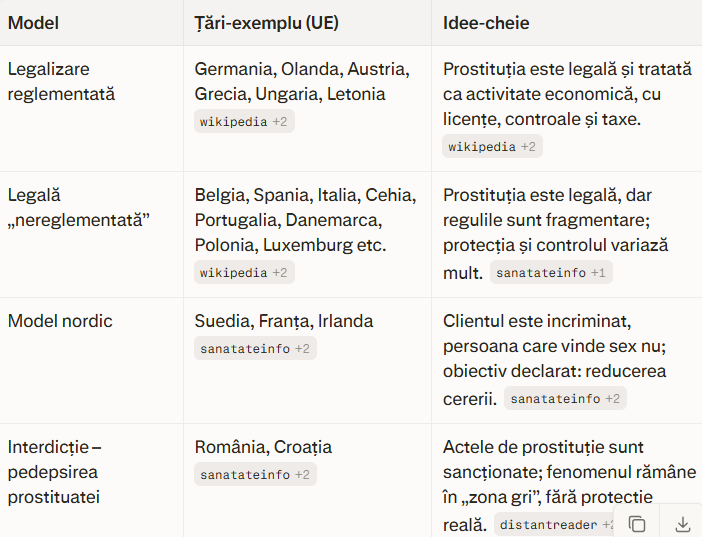
A DIW Berlin analysis on the relationship between the legalization of prostitution and human trafficking concludes that the effects are ambivalent: legalization can reduce certain abuses, but by expanding the market, it can also attract more trafficking if institutions are not robust.
The lesson for Romania: more important than the legal dictionary ("legalization" vs "decriminalization" vs "Nordic model") is how effectively trafficking victims are protected and how coherently the law is applied in practice.
Advantages and disadvantages of the status quo
Relative advantages of the status quo (semi-legal, unregulated prostitution):
Low political cost: parties avoid a polarizing issue, society maintains the "comfort" of public hypocrisy ("we do not legalize sin").
Flexibility for police and prosecutors, who can use related crimes (pimping, trafficking, corruption) without being obliged to manage a licensing system and controls.
Major disadvantages of the status quo:
Lack of protection for sex workers, who remain vulnerable to violence, coercion, abuse from clients and authorities, with little trust in institutions.
Lack of data and control: the state does not know the size of the phenomenon, cannot effectively direct health or anti-trafficking resources, and cannot collect tax revenues.
Maintaining social stigma, which hinders any social reintegration program for individuals who want to exit sex work.
What careful legalization would bring
Possible advantages of legalization (under a well-calibrated model):
Increased protection: sex workers could call the police, have easier access to justice and complaint mechanisms without fear of self-incrimination.
Public health: regular screening programs, easy access to treatment and counseling, targeted campaigns, with proven effects in other jurisdictions on reducing the risks of HIV and other infections.
Economic transparency: some money enters the fiscal circuit, reducing the underground economy and providing additional resources for social programs, including trafficking prevention.
Risks and costs of legalization:
Possible market expansion and "magnet" effect for trafficking networks in the region, if control institutions remain weak, as some European studies indicate.
Creation of a dual system: a "clean" licensed area and a deeply illegal area, where the most vulnerable (minors, migrants, trafficking victims) end up, difficult to reach by regulations.
Potential symbolic legitimization of an industry perceived as exploitative, with unpredictable effects on gender norms and perceptions of sexual violence.
For a state like Romania, with a high rate of migration and well-connected transnational trafficking networks, the key is not just whether we "legalize," but what real capacity we have to enforce the law, fund social services, and collaborate with other EU states against trafficking.
Societal reaction: between morality, pragmatism, and civic fatigue
The recent debate reignited in Romania after including prostitution in a classification of economic activities, without effectively legalizing it, shows how sensitive the subject is and how easily it can be politicized.
European surveys generally indicate a fragmented society: urban, younger segments tend to be more open to pragmatic approaches (regulation, decriminalization), while rural areas and the religious electorate prefer prohibition and the "protectionist" model.
In Romania, where trust in institutions is chronically low, reluctance does not only target the morality of prostitution but also the fear that "legalization" would, in fact, be a formalization of corruption, where the state is content to collect taxes without truly protecting victims.
Analysis conducted with the support of Perplexity
Latest News
14:28
14:18
14:15
14:04
13:57
See more news
NEWS ON THE SAME TOPICS