SPECIAL Informat.ro / The Iranian missile arsenal: what weapons does Tehran use against Israel and American bases in the Gulf and what pressure does it exert on the region



Always see our news on Google
Iran has responded to American and Israeli strikes since the beginning of the conflict on February 28 with a combination of medium-range ballistic missiles, hypersonic missiles, and attack drones, aimed both at Israel and at US bases in Gulf states. The pressure is very high and tends to increase, as Iran's missile arsenal provides it with a real military leverage precisely at the moment when power is transitioning to Mojtaba Khamenei, perceived as close to the Guardians of the Revolution and the hardline faction.
The barrage of missiles and drones is putting pressure on Israel, which is forced to intensively use interceptors, and due to the need to keep the military in a prolonged state of alert. On the other hand, there is also significant pressure on the US, which sees that Iranian missiles can hit multiple bases simultaneously in Bahrain, Qatar, Kuwait, Saudi Arabia, and Jordan, which poses risks to thousands of military personnel and to the credibility of the American security umbrella. Politically, each wave of missiles forces the Trump administration to choose between escalation (with the risk of a major war) and tacit acceptance of an Iran that can strike American bases, which is difficult to explain to the public and Congress.
Arsenal used by Iran since February 28
The first Iranian salvos came immediately after the American and Israeli airstrikes on February 28, which targeted Tehran's military and nuclear infrastructure. In response, Iran launched missiles and drones at military targets in Israel and at least 14 American bases and facilities in Bahrain, Qatar, Kuwait, Saudi Arabia, the UAE, Jordan, and Iraq.
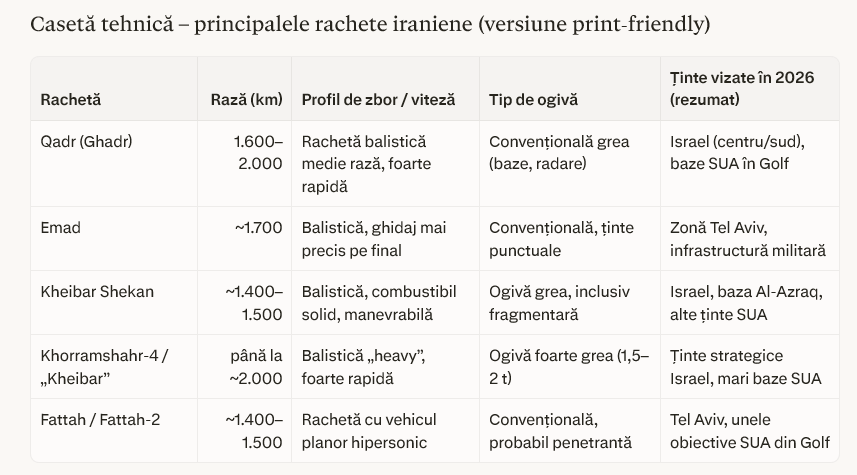
Independent military analyses and media reports show that, in these waves, Iran primarily relied on medium-range ballistic missiles from the Qadr (Ghadr), Emad, Khorramshahr (including the upgraded Kheibar/Khorramshahr 4 variant), and Kheibar Shekan families, with the occasional use of hypersonic Fattah missiles. These systems are part of the strategic arsenal that Tehran has built specifically for the scenario of a direct conflict with Israel and with American forces in the region, all falling within a range of 1,400–2,000 km.
Qadr (Ghadr): The "classic" arsenal
Qadr missiles, derived from the Shahab 3 family, are considered one of Iran's main medium-range ballistic weapons. They were developed to strike targets at distances of approximately 1,600–2,000 km, which fully covers the territory of Israel and a large part of American bases in the Gulf, starting from Iranian territory.
Qadr is a classic ballistic missile: it ascends on an arc trajectory and re-enters the atmosphere at several times the speed of sound. The warhead is conventional and heavy, on the order of hundreds of kilograms of explosives, sufficient to cause serious damage to an airbase, a radar facility, or energy infrastructure. Analyses of the first days of the conflict indicate that Qadr was used against areas in central and southern Israel, as well as against American bases in the Gulf, as part of mixed barrages with other missiles and drones.
Emad: the more precise version for critical targets
Emad is essentially a modernized version of Shahab 3, with a focus on better accuracy. The range is around 1,700 km, which still places it in the category of medium-range ballistic missiles, designed to strike regional targets, especially Israel and American bases in the Gulf.
The main difference compared to Qadr is the terminal guidance system: Emad has a maneuverable nose section, which allows it to correct its trajectory in the final phase, increasing the chance of hitting the exact building or infrastructure targeted. The warhead remains conventional, also weighing hundreds of kilograms, but the increased accuracy transforms it into a useful tool against pinpoint targets: command centers, depots, communication nodes. Analysis and press reports mention Emad among the missiles used by Iran in the initial waves against the Tel Aviv area and against American military infrastructures in the region.
Kheibar Shekan: the new generation solid-fuel missile
Kheibar Shekan represents a newer generation of Iranian ballistic missiles, powered by solid fuel, which allows them to be stored loaded and launched more quickly from mobile launchers. The declared range is approximately 1,400–1,500 km, sufficient to cover all of Israel and a significant part of American bases in the Gulf.
The flight profile remains ballistic, but Iran claims that the missile can maneuver in the final phase, making interception by missile defense systems more difficult. The warhead is described as heavy, weighing 700–1,000 kg, and in internal communications, the missile is categorized as part of the "new generation" of weapons, including options for fragmentation or multiple warheads. Iranian state television, cited in aggregated analyses, mentions Kheibar Shekan among the missiles used in recent waves of attacks against Israel and against the Al Azraq airbase in Jordan, where American troops and equipment are located.
Khorramshahr 4 / Kheibar: Iran's "heavy fist"
Missiles from the Khorramshahr family represent the "heavy" segment of the Iranian arsenal, and the modernized variant Khorramshahr 4, also promoted under the name Kheibar, is described in specialized press as one of the most advanced Iranian ballistic missiles used in this conflict. The declared range is up to approximately 2,000 km, and the warhead can reach about 1.5–2 tons, much more than the warheads of Qadr or Emad missiles.
This combination of long range and very heavy warhead allows striking strategic targets – major airbases, government infrastructure, energy terminals – from long distances. Military reports and international media indicate that Khorramshahr 4/Kheibar has been used in attacks on areas in central Israel, including near Tel Aviv and Ben Gurion Airport, as well as against major American military facilities in the Gulf. Some analyses also mention the possibility of submunition warheads (cluster), capable of covering larger areas, but this detail is not explicitly confirmed by official neutral sources.
Fattah: the peak of hypersonic technology
Fattah missiles belong to a different category: they are described as ballistic missiles with a hypersonic gliding vehicle, meaning that after launch, a warhead can glide and maneuver in the atmosphere at very high speeds. The declared range for Fattah 1 is around 1,400 km, and for Fattah 2 approximately 1,500 km, again covering Israel and the main American bases in the Gulf.
The speed, according to public estimates, would exceed more than ten times the speed of sound, and the maneuverability makes interception much more difficult for current missile defense systems. The warhead is conventional and is designed for strikes against critical targets: command centers, airbases, energy infrastructure. Security analyses mention that Fattah would have been used for the first time in combat in the waves from the beginning of March, both against targets in the Tel Aviv area and against American military objectives in the Gulf, although the exact details remain partially unclarified at the public level.
What targets have been hit so far
In Israel, the first missiles targeted the metropolitan area of Tel Aviv, the south of the country, and areas with military and airport infrastructure, including near Ben Gurion Airport. Qadr and Emad missiles were used in the initial waves, followed by newer missiles such as Kheibar Shekan and Khorramshahr 4/Kheibar, aimed at targets considered more sensitive.
In parallel, Iran launched missiles and drones at American bases in Bahrain, Qatar, Kuwait, Saudi Arabia, the UAE, Jordan, and Iraq. Analyses show that Qadr and Emad missiles covered long distances, while Kheibar Shekan and Khorramshahr 4/Kheibar were used where targets were clearly within the range of 1,400–2,000 km and where heavy warheads could cause significant damage to military infrastructure. A large part of the missiles and drones was intercepted, but there were also successful strikes that caused damage to military and communication facilities.
Pressure on Gulf states
For Gulf states, these attacks have brought the conflict directly onto their territory. The missiles and drones that targeted or hit airports, ports, airbases, and energy facilities have affected the internal sense of security and have called into question the image of these states as stable areas, crucial for global energy transport and civil aviation.
Politically, the Gulf monarchies face a difficult choice: on one hand, they depend on US protection and have increasingly open relations with Israel; on the other hand, relations with Iran and the risk of escalation on their own territory make them cautious. Think tank analyses show that the space for real neutrality has diminished, and Iranian strikes increase the pressure to align more firmly with Washington and to accelerate regional cooperation in air defense and missile defense.
The economic effects are also significant: the risk to LNG terminals, oil facilities, and maritime routes increases risk premiums, insurance costs, and volatility in energy prices. For Gulf economies, which have built their image on stability and openness, this publicly exposed vulnerability forces them to invest more in defense and economic diversification.
Pressure on the US
For the United States, attacks on bases in the Gulf represent a direct test of the credibility of its security commitment in the Middle East. Iranian missiles show that, despite decades of military presence and advanced defense systems, key facilities in Bahrain, Qatar, Kuwait, Saudi Arabia, and Jordan remain vulnerable.
This forces Washington to send reinforcements – additional missile defense systems, ships, aircraft – and to reassess the deployment of forces in the region. At the same time, there is a cost pressure: Iran uses relatively cheap missiles and drones, while the US and allies must respond with much more expensive interceptors and a broader military presence. In domestic political terms, American leadership must explain why it is worth assuming these costs and risks to defend bases located thousands of kilometers away.
Pressure on Israel
Israel faces dual pressure: military and psychological. From a military perspective, barrages of hundreds of missiles and drones aim to overload the Iron Dome, David’s Sling, and Arrow systems, forcing rapid consumption of interceptors and testing the weaknesses of the defense network. Even if the interception rate remains high, each successful wave of launches sends the message that no system is infallible, especially when attacked en masse.
The range of 1,400–2,000 km of Kheibar Shekan and Khorramshahr 4/Kheibar missiles shows that all of Israel's territory is within the reach of the Iranian arsenal. This means that not only border areas but also the political, economic, and military center – Tel Aviv, Haifa, major airbases, and strategic infrastructure – can be directly targeted. Politically, this reality strengthens arguments for maintaining or even intensifying operations against Iranian missile infrastructure and for close cooperation with the US and Gulf states in integrated air defense.
What this arsenal changes in the regional equation
The combination of "classic" ballistic missiles (Qadr, Emad), new generation missiles (Kheibar Shekan, Khorramshahr 4/Kheibar), and hypersonic missiles (Fattah) shows that Iran is no longer relying solely on quantity but also on quality and diversification of strike vectors. This puts pressure on adversaries to quickly adapt their defenses, to invest in new systems, and to think of political responses that combine deterrence with escalation control.
For Gulf states, these attacks are a signal that their security can no longer be treated as a secondary issue; for the US, that military presence in the region remains exposed; for Israel, that its entire territory is within the range of an increasingly sophisticated arsenal. In this context, the missiles used by Iran are simultaneously weapons of war and negotiation tools, with each launch recalibrating the balance of power and the maneuvering space of all involved actors.
How Mojtaba Khamenei changes the equation
Western analyses describe Mojtaba Khamenei, officially appointed as the new supreme leader of Iran, as closely linked to the IRGC and familiar with coordinating security and military operations, thus more inclined to use the state's hard instruments (missiles, proxies) to demonstrate strength and compensate for the internal legitimacy crisis.
The father-son power transfer, in a system that claims to be anti-dynastic, risks provoking internal contestation; in such moments, the leadership has a strong incentive to show that it does not yield to the US and Israel but resists and strikes back.
In simple terms: missiles give Mojtaba Khamenei a quick tool to show that "the regime has not collapsed" after his father's death, and this increases pressure on the US and Israel to decide how far they will go to limit this capacity without triggering an even larger war.
****Summary created with the help of a data monitoring flow provided by the media monitoring platform NewsVibe Romania. The analysis, data, and images presented have been enhanced with the help of Machine Learning and Artificial Intelligence tools.
Read also: What the official appointment of Mojtaba Khamenei as supreme leader would mean
Latest News
21:18
21:07
20:56
20:53
20:43
See more news
NEWS ON THE SAME TOPICS