ANALYSIS Europe with two speeds: Romania, between the high-speed train of the Union and the platform of the periphery



Always see our news on Google
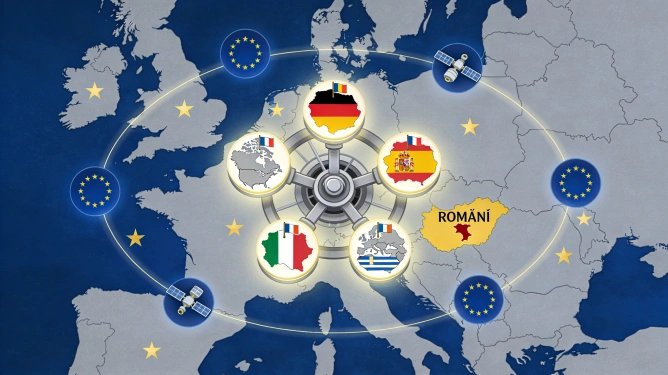
The European Union is officially preparing for a two-speed architecture: a core of states that accelerates integration in economy and defense and an outer circle that remains at the basic rules of the internal market. For Romania, the real question is not whether the model will be adopted, but whether it will be within the decision-making circle or outside it, with a weaker voice and a slower convergence of living standards.
Europe with two speeds, from theory to the E6 format
The recent proposal from Germany was to coalesce a core of six major economies – Germany, France, Italy, Spain, Poland, and the Netherlands – to function as an "engine" of a two-speed Europe. The ministers of these states announced that they would "drive European progress" in blocked files in the enlarged format of 27 states: defense, industrial policy, capital markets, critical raw materials.
In parallel, Ursula von der Leyen tells leaders that if unanimity blocks the agenda, they must resort to "enhanced cooperation" – that is, smaller formats already provided for in treaties, which push integration forward without all members. This combination – E6 political core plus institutional legitimization of "concentric circles" – transforms the scenario of a two-speed Europe from a theoretical exercise into a working option for the coming years.
Where Romania stands today: anti-two-speed rhetoric, peripheral reality
For almost a decade, Bucharest's official position has been clear: Romania rejects the idea of a multi-speed Union, arguing that it means fragmentation and second-class citizens. Klaus Iohannis and political leaders like Liviu Dragnea have rejected the scenario from Juncker's "White Paper," warning that such formulas could lead to the disintegration of the European project.
Former Foreign Minister Teodor Meleșcanu summarized, in an interview with Reuters in 2017, the line of the Ministry of Foreign Affairs: "more speeds" means fragmentation and contradicts the founding values of the Union, and the EU's approach "should be equal for all member states." The problem is that, beyond rhetoric, Romania is already outside some inner circles – it is not in the eurozone, it entered Schengen late, and in major informal coordination formats (like those now launched by Berlin) it is missing from the table.
The economic stakes: who writes the rules for money, industry, and jobs
The first critical axis for Romania in a two-speed Europe is economic: there, not only GDP growth is decided, but also the quality of jobs in the coming decades. If E6 manages to write in a restricted format the rules for a "Savings and Investment Union," for the union of capital markets, and for industrial policy, the periphery will receive the "key package," with minimal negotiation space.
Analyses regarding convergence already show a "multi-speed" Europe: groups of states that catch up and others that remain structurally behind, from the perspective of productivity, innovation, and income. For Romania, the risk is that the formalization of two speeds will deepen this gap: a core that attracts the most money, technology, and human capital and a periphery where the cost of financing remains higher and value chains remain at the subcontractor level.
However, there is also a window of opportunity: if Bucharest enters the game from the beginning in core projects – whether we are talking about consortia for critical raw materials, defense industry, or strategic infrastructure – it can recover part of the structural handicap. This, however, requires two hard conditions: a credible commitment to euro adoption and serious cleaning in the area of economic governance, from fiscal stability to the quality of regulatory institutions.
The political stakes: from co-decision maker to "policy taker"?
The political dimension of a two-speed Europe is, for Romania, at least as important as the economic one: it is about the place at the table when strategic decisions are made. If the E6 core pre-negotiates packages on the EU budget, defense, green industry, or migration, the other states will find themselves in the Council facing texts already agreed upon among "the big ones," with a reduced margin for real modification.
For a country that has built its European influence through discipline and alignment with the mainstream, losing access to the pre-negotiation phase risks turning Romania into a low-profile actor, even if it formally remains at the same table. The equation also includes the reconfiguration of regional alliances: Poland is part of the proposed core and can become a pivot for eastern interests, but that does not automatically mean it will also represent Bucharest's priorities.
In the background, the logic of conditionality instruments is also changing: a core willing to go further in enhanced cooperation can use, more subtly, the criteria of the rule of law and administrative performance to decide who enters and who remains at the door. Romania has so far escaped harsh sanctions, but remains vulnerable to any internal backlash on justice and anti-corruption, which can be used as an argument for exclusion from the "superior club."
The social stakes: the perception of periphery and fertile ground for populism
A two-speed Europe is not only played out in press releases from Brussels but also in the social perception of citizens. If Romanians see that there is a "club A" – with higher salaries, more robust social protection, and better quality public services – from which Romania is formally excluded, the risk of frustration and delegitimization of the European project increases exponentially.
Populists will not miss the opportunity to explain that "Brussels" has pushed Romania to the periphery, especially if stagnation in living standards combines with a perceived prolongation of inequalities compared to the West. At the same time, maintaining freedom of movement in a stratified EU can accelerate skilled emigration: the core becomes even more attractive for doctors, engineers, IT specialists, while Romania faces a double pressure – demographic aging and lack of personnel in key sectors.
3 scenarios for Romania
1. Romania catches the core train
Bucharest explicitly assumes the objective of entering the inner circle: it accelerates preparations for the euro, positions itself as a key partner in defense and capital projects, and strengthens the rule of law and administrative capacity. Romania enters some decision-making formats from the beginning, reduces financing costs, and becomes a credible destination for strategic investments, but the internal price is a much stricter fiscal and political discipline than that which the political class is used to.
2. Romania remains in the second circle but profits pragmatically
Officially, it continues to plead for a united Europe, but de facto accepts that there is a core and maximizes gains from the "disciplined" peripheral position – access to cohesion funds, a role as a regional hub for the eastern neighborhood, selective participation in some core projects. The advantage: internal flexibility margin, lower political cost. The disadvantage: reduced influence in defining the rules of the game and the risk of structural fixation of development gaps.
3. Europe fractures, Romania oscillates
If tensions between the core and the periphery get out of control or are exploited by illiberal governments, the scenario of a fragmented Union becomes real, with multiple parallel formats and acute politicization of economic cooperation. Romania, caught between the official pro-European reflex and the temptation of soft sovereignism formulas, risks being perceived as an indecisive actor, losing both the trust of the core and the opportunity to build coherent regional alternatives.
What a serious strategy for Bucharest would entail
In the face of this reconfiguration, Romania needs something it has so far avoided: a clear strategy regarding the place it aims for in the new European geometry and the costs it is willing to assume to get there. This means an articulated position ahead of major meetings where the formalization of enhanced cooperation is discussed, not just point-by-point reactions to initiatives coming from Berlin or Brussels.
Internally, the game is between the comfort of a periphery that benefits from European money without radically changing its way of functioning and the ambition of a country that wants to be in the "first league" of European decision-making, with all the constraints that this entails. A two-speed Europe is not just a concept debated in Western capitals, but a test of maturity for Romanian politics: how much do we really want to be at the table where the rules are written and how much are we willing to pay – in real reforms – for this place.
Analysis conducted with the support of Perplexity
Latest News
07:30
07:18
23:08
22:58
22:57
See more news
NEWS ON THE SAME TOPICS