Romania demands that the Black Sea and the eastern flank be prioritized in the European security strategy



Always see our news on Google
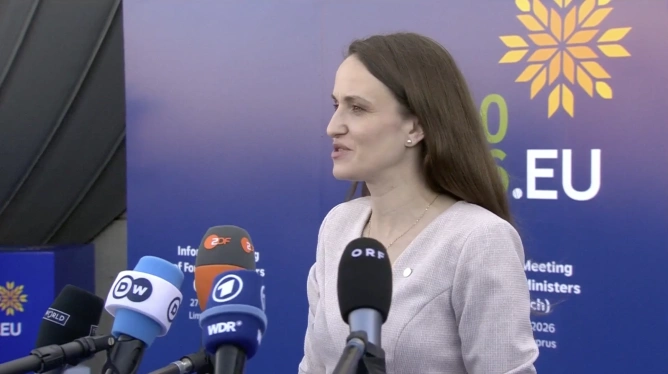
The Romanian Foreign Minister, Oana Ţoiu, stated that the future European security strategy must include a clear focus on the eastern flank, the Black Sea, funding, and capabilities. Romania's position comes at a time when the foreign ministers of the European Union are discussing support for Ukraine, the security of maritime routes, the Strait of Hormuz, relations with India and Saudi Arabia, and Europe's role in its own defense.
Romania demands that the future European security strategy include a concrete focus on the eastern flank and the Black Sea, with funding, capabilities, and critical infrastructure, said Romanian Foreign Minister Oana Ţoiu, ahead of the informal meeting of the EU foreign ministers in Cyprus.
In short
Oana Ţoiu said that Romania wants the eastern flank and the Black Sea to be reflected in the future European security strategy.
The Romanian Foreign Minister linked the Black Sea to security, energy, trade, logistics, and access for landlocked states to global markets.
Ţoiu stated that Europe must take on more responsibility for its own defense and deterrence, in complementarity with NATO.
The meeting also addresses support for a sustainable peace in Ukraine, without yielding to Russian intimidation.
Romania considers cooperation with India, Saudi Arabia, and partners in the Middle East important for reopening the Strait of Hormuz and protecting international maritime routes.
For Romania, the discussion about the European security strategy has a direct stake: how the European Union will transform concern for the eastern flank and the Black Sea into funding, capabilities, and infrastructure projects. Oana Ţoiu said that this strategy is prepared to be adopted after the NATO summit.
The Romanian Foreign Minister linked Romania's position to recent discussions in Bucharest, where the Bucharest 9 summit took place, with the participation of Nordic allies. According to her, the debate aims at transitioning to a "NATO 3.0", where Europe takes on more responsibility for its own defense and deterrence, but in complementarity with the European security strategy.
Ţoiu said that, for Romania, it is essential that the European strategy focuses on the eastern flank, and that this translates into funding and capabilities. She indicated the Black Sea as a strategic economic and geopolitical point, connected to the South Caucasus and the Middle East.
The Black Sea is also important for landlocked states, which depend on transport and logistics routes for access to global markets. The Romanian Foreign Minister also mentioned the region's role in energy, transit, and critical infrastructure, including submarine cables and projects developed with regional partners.
In the same logic, Ţoiu mentioned the Middle Corridor as a relevant route for transport and logistics. She linked these projects to Europe's broader goal of building strategic autonomy and reducing dependencies on Russia.
The meeting of foreign ministers takes place in a context where support for Ukraine remains one of the main themes of the European Union's foreign policy. Oana Ţoiu said that ministers need to discuss the next steps to support a sustainable peace in Ukraine and emphasized the importance of the presence of the Ukrainian foreign minister for a direct assessment of the situation on the ground.
The Romanian minister stated that member states remain united in the common position of not yielding to Russian intimidation, including following recent statements regarding diplomatic teams in Kyiv. The message places support for Ukraine within the broader framework of European security and the defense of the international order.
Another major theme is the Strait of Hormuz, one of the most important maritime routes for global energy transport. Oana Ţoiu said that the European Union must work with international partners to reopen this route, reduce energy pressures, and avoid a food crisis.
She welcomed the presence of the foreign ministers of India and Saudi Arabia, considering discussions with these partners important for identifying diplomatic paths and for the necessary pressure to reopen the Strait of Hormuz. The Romanian minister also warned about the risk that imposing some kind of tax or blockade on international maritime routes could create a dangerous precedent.
Ţoiu also mentioned the EU-India trade agreement, stating that it is relevant for companies and for the growth of European economies, including Romania. In the same area, she emphasized joint investments and collaboration with partners in the Middle East.
The Gymnich meetings are informal gatherings of the foreign ministers of the European Union. They do not produce formal legislative decisions, but are important for coordinating policy among member states on security, defense, and foreign policy issues. For Romania, the meeting in Cyprus provides a framework in which it can more visibly push the agenda of the Black Sea and the eastern flank in the European debate on security.
Latest News
12:38
12:36
12:36
12:22
12:18
See more news
NEWS ON THE SAME TOPICS



.webp)