The European Commission proposes EU Inc., a unique legal framework for companies, to eliminate barriers to the single market.



Always see our news on Google
The European Commission proposes a new optional corporate framework, fully digital and applicable throughout the Union, which would allow entrepreneurs to establish a company within 48 hours, with reduced costs and harmonized rules, in an effort to stop the legal fragmentation that hinders the expansion of European firms.
The European Commission has presented the proposal for EU Inc., a new optional corporate legal framework at the Union level, designed to allow the establishment, operation, and expansion of companies in the single market based on a single set of harmonized rules, instead of navigating between 27 national legal systems and over 60 forms of companies.
In short
The European Commission proposes EU Inc. as the central element of the 28th EU regime, an optional, digital, and harmonized corporate framework.
Companies could be established within 48 hours, for less than 100 euros, without minimum share capital and through fully digital procedures.
The legal fragmentation of the single market is presented as a major obstacle to growth, investment, and the expansion of companies in the EU.
EU Inc. introduces simplified share transfers, easier access to investments, stock options for employees, and simplified insolvency procedures.
The regime remains optional and does not affect national labor legislation or workers' rights.
The European Commission presents EU Inc. as a direct response to the fragmentation of the legal framework applicable to companies in the Union. According to the European executive, for too many entrepreneurs and for too many innovative companies, expanding across EU borders means navigating a fragmented legal landscape, which can delay the establishment of a company for weeks or months, increasing costs and discouraging development.
The proposal takes the form of a regulation and offers a unique set of corporate rules that companies can choose instead of national regimes. It does not replace existing legislations but creates a parallel European option, identical in all member states, for firms that want to operate on a European scale.
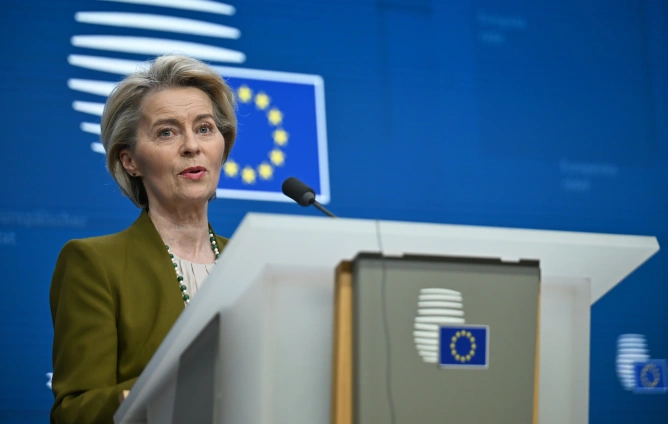
The President of the European Commission, Ursula von der Leyen, described the problem in direct terms. She stated that "Today, with a simple touch of the screen, capital shrinks instantly. Data circulates around the globe in a few seconds. However, in Europe, it can still take weeks or even months to establish a company or to start doing business in another country within the single market. Barriers within Europe affect us more than tariffs from outside." She added that entrepreneurs trying to expand are "the first victims of regulatory fragmentation."
The Commission states that EU Inc. is designed to eliminate these obstacles. Ursula von der Leyen said that "Any entrepreneur will be able to create a company within 48 hours, from anywhere in the European Union, in a fully digital manner, for less than 100 euros and without minimum share capital."
The European executive supports that the new regime will be fully digital throughout the life cycle of a company. Firms will submit information once, through a Union-level interface that will connect national registers, and this data will be reused by administrations without the need to resubmit documents.
The proposal also includes measures to facilitate access to financing. The Commission shows that EU Inc. will eliminate formalities requiring physical presence, simplify share transfers, and allow digital procedures for financial operations. Member states could provide EU Inc. companies access to the stock market.
At the same time, the initiative aims to attract and retain talent. EU Inc. will allow stock option plans for employees at the Union level, and taxation will occur only at the time of income realization. Ursula von der Leyen stated that this framework "makes it easier for companies to attract talent."
The Commission also proposes reducing the cost of failure for entrepreneurs. Insolvency procedures will be simplified for innovative start-ups, and processes will be fully digitized. Ursula von der Leyen said that "In business, failure should not be the end of the road, but part of the journey."
The European executive emphasizes that the proposal does not affect workers' rights. National labor legislation remains applicable, and rules regarding employee protection, including their participation in boards of directors, are fully maintained. The Commission specifies that there is "no weakening of the rules that protect workers."
Another element of the proposal is the flexibility of the ownership structure. EU Inc. companies will be able to create different classes of shares, with different economic or voting rights, to allow founders to retain control over the company and protect themselves against unwanted takeovers.
The initiative is part of a broader framework, called "the 28th regime," which includes measures regarding digitalization, access to financing, labor mobility, and simplifying the legal framework for enterprises. The Commission states that over 80% of participants in public consultations identified differences between national rules as a major obstacle for companies operating in the EU.
The proposal is anchored in the Union's competitiveness agenda and is linked to efforts to enable European companies to expand more easily and remain in Europe. The Commission conveys that the goal is to transform the single market into a space where firms not only circulate freely but can also effectively operate under a common legal framework.
In conclusion, Ursula von der Leyen summarized the political objective in very simple terms. She stated that the goal is "One Europe. One market." This is also the deeper context of the proposal. The European Union seeks to transform the single market from a space where firms can theoretically circulate freely into one where they can also effectively operate based on a unique, fast, and digital legal framework. For this reason, EU Inc. is presented not just as an administrative simplification but as an element of economic architecture for the future competitiveness of the Union.
Latest News
09:31
09:16
08:49
08:35
08:05
See more news
NEWS ON THE SAME TOPICS

.webp)