



The European Hera probe has discovered a stadium-sized crater on the Dimorphos asteroid, following the impact deliberately caused by NASA in 2022



Always see our news on Google
ESA’s Hera probe reveals a huge crater and disrupted rotation on Dimorphos after the 2022 DART impact. The observed asteroids pose no danger to Earth.
The European Space Agency (ESA) presented the first detailed images of the crater formed on the asteroid Dimorphos following the deliberate impact of the American DART probe in September 2022. Observations by the European Hera mission show that the impacted side of the asteroid was flattened, its rotation became chaotic, and the system consisting of Dimorphos and the larger asteroid Didymos is surrounded by hundreds of boulders. The findings open a new phase in research into the controlled deflection of asteroids.
Key points
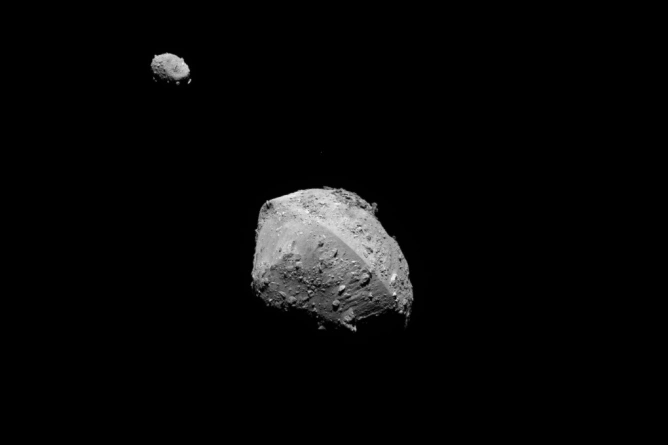
Images obtained by Hera highlight a crater comparable in size to a stadium, extending across almost the entire impacted side of the asteroid Dimorphos. Its exact dimensions remain to be determined.
The DART impact on September 26, 2022, reduced Dimorphos’s orbital period around the asteroid Didymos by approximately 33 minutes, experimentally demonstrating the possibility of altering the motion of a celestial body.
New observations indicate complex rotation of the asteroid Dimorphos and the presence of hundreds of boulders, several meters in size, near the binary system.
The Hera probe is due to approach the asteroids in December, and the release of the small satellites Juventas and Milani is scheduled for January 2027.
Romania contributes to the mission’s image-processing and communications technologies, while Belgium provides, among other things, computer and electrical systems and instruments for measuring the asteroid’s gravity.
The images and initial conclusions of the international Hera team were presented at the Natural History Museum in Berlin, after the European probe reached the vicinity of the Didymos–Dimorphos system at the beginning of November.
Dimorphos is an asteroid approximately 151 meters in diameter that orbits the primary body Didymos. According to new data published by ESA, the latter measures approximately 730 meters in diameter. At the time the results were presented, the binary system was approximately 193.5 million kilometers from Earth.
One of the main images was taken on November 7 using Hera’s Asteroid Framing Camera (AFC), from a distance of 29 kilometers. The image resolution makes it possible to distinguish surface structures measuring several meters. Researchers compared images transmitted by Hera in 2026 with photographs taken in 2022 by DART’s DRACO camera, selecting observation perspectives that were as similar as possible.
The comparison highlights a major transformation of the impact region. The previously curved surface appears flattened, while several geological structures are visible inside the crater, including an elongated formation in the central area. The German Aerospace Center, which coordinates the scientific component of the AFC camera, states that the images suggest the crater occupies almost the entire side affected by the collision.
By contrast, the rock formations observed in other regions of Dimorphos appear to have remained largely unchanged. The surface of the asteroid Didymos also shows no major changes in the compared images that could be attributed to the impact. The scientific team intends to construct three-dimensional models of the two celestial bodies to determine the crater’s geometry and the extent of the transformations produced across the asteroid as a whole.
Another finding concerns Dimorphos’s rotational motion. Successive images obtained by Hera show that the asteroid no longer maintains a stable orientation relative to Didymos, but exhibits complex rotation while moving along its orbit. Before the impact, researchers believed that Dimorphos had a rotation synchronized with its orbital motion, presenting approximately the same face toward the primary body.
The new observations support the hypothesis previously formulated on the basis of remote measurements, according to which the collision disrupted this state of equilibrium. The evolution of the rotation and the time required for it to stabilize remain subjects of research.
Long-exposure images taken by the HyperScout H multispectral instrument also revealed hundreds of meter-sized objects moving near the two asteroids. The origin, distribution, and trajectories of these objects must be determined through additional observations. The results will be important, including for planning the Hera probe’s approach to the asteroid surfaces. The presence of boulders represents an operational problem for the space mission, not evidence of an existing threat to Earth.
The experiment that generated these changes was carried out by NASA on September 26, 2022, through the Double Asteroid Redirection Test (DART) mission. The American probe deliberately struck the asteroid Dimorphos at a speed of approximately 6.1 kilometers per second. Before the collision, the asteroid required approximately 11 hours and 55 minutes to complete one revolution around Didymos. Subsequent astronomical observations showed a reduction in the orbital period of approximately 33 minutes, to about 11 hours and 22 minutes. The crater’s exact diameter remains to be determined.
Analyses published in the journal Nature in 2023 showed that material ejected during the impact contributed to changing the asteroid’s motion, amplifying the effect of the momentum transferred by the probe. A study published in March 2026 also identified an extremely small change in the motion of the entire binary system around the Sun. According to NASA, the system’s orbital period of approximately 770 days changed by a fraction of a second. This value must be distinguished from the approximately 33-minute reduction in Dimorphos’s orbital period around Didymos. The two measurements describe different astronomical motions.
The Hera mission aims to complement the results of the American experiment by measuring the physical properties of the impacted asteroid. Its exact mass, internal structure, and the properties of the materials that make it up are essential for assessing the effectiveness of the deflection method.
The European probe was launched on October 7, 2024, and is currently in the initial characterization phase of the binary system. The AFC camera, the HyperScout H multispectral instrument, and the TIRI infrared thermal camera, developed with the participation of the Japan Aerospace Exploration Agency (JAXA), are being used for current observations.
In December, ESA plans to bring the probe to within approximately 13 kilometers of the asteroids, as part of a more detailed characterization phase. The release of the two small satellites carried by Hera is planned for January 2027.
Juventas, developed under Luxembourgish coordination, will use a low-frequency radar to investigate Dimorphos’s internal structure. Toward the end of its operations, the satellite will attempt to land on the asteroid’s surface, where local gravity measurements are planned. Milani, developed under Italian coordination, will contribute to identifying the composition of surface materials and studying dust particles in the vicinity of the binary system.
Romania and Belgium participate in the mission’s industrial and scientific consortium. According to ESA’s updated industrial documentation, GMV Romania developed an image-processing unit intended for Hera’s autonomous guidance system. HPS contributed to the construction of the high-gain antenna. Image-processing technology contributes to the probe’s ability to identify surface features and use this information for navigation near celestial bodies.
In Belgium, Redwire Space coordinated the development of the data-management subsystem, including the onboard computer, while SPACEBEL developed the probe’s central software, simulation systems, and the mission control center for the CubeSats. Thales Alenia Space Belgium contributed to the electrical power-distribution systems and communications components.
The Royal Observatory of Belgium developed, together with the Spanish company EMXYS, the GRASS gravimeter carried by Juventas. The Belgian VITO Institute contributed, alongside the Royal Observatory, to data processing and calibration of the TIRI thermal instrument.
These contributions are part of an international effort to transform kinetic impact into a planetary-defense technique based on experimentally validated measurements and models. Neither Didymos nor Dimorphos poses an impact threat to Earth. The system was selected to test the method under conditions in which altering the asteroid’s motion does not endanger the planet.
The results presented on November 25 represent the beginning of a detailed analysis of the experiment’s physical consequences. Conclusions regarding the effectiveness of the deflection, the asteroid’s internal structure, and the crater’s evolution will depend on additional measurements by the European mission.
Latest News
15:59
15:59
15:59
15:56
15:43
See more news
NEWS ON THE SAME TOPICS

















.webp)


