[EXPLANATORY] What Europe needs to do after the drone that fell in Galați
2eu.brussels


EU
Foto: 2eu.brussels

Always see our news on Google
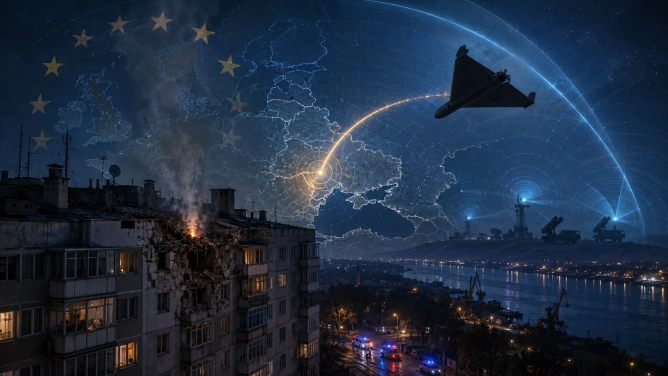
The drone that hit a residential block in Galați has shifted the European debate on anti-drone defense from the realm of strategic documents into the reality of a populated street. Romanian authorities reported that the device was a Russian Geran-2 drone, which struck the roof of a ten-story building, injured two people, caused a fire, and led to the evacuation of approximately 70 residents. Reuters reported that this is the first known case, during Russia's war against Ukraine, in which a drone causes civilian injuries in a densely populated area of Romania, a member state of the European Union and NATO. (reuters.com)
Romania has already faced repeated incursions by drones linked to Russian attacks on Ukrainian infrastructure along the Danube. Reuters reported that Romania has recorded 28 drone incursions since Russia began striking Ukrainian ports on the Danube. The incident in Galați is part of a broader pattern of airspace violations and risks of war spillover on NATO's eastern flank. (reuters.com)
The incident raises an operational question already present in EU and NATO documents: how can European states detect, classify, and neutralize drones flying low before they reach cities, ports, airports, or critical energy infrastructure?
The first response comes from Romania and NATO.
Romania's first course of action is political and military consultation within NATO. Article 4 of the North Atlantic Treaty allows any ally to request consultations when it believes its territorial integrity, political independence, or security is threatened. NATO describes consultation as a central part of the Alliance's decision-making process and as a tool of preventive diplomacy, through which allies can quickly bring a security issue to the agenda of the North Atlantic Council. (nato.int)
Article 4 does not automatically trigger military action. It provides Romania with the formal mechanism to request allied assessment, inquiry, and coordination. This distinction is important because drone incursions may remain below the threshold of a conventional attack but can pose a direct risk to civilians and public infrastructure.
NATO has already reacted in this logic following airspace violations on the eastern flank. In 2025, the Alliance launched Eastern Sentry to bolster its posture on the eastern flank, following what NATO described as a violation of Polish airspace by Russian drones. (nato.int)
For Romania, the operational agenda is clear: more surveillance along the Danube-Black Sea axis, faster integration of air policing data, better low-altitude detection, mobile anti-drone units, and clearer rules of engagement when drones head towards populated areas.
The role of the European Union is industrial, financial, and regulatory.
NATO remains the central framework for collective defense. The European Union controls a different set of tools: funding, coordination of procurement, industrial policy, research programs, certification, internal market rules, and policies for critical infrastructure.
The European Commission's Defence Readiness Roadmap 2030 establishes four major flagship projects for European preparedness: the European Drone Defence Initiative, Eastern Flank Watch, European Air Shield, and European Space Shield. The roadmap prioritizes the European Drone Defence Initiative and Eastern Flank Watch, with planned launches in the first quarter of 2026 and initial capacity by the end of 2026. (defence-industry-space.ec.europa.eu)
The Commission presented the roadmap as a transition from planning to implementation. Reuters reported that the European executive proposed the four flagship projects in October 2025, as part of a broader effort to make Europe capable of defending itself by 2030, with the European Drone Defence Initiative and Eastern Flank Watch considered the most urgent elements. (reuters.com)
The incident in Galați provides a concrete civil test for these projects. The question for the EU is whether funding, procurement, and industrial coordination can advance quickly enough to protect exposed regions.
The European Drone Defence Initiative needs operational speed.
The European Drone Defence Initiative is the most relevant European project following Galați. It is designed to strengthen Europe's ability to detect, track, and neutralize hostile drones, especially on the eastern flank. According to the Commission's Defence Readiness Roadmap, the initiative must achieve initial capacity by the end of 2026 and become fully operational by the end of 2027. (defence-industry-space.ec.europa.eu)
The initiative must be developed as a layered system. A credible anti-drone architecture requires detection, identification, command-control, electronic warfare, low-cost interceptors, conventional air defense, civil protection procedures, and technical investigation capacity after an incident.
The European Parliament's research service has warned that plans for Eastern Flank Watch and the European Drone Wall raise disputes related to costs, feasibility, and strategic orientation. This warning is relevant to the political risk: a very visible project can fail if it remains a slogan and does not become an interoperable defense architecture. (europarl.europa.eu)
The Commission's action plan on drone security and anti-drone systems provides the components that can make the initiative practical: increasing production, improving identification and registration of civilian drones, assessing supplier risks, creating a toolkit for drone security and anti-drone systems, introducing an "EU trusted" label for secure equipment, and bringing together civil and defense actors in an industrial forum. (digital-strategy.ec.europa.eu)
Eastern Flank Watch must include the Danube and the Black Sea.
Eastern Flank Watch should become the main European framework for exposed areas from the Baltic Sea to the Black Sea. EPRS describes the initiative as part of the EU's response to Russia's increasingly intense hybrid attacks, including drone incursions, and links it to NATO's Eastern Sentry operation. Its goal is to strengthen eastern defense through air, land, and maritime capabilities. (europarl.europa.eu)
For Romania, the Danube and the Black Sea cannot remain on the margins of this architecture. Galați, Tulcea, Brăila, Constanța, the Danube Delta, port infrastructure, energy facilities, and transport corridors form a single exposed security environment. Russian attacks on Ukrainian infrastructure near the Danube can have direct effects within the European Union.
Eastern Flank Watch should include permanent low-altitude monitoring in the Romanian-Ukrainian border area, mobile anti-drone systems, maritime and riverine surveillance, common operational imagery, and interoperability with NATO's air command structures.
The European Parliament's research service notes that the European Drone Wall and Eastern Flank Watch have been proposed as responses to Russia's hybrid attacks and drone incursions. The same analysis mentions disputes regarding strategic orientation. Galați provides this orientation: the eastern flank is a civilian protection issue, alongside the military dimension. (europarl.europa.eu)
The European Air Shield must adapt to the war with cheap drones.
The European Air Shield is designed to strengthen Europe's air and missile defense. The threat of drones requires this project to cover low-flying, cheap, slow, and hard-to-intercept targets, not just aircraft and missiles.
NATO's policy on Integrated Air and Missile Defence, adopted in 2025, states that integrated air and missile defense must support rapid detection, decision-making, and engagement across the entire spectrum of air and ballistic threats, including all classes of unmanned aerial systems, cruise missiles, ballistic missiles, and hypersonic threats. (nato.int)
The economic issue is severe. A cheap drone can force the defender to scramble aircraft or use expensive missiles. EPRS highlights this difficulty in its analysis of the European Drone Wall and Eastern Flank Watch, showing how challenging it is to sustain costly responses against incursions by cheap drones. (europarl.europa.eu)
Europe needs a cost scale for air defense. Fighter jets and advanced missiles remain necessary for high-end threats. Anti-drone defense also requires cheaper means: jamming, spoofing, interceptor drones, short-range systems, mobile units, directed energy weapons where technology is mature, and passive sensors connected through common command-control.
Detection comes before interception.
The central technical challenge in anti-drone defense is early detection. A drone flying low, slow, and close to civilian areas can be hard to distinguish from other objects and difficult to engage safely. Reuters reported that Romania scrambled F-16s and a military helicopter during the incident in Galați, but the drone still reached the residential building. (reuters.com)
A professional anti-drone network starts with sensors. It must combine radars, passive radio detection, acoustic sensors, electro-optical and infrared systems, detection through cellular networks where the legal framework allows, data fusion, and artificial intelligence. The academic study "Counter-Unmanned Aircraft System(s): State of the Art, Challenges and Future Trends" identifies radar, acoustic detection, visual detection, passive radio detection, and data fusion methods among the main detection technologies, alongside jamming and physical capture as options for neutralization. (arxiv.org)
Europe should build common detection corridors on the eastern flank. These corridors must connect military radars, border systems, civil aviation data, and critical infrastructure monitoring. Their value lies in decision time. Authorities must know what is flying, where it is heading, whether it is hostile, and what response creates the least risk for civilians.
Intercepting drones over cities requires clear rules.
The most difficult operational dilemma arises when an explosive drone flies over a populated area. Destroying it may prevent a direct hit on a target. However, fragments, fuel, or explosive payloads can still fall on civilians. Jamming can cause an uncontrolled crash. Waiting too long can reduce the action window too much.
Europe needs common protocols for drone incidents in civilian areas. These protocols should establish who decides, what level of certainty is required, what systems can be used over urban areas, how local authorities are alerted, how residents are warned, how evidence is collected, and how victims are supported.
The Commission's action plan on drone security and anti-drone systems is useful because it treats drones as a security issue that crosses the boundaries between military, civil, and industrial. The plan covers prevention, detection, and response to malicious drone activities and includes measures regarding registration, supplier risk, trusted equipment, and industrial coordination. (digital-strategy.ec.europa.eu)
The next step should be a European operational model for incidents over civilian areas, aligned with NATO procedures and national legislations. Member states on the eastern flank need the same action manual before the next incursion.
Europe must learn directly from Ukraine.
Ukraine has become the most advanced operational environment for drone warfare and anti-drone adaptation. European defense planning must systematically use this experience.
The EU Institute for Security Studies shows in the study "Minding the drone gap" that Europe is well-positioned to play a major role in drone warfare but faces industrial and supply chain risks, including a strong dependence of the global commercial drone market on DJI. EUISS also emphasizes the importance of Ukrainian battlefield experience for European adaptation. (iss.europa.eu)
The Commission's action plan goes in the same direction, linking EU activity on drones and anti-drone systems to increasing industrial capacity, practical testing, and cooperation with Ukraine. Reuters also reported that the Commission's action plan from February 2026 aimed to improve drone detection capabilities after security incidents, including airport disruptions and incursions of Russian drones into Polish airspace. (reuters.com)
A European anti-drone defense ecosystem should include Ukrainian manufacturers, operators, software developers, trainers, and testing ranges. Ukraine's experience reduces the gap between laboratory concepts and battlefield reality.
Production capacity is a security requirement.
European anti-drone defense depends on production speed. Drones and anti-drone systems are evolving rapidly. Procurement cycles measured in years can miss threat cycles measured in months.
The EUISS study highlights both Europe's strengths and its vulnerabilities. The analysis shows that Europe hosts a significant portion of global drone sector companies, but the broader commercial market remains heavily influenced by suppliers outside Europe. (iss.europa.eu)
The Commission's action plan addresses this production issue through investments to increase the production of drones and anti-drone systems, an industrial forum, supplier risk assessments, and labeling of secure equipment. (digital-strategy.ec.europa.eu)
EU funding tools should be directed towards deployable systems for exposed member states. SAFE can support joint procurements. EDIP can support industrial capacity. The European Defence Fund can support research and development. Horizon Europe and dual-use programs can contribute to sensors, software, autonomy, and testing.
Romania should be part of this industrial response, not just purchase equipment. An exposed state to the effects of the drone war from Ukraine must host testing, maintenance, training, production partnerships, and operational feedback mechanisms.
Fragmentation would weaken the response.
Europe can spend more and remain vulnerable if national systems are not interoperable. Different radars, different software, different data formats, different rules of engagement, and parallel procurements can produce separate systems, not a common defense network.
The European Defence Agency includes counter-UAS and autonomous systems among the relevant capability development priorities. The EDA approach indicates the need for capability planning, not isolated national procurements. (eda.europa.eu)
CEPS has warned, in its work on common European defense, that increasing national spending does not automatically produce common defense. Governance, coordination, industrial participation, and common standards remain decisive. (ceps.eu)
Each anti-drone system funded from European funds should meet interoperability requirements. It must be able to exchange data with neighboring states, connect to NATO-compatible command structures, and operate within a common European security architecture.
Critical infrastructure needs dedicated anti-drone protection.
Anti-drone defense must cover more than just military bases. Ports, airports, railway hubs, bridges, electrical networks, data centers, fuel depots, logistics facilities, nuclear plants, and public buildings need assessment.
The Commission's action plan links drone security to risks affecting public spaces, critical infrastructure, external borders, and airspace. (digital-strategy.ec.europa.eu)
For Romania, the priority map should include the Danube ports, Black Sea infrastructure, energy routes, transport corridors, and cities close to the border with Ukraine. The same logic applies to the rest of the European Union for airports, seaports, submarine cable entry points, LNG terminals, power plants, and strategic transport hubs.
The anti-drone policy involves the ministries of defense, interior ministries, transport authorities, energy regulators, civil aviation agencies, local administrations, and emergency services. The technology has military use in some contexts and civil security use in others. Governance must cover both dimensions.
Drone incursions are part of hybrid pressure.
Drone incursions produce military, psychological, and political effects even when they do not cause major damage. They force air alerts, test reaction times, expose vulnerabilities, create public anxiety, and increase defense costs.
EPRS places Russian drone incursions within a broader model of hybrid attacks, which has pushed NATO towards Eastern Sentry and the EU towards the European Drone Wall and Eastern Flank Watch. (europarl.europa.eu)
This framing matters for public policy. A one-off incident can be investigated based on its facts. Repeated incursions in multiple states require deterrence, attribution, sanctions policies, military reinforcement, public communication, and civil resilience.
NATO's doctrine on Integrated Air and Missile Defence already covers threats posed by all classes of unmanned aerial systems. The EU's task is to ensure that member states have the equipment, industry, standards, and legal frameworks necessary to act before incidents cause casualties. (nato.int)
What Romania should ask for.
Romania should request a NATO assessment focused on the Danube-Black Sea axis, emphasizing low-altitude drone detection, rules of engagement near populated areas, and deployable allied capabilities.
Romania should also request the explicit inclusion of the cities of Galați, Tulcea, Brăila, Constanța, the Danube Delta, and Black Sea infrastructure in the first phase of Eastern Flank Watch and the European Drone Defence Initiative. The Commission's roadmap already prioritizes these two initiatives and establishes initial capacity by the end of 2026. (defence-industry-space.ec.europa.eu)
At the EU level, Romania should use SAFE, EDIP, and the European Defence Fund for anti-drone procurements, testing, industrial participation, and cooperation with Ukraine. Romania should support joint procurements of low-altitude radars, passive sensors, electronic warfare systems, interceptor drones, and mobile protection units.
Romania also needs a national protocol for drone incidents in civilian areas, aligned with NATO procedures and future EU standards. The protocol should cover detection, decision-making, engagement of targets, emergency alerts, evacuation, public communication, technical investigation, and compensation mechanisms.
What Europe should decide now.
Europe should accelerate the European Drone Defence Initiative and Eastern Flank Watch, with exposed member states on the eastern flank at the center of the first phase of deployment.
Europe should map vulnerabilities to drones in border areas, ports, airports, energy infrastructure, railway hubs, military bases, and cities close to the war zone.
Europe should launch joint procurements for layered anti-drone systems: sensors, electronic warfare, interceptor drones, mobile units, command-control platforms, and low-cost neutralization means.
Europe should integrate Ukrainian expertise in training, testing, software development, production, and operational feedback.
Europe should adopt common rules for drone incidents in civilian areas, including legal authority, risk thresholds, communication procedures, and post-incident investigation.
Europe should publish periodic reports on anti-drone preparedness, including deployments made, capability gaps, industrial bottlenecks, and EU-NATO coordination.
Conclusion.
Galați has exposed the practical edge of the European drone problem. A cheap explosive drone that flew low reached a residential building within the EU and NATO. The incident did not involve strategic surprise, a missile barrage, or a conventional attack on allied territory. A drone, a vulnerable air corridor, and too little time to safely stop it were enough.
Europe has already identified the right directions to work: the European Drone Defence Initiative, Eastern Flank Watch, European Air Shield, the action plan on drone security and anti-drone systems, SAFE, EDIP, capability planning through EDA, cooperation with Ukraine, and the integrated air and missile defense framework of NATO.
The central risk is the implementation gap. Europe needs common detection, common standards, layered anti-drone systems, rapid procurements, industrial capacity, Ukrainian expertise, protocols for civilian areas, and stronger protection for critical infrastructure.
The next drone must encounter a European system already built to detect it, classify it, and stop it before it reaches civilians.
Romania has already faced repeated incursions by drones linked to Russian attacks on Ukrainian infrastructure along the Danube. Reuters reported that Romania has recorded 28 drone incursions since Russia began striking Ukrainian ports on the Danube. The incident in Galați is part of a broader pattern of airspace violations and risks of war spillover on NATO's eastern flank. (reuters.com)
The incident raises an operational question already present in EU and NATO documents: how can European states detect, classify, and neutralize drones flying low before they reach cities, ports, airports, or critical energy infrastructure?
The first response comes from Romania and NATO.
Romania's first course of action is political and military consultation within NATO. Article 4 of the North Atlantic Treaty allows any ally to request consultations when it believes its territorial integrity, political independence, or security is threatened. NATO describes consultation as a central part of the Alliance's decision-making process and as a tool of preventive diplomacy, through which allies can quickly bring a security issue to the agenda of the North Atlantic Council. (nato.int)
Article 4 does not automatically trigger military action. It provides Romania with the formal mechanism to request allied assessment, inquiry, and coordination. This distinction is important because drone incursions may remain below the threshold of a conventional attack but can pose a direct risk to civilians and public infrastructure.
NATO has already reacted in this logic following airspace violations on the eastern flank. In 2025, the Alliance launched Eastern Sentry to bolster its posture on the eastern flank, following what NATO described as a violation of Polish airspace by Russian drones. (nato.int)
For Romania, the operational agenda is clear: more surveillance along the Danube-Black Sea axis, faster integration of air policing data, better low-altitude detection, mobile anti-drone units, and clearer rules of engagement when drones head towards populated areas.
The role of the European Union is industrial, financial, and regulatory.
NATO remains the central framework for collective defense. The European Union controls a different set of tools: funding, coordination of procurement, industrial policy, research programs, certification, internal market rules, and policies for critical infrastructure.
The European Commission's Defence Readiness Roadmap 2030 establishes four major flagship projects for European preparedness: the European Drone Defence Initiative, Eastern Flank Watch, European Air Shield, and European Space Shield. The roadmap prioritizes the European Drone Defence Initiative and Eastern Flank Watch, with planned launches in the first quarter of 2026 and initial capacity by the end of 2026. (defence-industry-space.ec.europa.eu)
The Commission presented the roadmap as a transition from planning to implementation. Reuters reported that the European executive proposed the four flagship projects in October 2025, as part of a broader effort to make Europe capable of defending itself by 2030, with the European Drone Defence Initiative and Eastern Flank Watch considered the most urgent elements. (reuters.com)
The incident in Galați provides a concrete civil test for these projects. The question for the EU is whether funding, procurement, and industrial coordination can advance quickly enough to protect exposed regions.
The European Drone Defence Initiative needs operational speed.
The European Drone Defence Initiative is the most relevant European project following Galați. It is designed to strengthen Europe's ability to detect, track, and neutralize hostile drones, especially on the eastern flank. According to the Commission's Defence Readiness Roadmap, the initiative must achieve initial capacity by the end of 2026 and become fully operational by the end of 2027. (defence-industry-space.ec.europa.eu)
The initiative must be developed as a layered system. A credible anti-drone architecture requires detection, identification, command-control, electronic warfare, low-cost interceptors, conventional air defense, civil protection procedures, and technical investigation capacity after an incident.
The European Parliament's research service has warned that plans for Eastern Flank Watch and the European Drone Wall raise disputes related to costs, feasibility, and strategic orientation. This warning is relevant to the political risk: a very visible project can fail if it remains a slogan and does not become an interoperable defense architecture. (europarl.europa.eu)
The Commission's action plan on drone security and anti-drone systems provides the components that can make the initiative practical: increasing production, improving identification and registration of civilian drones, assessing supplier risks, creating a toolkit for drone security and anti-drone systems, introducing an "EU trusted" label for secure equipment, and bringing together civil and defense actors in an industrial forum. (digital-strategy.ec.europa.eu)
Eastern Flank Watch must include the Danube and the Black Sea.
Eastern Flank Watch should become the main European framework for exposed areas from the Baltic Sea to the Black Sea. EPRS describes the initiative as part of the EU's response to Russia's increasingly intense hybrid attacks, including drone incursions, and links it to NATO's Eastern Sentry operation. Its goal is to strengthen eastern defense through air, land, and maritime capabilities. (europarl.europa.eu)
For Romania, the Danube and the Black Sea cannot remain on the margins of this architecture. Galați, Tulcea, Brăila, Constanța, the Danube Delta, port infrastructure, energy facilities, and transport corridors form a single exposed security environment. Russian attacks on Ukrainian infrastructure near the Danube can have direct effects within the European Union.
Eastern Flank Watch should include permanent low-altitude monitoring in the Romanian-Ukrainian border area, mobile anti-drone systems, maritime and riverine surveillance, common operational imagery, and interoperability with NATO's air command structures.
The European Parliament's research service notes that the European Drone Wall and Eastern Flank Watch have been proposed as responses to Russia's hybrid attacks and drone incursions. The same analysis mentions disputes regarding strategic orientation. Galați provides this orientation: the eastern flank is a civilian protection issue, alongside the military dimension. (europarl.europa.eu)
The European Air Shield must adapt to the war with cheap drones.
The European Air Shield is designed to strengthen Europe's air and missile defense. The threat of drones requires this project to cover low-flying, cheap, slow, and hard-to-intercept targets, not just aircraft and missiles.
NATO's policy on Integrated Air and Missile Defence, adopted in 2025, states that integrated air and missile defense must support rapid detection, decision-making, and engagement across the entire spectrum of air and ballistic threats, including all classes of unmanned aerial systems, cruise missiles, ballistic missiles, and hypersonic threats. (nato.int)
The economic issue is severe. A cheap drone can force the defender to scramble aircraft or use expensive missiles. EPRS highlights this difficulty in its analysis of the European Drone Wall and Eastern Flank Watch, showing how challenging it is to sustain costly responses against incursions by cheap drones. (europarl.europa.eu)
Europe needs a cost scale for air defense. Fighter jets and advanced missiles remain necessary for high-end threats. Anti-drone defense also requires cheaper means: jamming, spoofing, interceptor drones, short-range systems, mobile units, directed energy weapons where technology is mature, and passive sensors connected through common command-control.
Detection comes before interception.
The central technical challenge in anti-drone defense is early detection. A drone flying low, slow, and close to civilian areas can be hard to distinguish from other objects and difficult to engage safely. Reuters reported that Romania scrambled F-16s and a military helicopter during the incident in Galați, but the drone still reached the residential building. (reuters.com)
A professional anti-drone network starts with sensors. It must combine radars, passive radio detection, acoustic sensors, electro-optical and infrared systems, detection through cellular networks where the legal framework allows, data fusion, and artificial intelligence. The academic study "Counter-Unmanned Aircraft System(s): State of the Art, Challenges and Future Trends" identifies radar, acoustic detection, visual detection, passive radio detection, and data fusion methods among the main detection technologies, alongside jamming and physical capture as options for neutralization. (arxiv.org)
Europe should build common detection corridors on the eastern flank. These corridors must connect military radars, border systems, civil aviation data, and critical infrastructure monitoring. Their value lies in decision time. Authorities must know what is flying, where it is heading, whether it is hostile, and what response creates the least risk for civilians.
Intercepting drones over cities requires clear rules.
The most difficult operational dilemma arises when an explosive drone flies over a populated area. Destroying it may prevent a direct hit on a target. However, fragments, fuel, or explosive payloads can still fall on civilians. Jamming can cause an uncontrolled crash. Waiting too long can reduce the action window too much.
Europe needs common protocols for drone incidents in civilian areas. These protocols should establish who decides, what level of certainty is required, what systems can be used over urban areas, how local authorities are alerted, how residents are warned, how evidence is collected, and how victims are supported.
The Commission's action plan on drone security and anti-drone systems is useful because it treats drones as a security issue that crosses the boundaries between military, civil, and industrial. The plan covers prevention, detection, and response to malicious drone activities and includes measures regarding registration, supplier risk, trusted equipment, and industrial coordination. (digital-strategy.ec.europa.eu)
The next step should be a European operational model for incidents over civilian areas, aligned with NATO procedures and national legislations. Member states on the eastern flank need the same action manual before the next incursion.
Europe must learn directly from Ukraine.
Ukraine has become the most advanced operational environment for drone warfare and anti-drone adaptation. European defense planning must systematically use this experience.
The EU Institute for Security Studies shows in the study "Minding the drone gap" that Europe is well-positioned to play a major role in drone warfare but faces industrial and supply chain risks, including a strong dependence of the global commercial drone market on DJI. EUISS also emphasizes the importance of Ukrainian battlefield experience for European adaptation. (iss.europa.eu)
The Commission's action plan goes in the same direction, linking EU activity on drones and anti-drone systems to increasing industrial capacity, practical testing, and cooperation with Ukraine. Reuters also reported that the Commission's action plan from February 2026 aimed to improve drone detection capabilities after security incidents, including airport disruptions and incursions of Russian drones into Polish airspace. (reuters.com)
A European anti-drone defense ecosystem should include Ukrainian manufacturers, operators, software developers, trainers, and testing ranges. Ukraine's experience reduces the gap between laboratory concepts and battlefield reality.
Production capacity is a security requirement.
European anti-drone defense depends on production speed. Drones and anti-drone systems are evolving rapidly. Procurement cycles measured in years can miss threat cycles measured in months.
The EUISS study highlights both Europe's strengths and its vulnerabilities. The analysis shows that Europe hosts a significant portion of global drone sector companies, but the broader commercial market remains heavily influenced by suppliers outside Europe. (iss.europa.eu)
The Commission's action plan addresses this production issue through investments to increase the production of drones and anti-drone systems, an industrial forum, supplier risk assessments, and labeling of secure equipment. (digital-strategy.ec.europa.eu)
EU funding tools should be directed towards deployable systems for exposed member states. SAFE can support joint procurements. EDIP can support industrial capacity. The European Defence Fund can support research and development. Horizon Europe and dual-use programs can contribute to sensors, software, autonomy, and testing.
Romania should be part of this industrial response, not just purchase equipment. An exposed state to the effects of the drone war from Ukraine must host testing, maintenance, training, production partnerships, and operational feedback mechanisms.
Fragmentation would weaken the response.
Europe can spend more and remain vulnerable if national systems are not interoperable. Different radars, different software, different data formats, different rules of engagement, and parallel procurements can produce separate systems, not a common defense network.
The European Defence Agency includes counter-UAS and autonomous systems among the relevant capability development priorities. The EDA approach indicates the need for capability planning, not isolated national procurements. (eda.europa.eu)
CEPS has warned, in its work on common European defense, that increasing national spending does not automatically produce common defense. Governance, coordination, industrial participation, and common standards remain decisive. (ceps.eu)
Each anti-drone system funded from European funds should meet interoperability requirements. It must be able to exchange data with neighboring states, connect to NATO-compatible command structures, and operate within a common European security architecture.
Critical infrastructure needs dedicated anti-drone protection.
Anti-drone defense must cover more than just military bases. Ports, airports, railway hubs, bridges, electrical networks, data centers, fuel depots, logistics facilities, nuclear plants, and public buildings need assessment.
The Commission's action plan links drone security to risks affecting public spaces, critical infrastructure, external borders, and airspace. (digital-strategy.ec.europa.eu)
For Romania, the priority map should include the Danube ports, Black Sea infrastructure, energy routes, transport corridors, and cities close to the border with Ukraine. The same logic applies to the rest of the European Union for airports, seaports, submarine cable entry points, LNG terminals, power plants, and strategic transport hubs.
The anti-drone policy involves the ministries of defense, interior ministries, transport authorities, energy regulators, civil aviation agencies, local administrations, and emergency services. The technology has military use in some contexts and civil security use in others. Governance must cover both dimensions.
Drone incursions are part of hybrid pressure.
Drone incursions produce military, psychological, and political effects even when they do not cause major damage. They force air alerts, test reaction times, expose vulnerabilities, create public anxiety, and increase defense costs.
EPRS places Russian drone incursions within a broader model of hybrid attacks, which has pushed NATO towards Eastern Sentry and the EU towards the European Drone Wall and Eastern Flank Watch. (europarl.europa.eu)
This framing matters for public policy. A one-off incident can be investigated based on its facts. Repeated incursions in multiple states require deterrence, attribution, sanctions policies, military reinforcement, public communication, and civil resilience.
NATO's doctrine on Integrated Air and Missile Defence already covers threats posed by all classes of unmanned aerial systems. The EU's task is to ensure that member states have the equipment, industry, standards, and legal frameworks necessary to act before incidents cause casualties. (nato.int)
What Romania should ask for.
Romania should request a NATO assessment focused on the Danube-Black Sea axis, emphasizing low-altitude drone detection, rules of engagement near populated areas, and deployable allied capabilities.
Romania should also request the explicit inclusion of the cities of Galați, Tulcea, Brăila, Constanța, the Danube Delta, and Black Sea infrastructure in the first phase of Eastern Flank Watch and the European Drone Defence Initiative. The Commission's roadmap already prioritizes these two initiatives and establishes initial capacity by the end of 2026. (defence-industry-space.ec.europa.eu)
At the EU level, Romania should use SAFE, EDIP, and the European Defence Fund for anti-drone procurements, testing, industrial participation, and cooperation with Ukraine. Romania should support joint procurements of low-altitude radars, passive sensors, electronic warfare systems, interceptor drones, and mobile protection units.
Romania also needs a national protocol for drone incidents in civilian areas, aligned with NATO procedures and future EU standards. The protocol should cover detection, decision-making, engagement of targets, emergency alerts, evacuation, public communication, technical investigation, and compensation mechanisms.
What Europe should decide now.
Europe should accelerate the European Drone Defence Initiative and Eastern Flank Watch, with exposed member states on the eastern flank at the center of the first phase of deployment.
Europe should map vulnerabilities to drones in border areas, ports, airports, energy infrastructure, railway hubs, military bases, and cities close to the war zone.
Europe should launch joint procurements for layered anti-drone systems: sensors, electronic warfare, interceptor drones, mobile units, command-control platforms, and low-cost neutralization means.
Europe should integrate Ukrainian expertise in training, testing, software development, production, and operational feedback.
Europe should adopt common rules for drone incidents in civilian areas, including legal authority, risk thresholds, communication procedures, and post-incident investigation.
Europe should publish periodic reports on anti-drone preparedness, including deployments made, capability gaps, industrial bottlenecks, and EU-NATO coordination.
Conclusion.
Galați has exposed the practical edge of the European drone problem. A cheap explosive drone that flew low reached a residential building within the EU and NATO. The incident did not involve strategic surprise, a missile barrage, or a conventional attack on allied territory. A drone, a vulnerable air corridor, and too little time to safely stop it were enough.
Europe has already identified the right directions to work: the European Drone Defence Initiative, Eastern Flank Watch, European Air Shield, the action plan on drone security and anti-drone systems, SAFE, EDIP, capability planning through EDA, cooperation with Ukraine, and the integrated air and missile defense framework of NATO.
The central risk is the implementation gap. Europe needs common detection, common standards, layered anti-drone systems, rapid procurements, industrial capacity, Ukrainian expertise, protocols for civilian areas, and stronger protection for critical infrastructure.
The next drone must encounter a European system already built to detect it, classify it, and stop it before it reaches civilians.

Latest News
23:13
Montenegrin authorities expelled the founder of the Russian military blog Rybar
23:02
Donald Trump announced that Russia will begin massive diesel deliveries to the US and the global market, following a discussion with Vladimir Putin
22:58
A Romanian woman was killed in Spain, and her husband, suspected of the murder, allegedly later committed suicide
22:25
A Romanian man who went missing in Italy was found dead in a river
22:21
A magnitude 7.6 earthquake occurred off the coast of Panama / Tsunami warnings were issued
See more news
NEWS ON THE SAME TOPICS





Personalized news feed, AI-powered search, and notifications in a more interactive experience.





.webp)