Venice can no longer be saved as it is today



Always see our news on Google
A study supported by the European Union shows that no adaptation strategy can keep Venice in its current form indefinitely. The MOSE barriers, which cost 6 billion euros and became operational in 2020, are being activated more frequently, and the scenarios analyzed range from building dikes around the city to isolating the entire lagoon or, in the very long term, relocating a significant part of the city and its population.
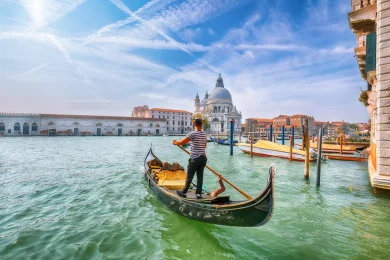
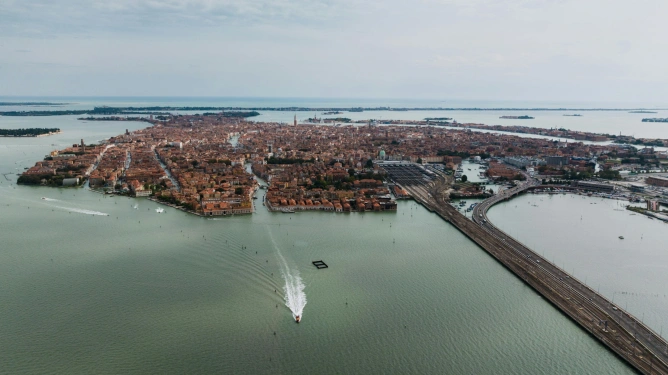
Venice has lived for 1,500 years alongside the sea, but the accelerated rise in water levels and subsidence threaten the very shape in which the city exists today. A study supported by EU-funded projects shows that no adaptation strategy can preserve Venice as it is now indefinitely.
The conclusion is harsher than the usual messages about climate adaptation: it is not just about protecting the city from flooding, but about choosing the type of Venice that will be able to exist in the future. The options analyzed involve different sacrifices for residents, the economy, tourism, heritage, the lagoon ecosystem, and local culture.
In short
The study supported by the European projects P2R and CoCliCo analyzes long-term options for adapting Venice and the lagoon to rising sea levels.
The MOSE barriers cost 6 billion euros, have been operational since 2020, and were closed 108 times between 2020 and 2025.
In the first two months of 2026, the barriers were already activated 30 times, indicating a shift from exceptional protection to frequent use.
A ring of dikes around Venice could cost between 500 million and 4.5 billion euros, but it would physically separate the city from the lagoon.
An extreme solution, with a barrier for the entire lagoon and continuous pumping, would cost over 30 billion euros, and long-term relocation could reach 100 billion euros.
The MOSE system is Venice's current defense against very high waters. It consists of 78 mobile gates made of steel, fixed to the seabed, which block excessive tidal inflow into the lagoon. The system became operational in 2020 and is effective against occasional high water episodes.
The problem is that these occasional episodes are becoming more frequent. According to the CORDIS article, the barriers were closed 108 times between 2020 and 2025, but were activated 30 times in just the first two months of 2026. This change shows that an infrastructure designed as an occasional shield risks becoming an almost permanent closure of the lagoon.
Such a transformation would have major effects. Frequent closures would disrupt navigation and tourism, change the lagoon's ecology, and require massive additional infrastructure for wastewater treatment and water pumping. Even with additional measures, such as injecting seawater into deep rocks to reduce subsidence, the efficiency of the MOSE system decreases after about one meter of sea level rise.
The study also analyzes more radical options. One of them is building a ring of dikes around Venice, which could become necessary by 2100. Estimated costs range from 500 million to 4.5 billion euros. Such a solution would physically protect the city but would fundamentally change its relationship with the lagoon.
An even more extreme option is to enclose the entire lagoon in a large dike system, supported by continuous pumping. This option could withstand a sea level rise of up to 10 meters but would cost over 30 billion euros and severely impact the lagoon's ecosystem.
In the very long term, beyond a projected 5-meter rise in sea level after 2300, relocating a significant part of the city and its population to safer ground could become the only viable option. Costs could reach up to 100 billion euros.
Researchers cited by CORDIS emphasize that the problem is not just financial. Venice cannot be reduced to infrastructure costs, as its cultural, historical, and symbolic value cannot be simply calculated. The study shows that all adaptation pathways involve losses and compromises, and no option preserves the city exactly in its current form.
This is the real stake of the study: adaptation can manage change up to a point, but beyond that point, it no longer preserves the present. It projects a different future. For Venice, the difference between salvation and transformation becomes increasingly difficult to separate.
The study was published in the journal Scientific Reports and was supported by the European projects P2R, Pathways2Resilience, and CoCliCo, Coastal Climate Core Services. According to CORDIS, the implications go beyond the case of Venice: all low-lying coastal regions must recognize the inevitability of long-term sea level rise and begin planning in advance.
Venice is an extremely visible case, but not an isolated one. What is decided there illustrates the dilemma that more and more coastal cities will face: how much can a place be defended, how much can it be transformed, and when does adaptation actually become acceptance of a partial loss.
https://2eu.brussels/ro/stiri/venetia-nu-mai-poate-fi-salvata-asa-cum-este-astazi
Latest News
23:06
22:49
22:37
22:22
22:03
See more news
NEWS ON THE SAME TOPICS