Consumers, between the reassurance of protection and the diversion of the increase in gas prices



Always see our news on Google
1. Maintaining the price cap, a possible last-minute decision or how to create price increases by talking about protection
With only 2.5 months before the deadline for the gas price cap expires, the Ministry of Energy announces again that it is "analyzing" a new price capping plan for gas. It is not a decision, it is not a calendar, it is not a rule. It is uncertainty. And in energy, uncertainties drive up prices.
The gas market does not operate on good intentions, but on predictability and contracts that are generally concluded for the following year. And here we are talking about gas purchase contracts, contracts for reserving transport capacity, contracts for reserving storage capacity, sales contracts, concluded for a term of one year that cannot be subsequently "canceled" and produce adverse effects. When the status suggests that it will change the rules in the middle of the game, producers, importers, traders, and suppliers do the only rational thing: they withdraw offers, postpone issuing offers, in fact, they defend themselves. Offers disappear from the market, liquidity decreases, and prices rise—not due to a lack of gas, but due to a lack of offers, due to a lack of trust. This practice of creating uncertainty regarding what will happen on April 1, 2026, does not protect the consumer. It taxes them indirectly. Suppliers introduce risk premiums, contracts get blocked, and the differences inevitably end up either in the bill or in the state budget. The cost does not disappear. It shifts. But surely, people will pay for it.
Worse, the repeated improvisation (2020, 2021, 2022, 2025, 2026) sends a toxic message that energy is governed "in the short term," not strategically. Investors who require years and millions will look at this behavior and hit pause. Domestic production does not grow with last-minute ordinances, but with stable rules announced in advance, with what is most important but is completely missing—trust.
The problem is not the capping itself. The problem is the timing. When you come with "analyses" 2.5 months before the deadline, you are not making public policy; you are managing panic. And panic is the most expensive fuel. If the status really wants to protect consumers, it has solutions: timely assistance to the vulnerable, announcing changes to the framework 9-12 months in advance, creating a mechanism to protect consumers from large price fluctuations, respecting concluded contracts, real consultation with the market. Otherwise, we will continue to see the Romanian paradox: we take measures to lower energy prices, measures that actually raise them. Energy does not forgive improvisation. And the market responds to these causes exactly as it knows—by increasing prices.
2. We are not "liberalizing" anything because the gas market has not been regulated, but only distorted
The statement that the state is considering "a gradual reduction of this capping" after March 31, 2026, starts from a reassuring formulation and reaches a wrong conclusion. With all due respect, we are not in a regulated market that we can gradually liberalize.
The statement that "we will not have a price increase" is plausible and supported by current reality: sufficient domestic production, offers below the cap, functional competition. The problem arises exactly at the moment when the Ministry of Energy introduces the idea that the market would need a "controlled transition," as if it were a closed market that is to be reopened.
The statement that "we will not have a price increase after March 31, 2026" is supported by current data: sufficient domestic production, offers below the cap, competitive pressure. The problem arises at the moment when apparently the Ministry introduces the concept of "gradual liberalization calendar," as if the gas market had been regulated and is to be reopened. This interpretation is economically and legally erroneous.
Emergency Ordinance 27 modified by Emergency Ordinance 6 did not suspend the free market and did not introduce a regulated market in Romania. It did not eliminate competition. It temporarily suspended the price from the gas sale contract with the final customer (except for clients with an annual consumption of more than 50,000 MWh) and replaced it with a formula, set the price at which gas is to be sold by domestic producers (but the price of imported gas is negotiated freely), imposed a maximum cap on the final consumer, and fixed the commercial margin for suppliers.
In other words, the market continued to operate, but with the price administratively distorted, not with the mechanisms suspended. Therefore, the idea of "a gradual reduction of this capping," that is, of "gradual liberalization" is conceptually wrong. I cannot liberalize something that has not been deliberalized. On March 31, 2026, a regulated market is not "released"; rather, a set of temporary distortions ceases. The market does not start from scratch, it does not need the reintroduction of competition nor progressive doses of freedom. But it does need the restart of competition stifled by Emergency Ordinance 27 and Emergency Ordinance 6.
The comparison with electricity is also forced. There, the shock came from the simultaneous exit from several mechanisms, in a structurally import-dependent market. Gas is a different equation, with dominant domestic production, stable costs, and limited external exposure. The lesson is not "let's exit more slowly," but rather "let's not distort unnecessarily anymore."
The real risk is not the removal of the capping, but ambiguity. The market does not need a transition, but a firm message: the capping ends, the rules revert to contractual, and protection shifts where it is needed.
On March 31, 2026, we do not liberalize the gas market. We slow down treating it as a regulated one. Any "gradual capping" applied to a market that has remained free is not only unnecessary but also risky. In energy, it is not the lack of control that raises prices, but the lack of clarity.
3. Why do we want to cap the gas price for the population when the actual price paid is below the capped price?
Analyzing the last natural gas bill, one can observe an essential fact: the actual price of natural gas paid by the final consumer during the period September-December 2025 is below the level of the capped price, with a difference ranging between 3% and 8%. This reality raises a legitimate and uncomfortable question: what is, in reality, the problem we are trying to solve by continuing the capping?
 The capping mechanism was introduced as an exceptional measure, justified by extreme market volatility and the risk of sharp price increases that would severely affect the population. However, the current context is different. The gas market has stabilized, wholesale prices have decreased, and competition and medium-term contracts have led to actual prices lower than the administratively stabilized cap. In other words, the cap is no longer a shield but has become an artificial, economically irrelevant benchmark.
A frequently cited argument for maintaining the capping is the disappearance of the administratively set price for gas from domestic production, previously set at 120 lei/MWh. It is suggested that complete liberalization would automatically lead to an explosion of prices for household consumers. However, the data from the bills contradict this fear. In the bill for December 2025, the price of natural gas—the commodity component—is 180.53 lei/MWh, a significantly higher level than the administratively set price for domestic production, but which must be viewed in the context of the current market.
Moreover, this price of 180.53 lei/MWh is higher than the prices of gas traded on the relevant exchanges for delivery in the second quarter of 2026, indicating that suppliers already have the opportunity to procure at prices lower than those reflected in current facts. In other words, the market anticipates lower prices, not higher ones. In this context, capping not only fails to protect the consumer, but risks distorting market signals and delaying the transfer of price reductions to the population. BRM Romania – 151.5 lei/MWh
TTF Netherlands – 133.22 lei/MWh
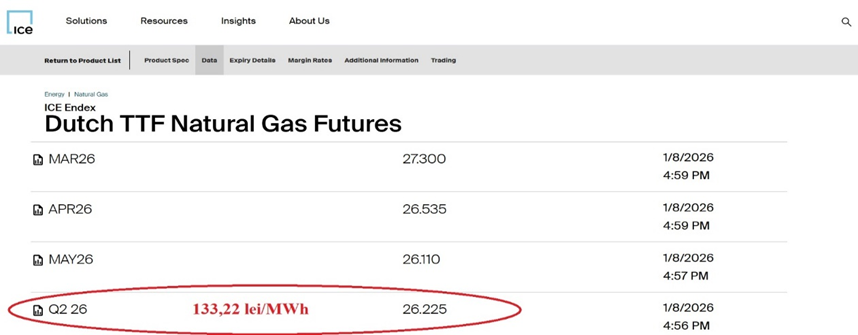 The persistence of the capping also creates other negative effects. It reduces transparency, discourages real competition among suppliers, and maintains the illusion of a risk that, at present, is no longer reflected in the final price. Additionally, the cap becomes a psychological price-anchor, over which suppliers know they can raise prices without provoking major political or social reactions, as long as they do not formally exceed it. Thus, a measure initially designed for protection functions as an obstacle to the natural decline of prices.
Capping the gas price, under conditions where the actual price paid is already below the cap, is no longer a protective measure but an administrative self-deception measure. It does not protect the consumer but masks the lack of courage to let the market function and to recognize that the crisis situation has passed. The artificial maintenance of the cap sends a false message: that the danger is imminent, when reality shows the opposite. Instead of protecting the population, we keep them captive in an outdated mechanism that hinders price reductions, conserves inefficiency, and raises gas prices.
4. What should state institutions do for the liberalization of the gas market from April 2026?
Is it an aberration or perhaps on the contrary, is it desired that the gas price on the Romanian exchange be 14% higher than the European exchange? Romania is dependent on only 7% of gas imports by 2025, meaning it has sources to almost fully cover the annual gas demand from its own sources. The EU is 85% dependent on imports. This situation shows gross anomalies of the existence of higher gas commodity prices in Romania compared to the EU.
What is certain is that if April 1, 2026 comes without:
• reforming the way state institutions operate in the gas market,
• increasing BRM liquidity,
• providing comprehensive protection for vulnerable consumers,
• real coupling with the EU,
then:
prices will remain higher in Romania than in the West,
we will have a political and social shock,
pressure will be created for re-regulation, which has other winners than the population.
What the STATE needs to do (if it wants fair prices, currently its actions prove the opposite, even if declaratively it says otherwise):
• clearly state what will happen on April 1, 2026, and eliminate the uncertainty that generates concern and price increases in the gas market
• ensure real liquidity on BRM/OPCOM (not just formal),
• eliminate administrative barriers that discourage transactions,
• prevent oligopolistic behaviors,
• align internal rules with EU hubs (TTF, CEGH).
• minimum trading obligations (especially during this period),
• transparency on end-user prices,
• a contingency plan in case of escalating gas prices,
• reducing taxation,
• real support for vulnerable consumers by reconsidering the aid included in the Law on vulnerable consumers.
Although we are physically connected, the Romanian market is not efficiently coupled with efficient exchanges, which allows:
• the appearance of price islands,
• local speculation,
• limited arbitrage (not enough players to "bring down" the price).
The result for the population is poor, but this is not due to liberalization, but due to the lack of actions, lack of regulations, lack of real oversight, and the concentrated interests of certain parties (especially the state).
Latest News
20:09
19:53
19:25
19:07
19:00
See more news
NEWS ON THE SAME TOPICS