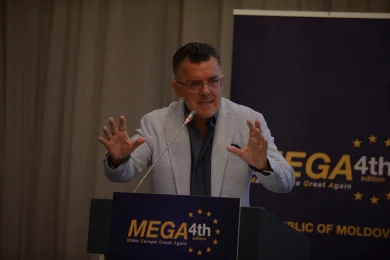
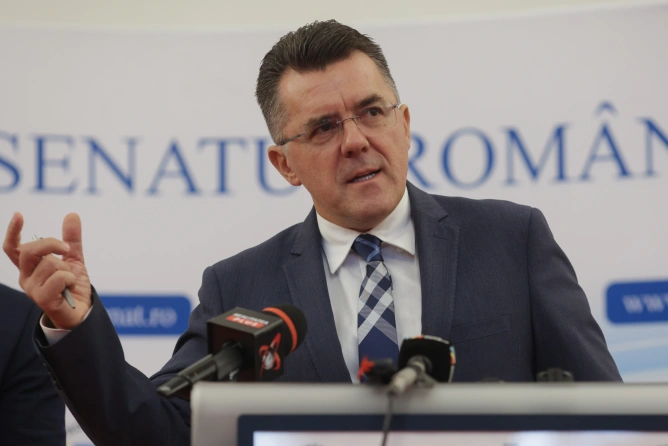
The Black Sea Foundation of Dan Dungaciu, left without funds from the Ministry of Foreign Affairs. AUR leader: "How this decision is made, I really don't know"



Always see our news on Google
The Black Sea University Foundation (FUMN), led by Dan Dungaciu (AUR), has remained without the main source of funding, after the Ministry of Foreign Affairs designated another organization as the head of the Anna Lindh Foundation's international network in Romania, thus cutting off its access to the grants that supported its current operation. The AUR leader reacted, for Cotidianul.ro, stating that he does not know what the MFA procedures are and how the decision was made, but he respects the change.
The Ministry of Foreign Affairs announced on February 3 that the Group of the European Youth for Change (GEYC) has been selected as the Head of Network of the Anna Lindh Foundation Romania for the period 2026-2028.
At the end of 2025, the Ministry of Foreign Affairs launched a public selection procedure for designating a civil society organization as the head of the national Anna Lindh Romania network, marking the transition from direct designation to an open competition. Following the selection procedure, the ministry decided that GEYC would take on the role of Head of Network, a position held by FUMN since 2007. This change means that the foundation led by Dan Dungaciu will no longer manage the national network and will no longer have direct access to the funding dedicated to this position.
Why it matters in this case
For the story of the funding cut by the MFA, the role of FUMN is important because it was, until now, the Romanian hub for an international network – the Anna Lindh Foundation – which funds intercultural dialogue and Euro-Mediterranean cooperation projects. As a think tank focused on foreign policy centered on the Black Sea, FUMN used this position both to carry out projects and events, as well as to produce analyses and expertise that then entered the public debate circuit and, indirectly, the agenda of Romanian institutions.
Dungaciu "acts" of change
In a reaction for Cotidianul, Dungaciu emphasizes that the Black Sea University Foundation had the "accreditation" from the Ministry of Foreign Affairs to represent the Anna Lindh Foundation in Romania and that this accreditation was obtained before he became president of the foundation. He insists that the annual extension of this status was based on reports and accreditations sent by the Anna Lindh Foundation from Cairo, not as a result of a direct relationship between the MFA and his foundation.
"Based on those reports and based on those accreditations, from the central foundation, the MFA extended the accreditation. That’s all we know. Don’t ask me, because, and if you ask me, I don’t know what the internal procedures of the MFA are to extend this accreditation beyond the obvious consultation with the Anna Lindh Foundation. Because it is taken by the signature of the Minister of Foreign Affairs, that these accreditations are given by decision by vote... How this decision is made, really, I don’t know, it’s not our business. I understand now that the Ministry of Foreign Affairs would have changed its decisions and procedures. Again, it’s not our business. We acknowledge this decision of the MFA and wish success to the future entity, NGO, that will somehow represent Romania in this partnership," said Dungaciu.
Who is Dan Dungaciu
Dan Dungaciu is a sociologist and political scientist, a professor at the University of Bucharest and one of the most visible analysts of foreign policy in the Romanian public space. Since 2025, he has been the first vice president of AUR and is part of the party's "triumvirate" leadership, alongside George Simion and Petrișor Peiu, with a role as the architect of the foreign policy and security line.
He is a controversial figure, as the press reported that he was sanctioned by the National Integrity Agency for not submitting his wealth and interest declarations during the period he led the Institute of Political Science and International Relations of the Romanian Academy. In April 2024, the DNA sent him to trial for abuse of office, in a case related to the allocation without rent to the LARICS association (of which he was a co-founder) of spaces of the institute he led; the case is being judged at the Bucharest Tribunal, with ISPRI constituted as a civil party. In 2026, Libertatea reported that the case risks reaching the statute of limitations, with lawyers citing the vagueness of the accusations, while the press criticized the delays in the procedures.
Latest News
22:25
22:06
21:47
21:18
21:00
See more news
NEWS ON THE SAME TOPICS