Russian oil has not disappeared from Europe — it has moved to other routes, but it has made Europe vulnerable.




Always see our news on Google
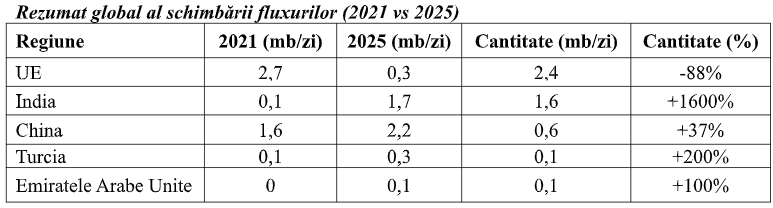
Four years after the outbreak of the war in Ukraine and after the most extensive energy sanctions ever adopted by Europe, the official statistics seem to show a clear success: imports of Russian oil into the European Union have plummeted. In 2021, EU states imported approximately 2.7 million barrels per day of Russian oil. By 2025, the level had dropped to about 0.3 million barrels per day – a reduction of nearly 88%.
In December 2022, the European Union banned maritime imports of Russian oil, and in February 2023, it extended sanctions to refined petroleum products from Russia. The share of Russian oil in EU imports fell from about 29% before the war to nearly 1%.
At first glance, the sanctions seem to have eliminated Russian oil from the European market. A closer analysis of global oil flows and petroleum products suggests, however, a more complex reality: Russian oil has not disappeared from the European energy economy, but has changed its trade routes.
 Reconfiguring Global Flows
The oil market is global and extremely flexible. If one buyer disappears, the supply redirects to another. This is exactly what happened after the introduction of sanctions. Before the war, the main importers of Russian oil were the European Union, China, and Turkey. After 2022, the map changed radically. The new major buyers of Russian oil are China, India, and Turkey.
Trade data shows a spectacular increase in Russian oil imports in these economies. India, for example, imported about 0.1 million barrels per day of Russian oil in 2021. By 2025, imports had reached approximately 1.7 million barrels per day – an increase of over 1600%. China increased its imports from about 1.6 million barrels per day to over 2.2 million barrels per day. Turkey tripled its imports, and countries in the Middle East, such as the United Arab Emirates or even Saudi Arabia, have also started to buy larger volumes of Russian oil.
Currently, China buys about 47% of Russia's oil exports, India about 38%, and Turkey around 6%. Europe has almost completely disappeared from the list of direct buyers.
This redistribution is not surprising. Russian oil has been sold after sanctions at significant discounts compared to the Brent benchmark price, sometimes $10–20 per barrel cheaper. For refiners in Asia or the Middle East, this discount represented a major economic opportunity.
The European Paradox: Less Oil, More Imported Diesel Meanwhile, European energy statistics show an interesting phenomenon. While imports of crude oil are slightly decreasing, imports of refined petroleum products are increasing.
Data for the period 2022–2025 indicate the following approximate evolution in the European Union:
• Imports of crude oil have decreased from about 9.7 million barrels per day in 2023 to about 9 million barrels per day in 2025
• Imports of petroleum products have increased from about 3.1 million barrels per day in 2022 to about 3.5 million barrels per day in 2025
• Total consumption of petroleum products has remained relatively stable, around 13–14 million barrels per day.
This combination suggests a structural change: part of the oil refining necessary for Europe has moved outside the continent.
 The situation is even more visible in the diesel market, the dominant fuel in European transport. In 2022, the European Union imported about 1.3–1.4 million barrels per day of diesel, and nearly half of these imports came from Russia. After the introduction of sanctions on Russian petroleum products, the structure of imports changed radically.
In the period 2023–2025, the main sources of diesel for the EU became the United States (about 25% of imports), India (about 20%), Saudi Arabia (about 12%), Kuwait (about 10%), Turkey (about 8%), and the United Arab Emirates (about 7%).
The total volume imported remained relatively constant, around 1.3–1.5 million barrels per day. In other words, Europe has not necessarily reduced its dependence on diesel imports. It has, however, changed suppliers. Many of the suppliers are actually importers of Russian crude oil.
Refining Russian Oil in Third Countries
This is where the mechanism that has generated intense debates in the energy market comes into play. Some of the diesel exported to Europe by countries like India or Turkey is produced in refineries that process large quantities of Russian oil.
Legally, the resulting product is no longer considered "Russian." International trade rules establish that the origin of a refined product is the country where the refining took place, not the country from which the raw material comes.
Therefore, a refinery in India can buy Russian oil, refine it into diesel, and export the fuel to Europe as an "Indian" product. The same principle applies to refineries in Turkey or Gulf states.
This mechanism is not necessarily a direct violation of sanctions, but it creates what analysts call a "backdoor" for Russian oil. For this reason, the European Union has begun to introduce additional rules to verify the origin of the crude oil used in refineries in third countries.
Romania – A Regional Example
The change in energy flows is also visible in Romania. The consumption of petroleum products has slightly increased in recent years, while domestic production and imports of crude oil have remained relatively stable.
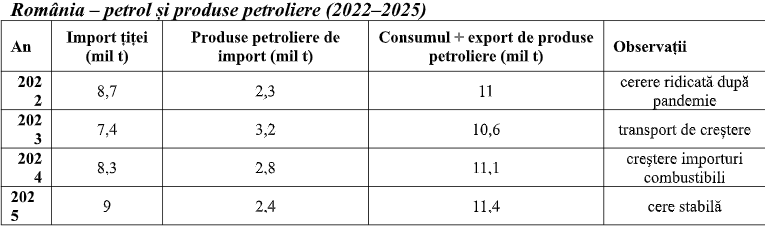 Aggregated data indicate the following approximate evolution:
• In 2022, Romania imported approximately 8.7 million tons of crude oil and 2.3 million tons of petroleum products
• In 2025, imports of crude oil were about 9 million tons, while imports of petroleum products increased to about 2.4 million tons
• Total consumption of petroleum products remained relatively constant at 11.3 million tons.
Diesel imports clearly illustrate the change in suppliers. Before the sanctions, Russia was one of the main sources. After 2022, Russian diesel almost completely disappeared from statistics, being replaced by imports from Greece, Turkey, Bulgaria, Italy, and regions such as the United States or the Middle East.
At the same time, the port of Constanța has become one of the most important hubs for importing petroleum products in the Black Sea region, reflecting the reorganization of trade routes.
A More Complex Energy Reality
All these developments indicate that energy sanctions have had a real effect on the direct trade relationship between Europe and Russia. Direct imports of Russian oil have drastically decreased, and the EU's formal dependence on Russian oil has reduced.
At the same time, however, the global oil market has adapted quickly. Trade flows have reorganized, and Russian oil has found new markets in Asia and the Middle East. Some of this oil is refined into petroleum products that subsequently reach the European market.
The result is a paradoxical situation: Europe has reduced direct imports of Russian oil (cheap), but continues to consume fuels (expensive) in a global market where Russian oil remains an important component.
In the global energy economy, oil molecules do not have passports. They follow the most economically efficient routes. Sanctions can change the direction of flows, but rarely can they completely eliminate a major resource from the market.
Latest News
22:50
22:36
22:24
22:20
22:16
See more news