Borderless politics. How Romanians relate to leaders they cannot vote for.



Always see our news on Google
Globalization has redefined the boundaries of politics. What once seemed a strictly internal matter — who leads a country, what values they promote, what alliances they cultivate — has become a subject of interest, sympathy, or antipathy for electorates on the other side of the world. The lines between domestic and international politics have blurred considerably, and this phenomenon does not bypass Romania either. Sympathy or antipathy towards foreign political leaders (and often towards the countries they represent) reveals attitudes based less on interests and more on the cultural-political model that these leaders express.
The most visible paradox of this era is that ultranationalist movements and globalist ones share the same reflex: solidarity with foreign leaders who express a recognizable cultural and political model, regardless of whether the concrete policies of those leaders serve or contradict the real interests of their own country. It is not calculated interest that dictates sympathy, but belonging to a quasi-transnational ideology.
This dynamic also has a pragmatic explanation. In an interdependent world, the decisions of major economic and military powers are often felt more acutely in the lives of ordinary citizens than the legislation adopted by their own parliament. The foreign policy of Washington, Berlin, or Moscow produces direct effects — economic, military, cultural — in countries that had no say in the election of those leaders. This creates a structural deficit of representation, but also a transfer of political attention: electorates follow, comment on, and identify with leaders they cannot vote for.
What truly reveals sympathies or antipathies towards foreign leaders is not a cold analysis of national interests, but a map of values. Enthusiasm or rejection functions as identity markers, signaling belonging to one of the major cultural blocks of the moment — the one that embraces social modernization, globalization, and the revision of traditional value sets, respectively the one that rejects them.
Romania is no exception to this rule. The Inscop Research survey "Barometer of Informat.ro – The perception of Romanians regarding the Republic of Moldova, May 2026" provides, in the sections dedicated to the perception of other countries and foreign leaders, an accurate snapshot of these divides. The clearest part of the research is the one that breaks down the results based on voting intention: the image that emerges describes the extent of Romanian political polarization and confirms that almost any issue of foreign policy is processed not through a grid of national interests, but through the filter of these quasi-ideologies of the moment, whose inflection point remains the attitude towards social modernization, economic progress, and global integration.
Political Leaders The graphical presentation of the data is available at: https://www.inscop.ro/wp-content/uploads/2026/05/13.05.2026-Sondaj-INSCOP-Increderea-in-lideri-nationali-si-internationali-1.pdf Trust in International Personalities
Emanuel Macron leads the trust ranking in international leaders, with 32.9% of respondents declaring that they have a lot (9.6%) and quite a lot (23.3%) of trust in the French president. The ranking continues with Maia Sandu with a trust capital of 28.6% (respectively very much trust 11.5% and quite a lot trust 17.1%), Donald Trump with 24.8% trust (respectively very much trust 10.1% and quite a lot trust 14.7%), Ursula von der Leyen with 23.7% (respectively very much trust 4.7% and quite a lot trust 19%) and Friederick Merz with 20.9% (respectively very much trust 4.8% and quite a lot trust 16.1%).
Emanuel Macron
9.6% of those interviewed mention that they have a lot of trust in Emanuel Macron, while 23.3% have quite a lot, 19.8% quite little, and 33.5% very little or none at all. 2.5% do not know or do not respond.
Those who have the most trust in the French president are: PNL and USR voters, young people under 30, those with higher education, residents of Bucharest and large urban areas. PSD and AUR voters, people aged between 30 and 59, residents of small urban areas, and public sector employees are the categories of the population that have the least trust in Emanuel Macron.
Maia Sandu
11.5% of respondents state that they have a lot of trust in Maia Sandu. 17.1% say they have quite a lot of trust, 16.5% quite little, and 37.2% very little or none at all. The proportion of non-responses is 3.9%.
They have more trust in the President of the Republic of Moldova than the rest of the population: PNL and USR voters, people over 60, those with higher education, residents of Bucharest and large urban areas. PSD and AUR voters, people aged between 30 and 59, those with primary education, residents of small urban areas and rural areas, and state employees have the least trust in Maia Sandu.
Donald Trump
10.1% of survey participants have a lot of trust in Donald Trump. 14.7% have quite a lot of trust, 24.5% quite little, and 46.4% very little or none at all. 1.6% do not know or do not respond.
They have more trust in the American president than the rest of the population: PSD and AUR voters, young people under 30, people with higher education. PNL and USR voters, people aged between 30 and 44, those with higher education, residents of Bucharest and small urban areas have the least trust in Donald Trump.
Ursula von der Leyen
Regarding how much trust they have in Ursula von der Leyen, 4.7% of those interviewed say they have a lot of trust, 19% quite a lot, 16.5% quite little, and 40.8% very little or none at all. The proportion of non-responses is 2%.
PNL and USR voters, people with higher education, residents of Bucharest and large urban areas, and state employees tend to have the most trust in Ursula von der Leyen. They have little or no trust in the head of the European Commission to a greater extent than the rest of the population: PSD and AUR voters, people over 45, those with secondary education.
Friedrich Merz
4.8% of survey participants declare that they have a lot of trust in Friedrich Merz. 16.1% have quite a lot of trust, 10.2% quite little, and 16.7% very little or none at all. 5.3% do not know or do not respond.
They have more trust in the German chancellor than the rest of the population: PNL and USR voters, men, those with higher education, residents of Bucharest and large urban areas, public sector employees. PSD and AUR voters have the least trust in Friedrich Merz.
Other Countries
Relations between Romania and other countries
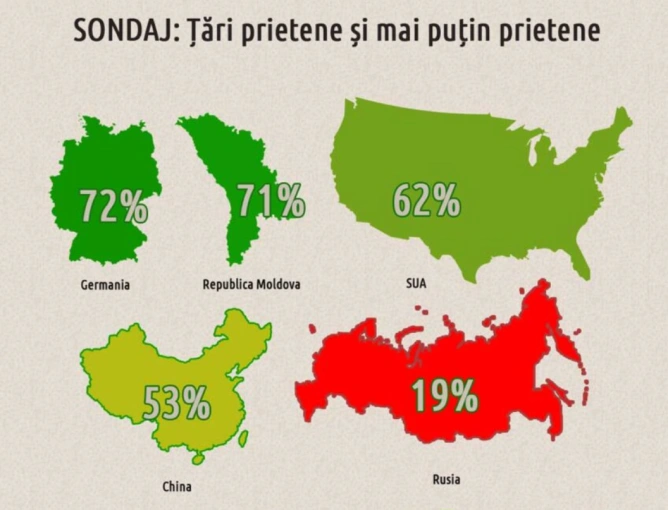
In the ranking of countries perceived as friendly (very friendly and quite friendly) towards Romania, Germany ranks first with 71.8%, followed by the Republic of Moldova with 71.1%, France with 70.8%, and the European Union with 68.9%. The ranking continues with Turkey – 67.3%, the United States of America – 61.9%, and China – 52.7%. At the bottom are Hungary (51.1%), Ukraine (48.3%), and Russia (19.3%).
Germany
71.8% of Romanians consider Germany a friendly country. (17.9% of survey participants see Germany as a very friendly country, with excellent relations, while 53.9% believe it is quite a friendly country, with good relations). 15.2% believe it is a not very friendly country, with somewhat tense relations, and 8.6% not friendly at all, with very cold and tense relations. The proportion of non-responses is 4.4%. They consider Germany to be a friendly country (very and quite friendly) at a higher percentage than the average: PNL and USR voters, men, young people under 30, people with higher education. PSD and AUR voters, women, people over 60, and those with primary education believe at a higher proportion than the rest of the population that Germany is not a friendly country towards Romania.
Republic of Moldova
71.1% of Romanians consider the Republic of Moldova a friendly country. 26.8% of respondents believe that the Republic of Moldova is a friendly country, with excellent relations with Romania. 44.3% believe it is quite a friendly country, with good relations, 11.5% a not very friendly country, with somewhat tense relations, and 12% not friendly at all, with very cold and tense relations. The proportion of non-responses is 5.4%. They consider the Republic of Moldova to be a friendly country (very and quite friendly) at a higher percentage than the average: PSD, PNL, and USR voters, young people under 30, people with higher education. AUR voters, people aged between 45 and 59, those with primary education, and state employees believe at a higher proportion than the rest of the population that the Republic of Moldova is not a friendly country towards Romania.
France
70.8% of Romanians consider France a friendly country. 23.3% of those interviewed consider France to be a very friendly country, with excellent relations towards Romania. 47.5% see it as quite friendly, with good relations, 12.6% a not very friendly country, with somewhat tense relations, and 12% not friendly at all, with very cold and tense relations. 4.6% do not know or do not respond. They believe that France is a friendly country (very and quite friendly) towards Romania at a higher percentage than the average: PNL and USR voters, young people under 30, those with higher education, residents of large urban areas, private sector employees. AUR voters, people aged between 30 and 44, those with primary education, and public sector employees believe at a higher proportion than the rest of the population that France is not a friendly country towards Romania.
European Union
68.9% of Romanians consider the European Union friendly. 24.7% of Romanians believe that the European Union is very friendly, having excellent relations with Romania. 43.9% consider the EU quite friendly, with good relations, 14.6% not very friendly, with somewhat tense relations, and 12.4% not friendly at all, with very cold and tense relations. 4.4% do not know or do not respond. They believe that the relationship with the EU is a good one at a higher proportion than the rest of the population: PNL and USR voters, people aged between 18 and 44, those with higher education, residents of large urban areas and Bucharest, private sector employees. AUR voters, people over 60, those with primary education, residents of small urban areas, and state employees believe at a higher percentage than the average that the relationship with the EU is a tense one.
Turkey
67.3% of Romanians consider Turkey a friendly country. In the opinion of 13.3% of respondents, Turkey is a very friendly country, with excellent relations. 54.1% appreciate that Turkey is quite a friendly country, with good relations, 13.3% a not very friendly country, with somewhat tense relations, and 9.8% not friendly at all, with very cold and tense relations. The proportion of non-responses is 9.5%. They believe that Turkey is friendly (very and quite friendly) at a higher proportion than the rest of the population: PSD and USR voters, young people under 30, those with higher education, residents of large urban areas. PNL and AUR voters, people aged between 30 and 44, and those with primary education believe at a higher proportion than the average that Turkey is not a friendly country.
United States of America
61.9% of Romanians consider the USA a friendly country. 14.9% of respondents consider that the United States of America is a very friendly country, with excellent relations towards Romania, while 47% perceive them as quite a friendly country, with good relations. 21.5% appreciate that the USA is a not very friendly country, with somewhat tense relations, and 10% consider them not friendly at all, with very cold and tense relations. 6.6% do not know or do not respond. They believe that the USA is a friendly country (very and quite friendly) at a higher proportion than the rest of the population: PSD and PNL voters, people over 60. USR voters, people aged between 45 and 59, and residents of Bucharest and large urban areas believe at a higher percentage than the average that the USA is a not very / not friendly country.
China
52.7% of Romanians consider China a friendly country. 7% of those interviewed consider China a very friendly country, with excellent relations towards Romania. 45.7% see it as quite friendly, with good relations, 21.1% a not very friendly country, with somewhat tense relations, and 15% not friendly at all, with very cold and tense relations. The proportion of non-responses is 11.1%. PSD voters, people over 60, those with higher education, and residents of small urban areas believe at a higher proportion than the rest of the population that the country led by Xi Jinping is a friendly country (very and quite friendly). They believe that the Chinese state is not a friendly country at a higher percentage than the average: people aged between 18 and 44, residents of large urban areas.
Hungary
51.1% of Romanians consider Hungary a friendly country. 5.5% of Romanians see Hungary as a friendly country, with excellent relations towards Romania, while 45.6% consider it quite a friendly country, with good relations. 27.7% believe it is a not very friendly country, with somewhat tense relations, and 15% consider it not friendly at all, with very cold and tense relations. 6.3% do not know or do not respond. USR voters, young people under 30, those with higher education, and public sector employees believe at a higher proportion than the rest of the population that Hungary is a friendly country (very and quite friendly). They believe that Hungary is not a friendly country at a higher percentage than the average: people aged between 45 and 59, residents of Bucharest.
Ukraine
48.3% of Romanians consider Ukraine a friendly country. 11.4% of respondents classify Ukraine as a friendly country, with excellent relations towards Romania. 36.9% believe it is quite a friendly country, with good relations, 22% a not very friendly country, with somewhat tense relations, and 24.9% not friendly at all, with very cold and tense relations. 4.8% do not know or do not respond. They consider Ukraine to be a friendly country (very and quite friendly) at a higher percentage than the average: PNL and USR voters, young people under 30, people with higher education, residents of Bucharest. AUR voters, people aged between 45 and 59, those with primary and secondary education, and state employees believe at a higher proportion than the rest of the population that Ukraine is not a friendly country towards Romania.
Russia
19.3% of Romanians consider Russia a friendly country. In the opinion of 3.9% of respondents, the relationship with Russia is excellent, being a very friendly country. 15.3% appreciate that Russia is quite a friendly country, with good relations, 29.9% a not very friendly country, with somewhat tense relations, and 45.6% not friendly at all, with very cold and tense relations. The proportion of non-responses is 5.3%. They believe that Russia is a friendly country (very and quite friendly) at a higher percentage than the average: AUR voters, young people under 30, residents of rural areas. PNL and USR voters, people with higher education, residents of Bucharest and large urban areas believe at a higher percentage than the rest of the population that Russia is not a friendly country towards Romania.
Latest News
22:58
22:44
22:41
22:21
22:08
See more news