Political pessimism in Romania and in the world: two social research studies




Always see our news on Google
In the context of accelerated technological transformations and increasingly visible geopolitical tensions, the contemporary social landscape is marked by a worrying trend towards isolation and distrust. Two benchmark studies published at the beginning of 2026, the "2026 Edelman Trust Barometer" and the "Informat.ro Barometer" conducted by INSCOP Research, provide a detailed snapshot of this phenomenon, highlighting an ever-deepening fracture between citizens and institutions, as well as a pessimistic view of the future. These studies are not merely simple collections of statistical data, but essential tools for grounding political and cultural strategies capable of restoring social cohesion in a world defined by uncertainty.
Dark Horizons and the Decline of Global Generational Optimism
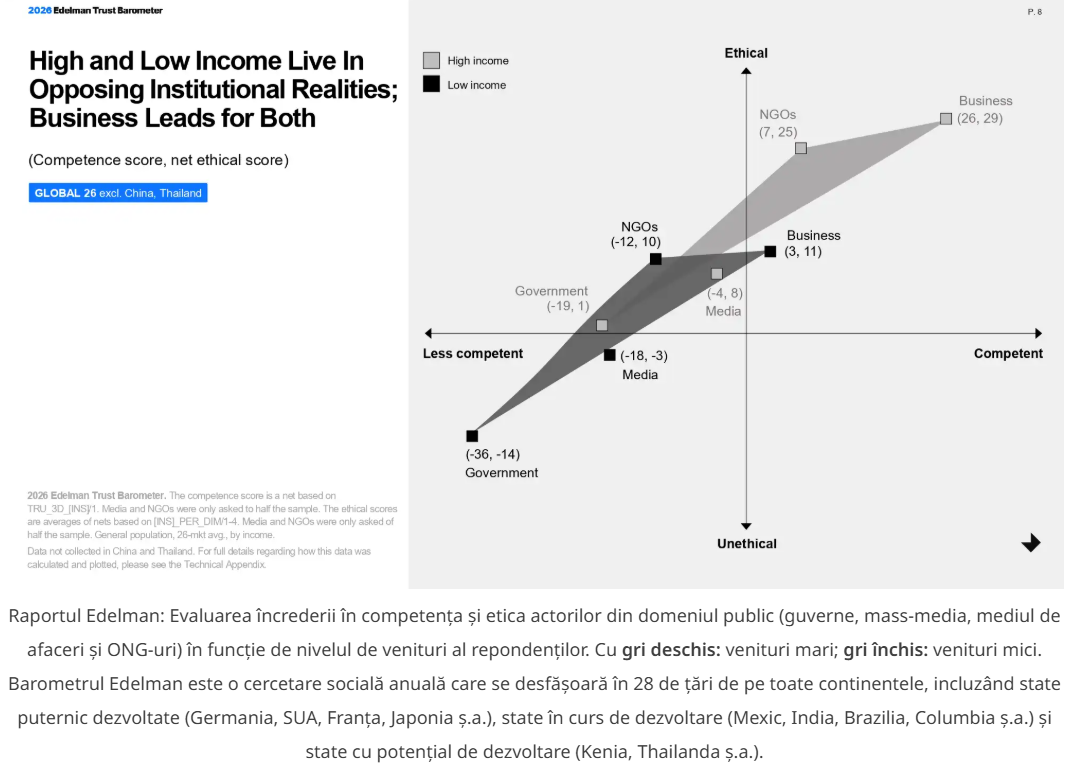
The global Edelman report underscores a grim reality in which economic optimism is at alarmingly low levels, with only 32% of respondents worldwide still believing that the next generation will have a better life than the current one. This feeling of regression is fueled by deep economic fears, including the fear of job loss due to a possible recession, felt by 67% of employees, and concerns related to international trade conflicts, which affect 66% of the active population. Moreover, the impact of generative artificial intelligence creates a new social divide, with the majority of low-income individuals (54%) fearing they will be left behind by this technological revolution, in contrast to high-income segments, where only 31% feel this danger.
The Perception of Romanian Citizens on the National Direction
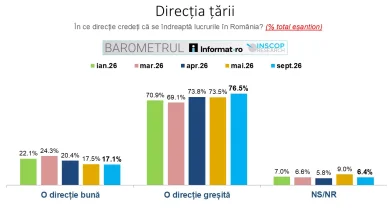
At the national level, data provided by the Informat.ro Barometer, conducted by INSCOP Research, confirms Romania's alignment with this trend of heightened pessimism. According to research conducted in January 2026, an overwhelming majority of 70.9% of Romanians believe that things in the country are heading in the wrong direction, marking an increase in dissatisfaction compared to the end of the previous year. In contrast, the segment of those who look confidently towards the immediate future of the country has decreased to 22.1%, reflecting a state of mind dominated by skepticism. This dynamic underscores the importance of this type of monthly public opinion monitoring to understand the pulses of society and provide policymakers with a credible database for adjusting public policies.
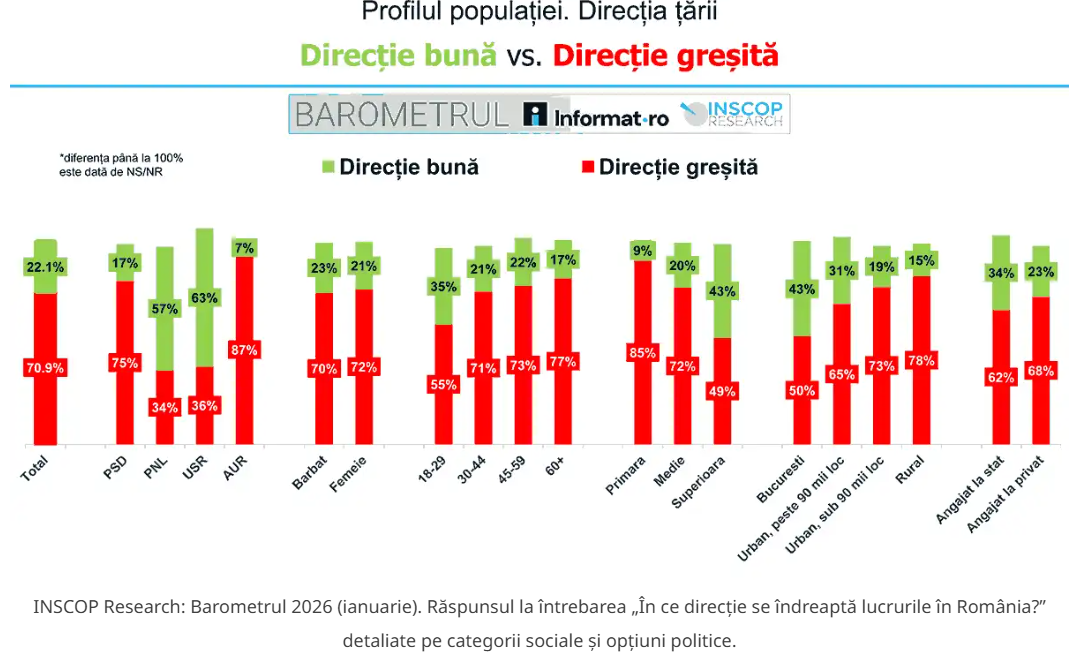
The direction in which the country is heading is a much more interesting indicator than it seems. Many surveys use it more as an introductory question, a "warm-up," but it is actually a fairly sophisticated signal of the climate of social calm or turmoil. Of course, in general, Romanians have not been very optimistic about the direction in which the country is heading, but the heightened dissatisfaction in recent years has led to historic lows in the percentage of optimists. It is also worth observing how the two camps (optimists and pessimists) are delineated based on voting preferences or the socio-demographic data of the public. These delineations show us very interesting political configurations, but also which segments of the population the "epidemic" of social dissatisfaction is primarily extending to. Darie Cristea – Director of Research INSCOP Research
The Roots of Pessimism: From Economic Inequity to Fear of Technology
The widespread phenomenon of distrust, which the Edelman study refers to as "retreat into insularity," has its roots in a complex mix of socio-economic factors. Among the main causes identified are the high cost of living, political polarization, and the feeling of "grievance" (inequity/injustice/danger) – a deep dissatisfaction with a system perceived as rigged in favor of the wealthy. Additionally, 75% of respondents fear that foreign actors deliberately spread disinformation to inflame internal differences, leading to an erosion of common reality. This state of affairs prompts a paradigm shift in which "local" trust (in family, neighbors, or one's own employer) becomes a refuge in the face of distrust in government leaders or global media organizations.
The Importance of Social Research in Grounding Future Policies
The relevance of these two studies, the 2026 Edelman Trust Barometer Global Report and the Informat.ro Barometer – INSCOP Research, goes beyond the academic sphere, providing a model of action for institutions. Edelman proposes the concept of "trust brokering," a strategy through which businesses, governments, and NGOs can facilitate dialogue between groups with divergent values, without trying to change their identity. In a world where 7 out of 10 people exhibit an insular mindset, being reluctant to trust those who think differently, the ability of institutions to act as mediators becomes crucial to unlocking economic and social progress. Only by recognizing these figures and understanding the deep-rooted causes of pessimism can cultural and political bridges of inclusion be built that transform "me" back into "we."
Latest News
18:53
18:47
18:30
18:24
18:20
See more news
NEWS ON THE SAME TOPICS