Informat.ro Barometer – INSCOP Research: Administrative-territorial reform: urban optimism and rural resistance



Always see our news on Google
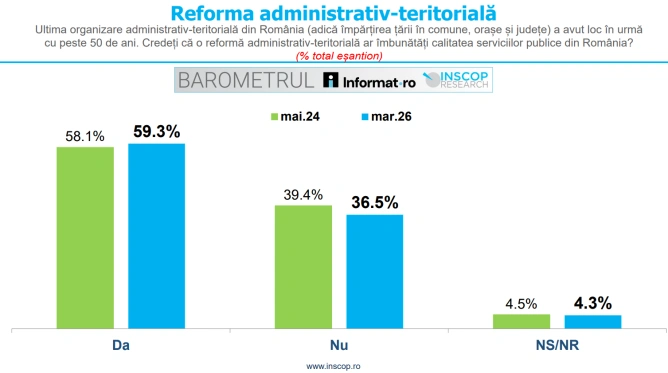
Although political support for the administrative-territorial reform in Romania remains at a purely theoretical and declarative level, the subject presents a real interest for the public. Recent data from the Informat.ro Barometer – Inscop Research, collected between March 2-6, 2026, shows solid support for change: 59.3% of Romanians believe that such a reform would improve the quality of public services, 60.8% support more complex measures, such as the unification or merging of localities, and 60.1% even agree with the possibility of establishing regions that would unite several counties.
The analysis of supporters of the administrative-territorial reform by socio-demographic categories reveals a massive concentration of optimism in large cities. Residents of Bucharest (68%), individuals with higher education (67%), and voters of USR (85%), PSD (71%), and PNL (66%) see the merging of localities as a solution for budget efficiency and modernization of services.
On the opposite end, resistance appears exactly where this reform could, at least in principle, allow for a significant improvement in the quality of life and increase access to resources. Residents of small urban areas (40%) especially oppose the possibility of establishing regions that would unite several counties, while those in rural areas (39%), voters of AUR (41%), and those with primary education (42%) oppose the possibility of unifying/merging localities.
A paradoxical situation thus arises: in the absence of correct information about the possible benefits of the administrative-territorial reform, the population that could benefit the most from it significantly rejects it, fearing the unknown.
Methodology: The data from the eighth edition of the BAROMETER Informat.ro – INSCOP Research were collected between March 2-6, 2026. Research method: interview via questionnaire. The data were collected using the CATI method (telephone interviews), with a simple stratified sample volume of 1100 people, representative of significant socio-demographic categories (gender, age, occupation) for the non-institutionalized population of Romania, aged 18 and over. The maximum allowable error of the data is ± 3%, at a confidence level of 95%.
Latest News
15:46
15:38
15:34
15:33
15:29
See more news
NEWS ON THE SAME TOPICS
.webp)