Sever Voinescu, Dilema.ro: Armies fight for nations



Always see our news on Google
With your permission, I will continue the discussion started last week, reminding you – or clarifying for those who have not read that article – that I proposed we have in front of us Marco Rubio's speech at the Munich Security Conference an attitude based on the old Romanian wisdom: the mouth of the sinner speaks the truth. Marco Rubio is nothing more than an opportunistic politician, ready to kiss where he spat and to spit where he kissed if that’s how the times go, being interested in climbing like a vine, I said, recalling an aphorism by Lucian Blaga. That is, only by holding on. Agreeing on this reality, I continued by saying that, nevertheless, at Munich, this Rubio said some profound, true things.
In principle, I have never liked to discredit an idea because I do not like the person who supports it. Although, like any of us, I have fallen into this mistake more than once. The greater the mistake is to confuse the person with the idea, as the ideas that circulate are rarely original, and the chance of confronting directly with the one who produced them is minimal. We, humans, are more "respondents" than creators of ideas – it’s good not to forget that. The idea that we are currently demolishing by attacking the unsympathetic person who supports it could very well have pleased us if we had heard it, for the first time, from a sympathetic person.
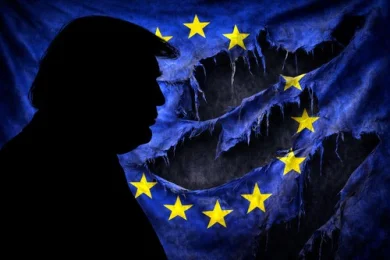
Returning to Rubio's speech at Munich, I said that I agree with him, that the deep foundation of the transatlantic relationship is civilizational and historical and that the conventional ties, such as treaties, institutions, common interests, are important but superficial. The proof: it is very easy to denounce a trade agreement between the USA and the EU, or even to dismantle NATO – it’s amazing how easy it is for Donald Trump to confuse the entire transatlantic institutional machinery, isn’t it? – but nothing can change regarding the factual, historical, civilizational truth that America is an extension of Europe, from language to legal system, from the dominant religion to a certain generally accepted vision of the relationship between man/individual and society (this is called, in political theory, "the doctrine of fundamental human rights"). Not even Donald Trump – or any other Trump even more Trump than Trump – can overturn this truth. Therefore, saying this with his words, taking even a step further when he said that America’s fate is linked to Europe’s fate, projecting the "destinal" connection towards the future, Rubio was right.
And we have reached the topic of defense, here it is. The conference in which Rubio spoke as he did was dedicated to strategic issues. Thus, there was no more appropriate place for the head of American diplomacy in the Trump era to say this: "National security does not raise, above all, technical questions: how much we spend on defense or where and how we deploy defense systems, although these are important questions. But they are not fundamental. The fundamental question we must answer from the very beginning is what exactly we are defending, because armies do not fight for abstractions. Armies fight for people, armies fight for nations. Armies fight for life. And that is what we defend: a great civilization that has every reason to be proud of its history, believing in its future and wanting to always be master of its economic and political destiny."
I urge anyone to say what is wrong with this approach. And I find it essential to know why we are fighting. What exactly, at a certain point, do we defend "even at the cost of life," as a military jurist would say? I naturally exclude from the scope of my question the recent jellyfish that believe their life is the most important thing in the world, that there is nothing for which they would sacrifice it and that all those who do such a thing are somewhat stupid. I know that such invertebrates float among us, products of an education specific to a degraded society, I know that they are as light as snowflakes due to so much selfishness, so I make this clarification so that I do not hear them explaining that nothing in the world deserves the ultimate sacrifice. My question is for serious people, who truly feel that they are responsible for something in this world. For those of us who believe that there are one or two things in the world worth sacrificing for, it is essential to know clearly what these are because otherwise we cannot defend ourselves if a war starts.
Marco Rubio gives the answer. You might say that it’s his answer, his business, I, we, each of us, have our own answers, different ones. But if we formulate them, each of us will see that they are, in fact, the same thing as Rubio's answer. So, for what would we sacrifice our lives? For my children – parents would say. For my parents – children might say. For my brothers and sisters – brothers and sisters would say. For my best friend – my best friend would say. For my faith – a true believer would say. For the ideal of freedom – a beautiful idealist would say. But what are all these, put together: family, friends, faith, our idea of freedom? They are indeed our civilization, our tradition, and our future. "Armies fight for people." Immediately after this statement, the American Secretary of State formulates another: "Armies fight for the nation." For some, the phrases are equivalent. People live gathered in a political body called "nation," which determines their identity and not only. For others, the second phrase is an ideological manipulation of the first. For them, when you say nation, it sounds like nationalism. Strangely, for the same ones, when you say community, it does not sound like communism.
And I would add one more thought: being so important the value for which you fight, which you defend "even at the cost of life," this does not remain a reason detached from the being of the fighter. On the contrary, it becomes an ally, it becomes inspiration, it gives power and mobilizes the resources of resistance and ultimate sacrifice. True fighters, ready to give their lives in this struggle, do not fight for something that remains at home when you go to the front, but for something that goes with you wherever you are in the world. Well, that is your very identity. You do not fight for others, you fight for yourself – this "you" that is revealed only by reflecting in others like this: your nation.
https://www.dilema.ro/tilc-show/armatele-lupta-pentru-natiuni
Latest News
23:13
23:02
22:58
22:25
22:21
See more news
NEWS ON THE SAME TOPICS







.webp)