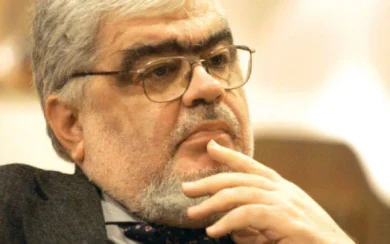
Andrei Pleșu: Notes on Old Age




Always see our news on Google
Moreover, a nice quote from the American psychologist James Hillman: "Being old is an adventure. To get out of bed and to run to the phone, or simply to go down a few steps, involves as many risks as a journey through the Gobi desert, riding a camel. Once, when our legs helped us, we would quickly go down the stairs and be at the door in no time. Now, however, who knows when our knees will betray us, insidiously, and when we will miss a step on the way down. Once, we learned from foxes and hawks; today, our teachers and guides are the slugs, the clumsy frogs, and the sluggish elk in the marshes. The adventure of slowness."
In English and German, old age is not expressed as a reference to late age, but simply as a generic term for "age." The Englishman asks you: "How old are you?" Just like the German: "Wie alt bist du?" In Romanian: "Câți ani ai?" And the answer is something like "I am 2, 3, 15, 40, 70 years old." This means that "old age" begins from the moment you are born! Coming into the world equates to starting a process of aging, with the accompanying sighs... "I am old at five years old" – declares, politely, the child in front of you. An answer full of... metaphysics.
But history also records other types of discrimination. In ancient Rome (and in the Middle Ages), the irritation caused by the political involvement (through influence or vote) of the elderly sparked the slogan: "Sexagenarios da ponte!" (let them be thrown off the bridge). A mentality that spectacularly reappeared in the "revolutionary" Paris of 1968: "Let us not trust those over 30!" Even harsher is the regulation of the Christian Middle Ages regarding monetary compensation for certain crimes: if you killed a person aged 20 to 50, you could redeem your sin by paying 300 gold coins. If the victim was over 65, you could get away with 100.
However, there are also more "noble," more encouraging visions about old age. Alexandru Paleologu spoke with emotion about the beautiful experience of "grandmotherhood" as a privilege of advanced age. He added, humorously, that being old helps you get rid of unpleasant obligations. When you get bored at a gathering, you can withdraw on the grounds of fatigue (senile), of a fabricated excuse. Noica had an even more radical observation: in old age, you escape, for example, from various organic nuisances: erotic pressure, painful appendages (toothaches, for instance: 32 teeth, 32 enemies – you no longer have them, you are saved!) etc. As for the approach of death, Noica also observed in amazement: "People have been dying for millions of years and the world still hasn't gotten used to understanding the situation..." Old age also has the advantage of being able, finally, to savor the respite. The state of "otium" is restful and rewarding.
John Chrysostom, like Cyril of Alexandria, listed the "Christian" sins of old age: grumpiness, procrastination, presumption, immobility. Conversely, Origen is more attentive to virtues: purity of heart, sincerity of soul, the ability to understand. But Cicero was more nuanced (De Senectute): "It is not age that is guilty, but morals." And then, there are old people and old people. Not all wines turn sour with the passage of time... The farmer has no reason to complain that winter has come.
Creativity is not necessarily affected by aging. Titian died of the plague at 86, but he was hyperactive even after 70. Similarly, Picasso (who died at 92), Bach, and others. It is rather sad the premature end of some massive values, whose achievements deserved a more generous fate. It is hard to believe and accept that Raphael died at 37, Eminescu at 39, Novalis at 23, Mozart at 35, Pascal at 39. And perhaps when you fear, humanly, that you might not last too long, it is wiser to think of such destinies and to wonder who you think you are to live longer than they did...
https://www.dilema.ro/situatiunea/notite-despre-batrinete_3199
Latest News
19:09
19:05
19:00
18:48
18:48
See more news
NEWS ON THE SAME TOPICS