Mammoth bones show that people of the Ice Age were organized hunters, not just simple survivors.



Always see our news on Google
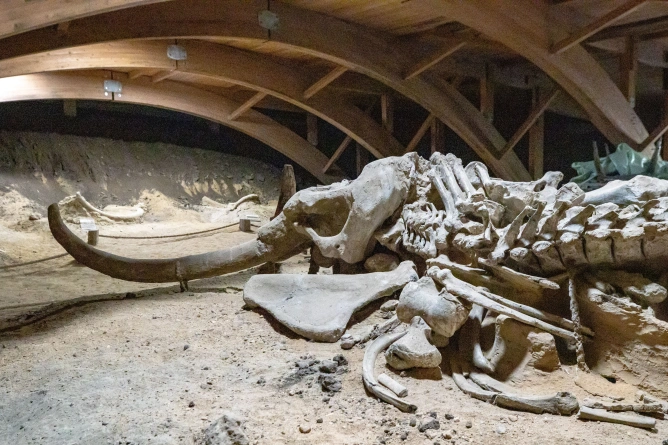
Researchers supported by the European Union are reanalyzing huge accumulations of mammoth bones from Central Europe and finding evidence that people 35,000-25,000 years ago were cooperative hunters, capable of understanding mammoth behavior and environmental changes. The MAMBA project combines excavations, ancient DNA, isotopes, geoarchaeology, and paleoclimatology to explain whether sites like Kraków Spadzista, Dolní Věstonice, and Langmannersdorf are traces of hunting, natural death, or a combination of the two.
The mammoth bones discovered in huge quantities at sites in Poland, the Czech Republic, and Austria change the image of people from the Ice Age. Researchers supported by the European Union through the MAMBA project are finding more and more evidence that the people who lived in Central Europe 35,000-25,000 years ago were not just opportunistic survivors or gatherers of leftovers, but organized hunters, capable of tracking herds, cooperating, and using the mammoth as an essential resource.
In short
The MAMBA project investigates large accumulations of mammoth bones from sites like Kraków Spadzista, Dolní Věstonice, and Langmannersdorf.
Researchers use excavations, ancient DNA, isotopes, geoarchaeology, and paleoclimatology to reconstruct life between 35,000 and 25,000 years ago.
Preliminary results suggest that Ice Age people were cooperative hunters, with an advanced understanding of mammoth behavior and the environment.
The study may also help in understanding the extinction of the mammoth by separating the effects of climate change from the pressure of human hunting.
The large accumulations of mammoth bones in Central Europe have been a mystery for researchers since the 19th century. Some sites contain thousands of bones, and the essential question remains open: are these traces of mass hunting, natural death of the animals, or a combination of the two phenomena?
The MAMBA project, funded by the European Union, seeks to provide an answer using scientific tools that did not exist when these collections began to be studied. Researchers are analyzing sites like Kraków Spadzista in Poland, Dolní Věstonice in the Czech Republic, and Langmannersdorf in Austria, places where mammoth bones preserve information about people, animals, climate, and landscape.
The stakes of the discovery are higher than the history of a vanished species. If these accumulations are traces of coordinated hunting activities, then the Paleolithic people of Central Europe had a more advanced social organization and planning ability than the classic image of groups that merely reacted to extreme conditions. They would have known when herds moved, how animals behaved, and how the environment could be used for hunting.
Jarosław Wilczyński, an archaeologist and associate professor at the Institute of Systematics and Evolution of Animals of the Polish Academy of Sciences, the coordinator of the MAMBA project, says that the research combines fieldwork with laboratory work. "We always bring together fieldwork and laboratory work," he stated in a Horizon article quoted by CORDIS. Researchers are collecting new materials but are also reexamining museum collections with methods that were not available before.
One of the main directions is the analysis of ancient DNA. Extracting DNA from samples that do not come from permafrost is difficult because genetic material degrades over time. The MAMBA team is developing better methods to obtain genetic information from specimens previously considered difficult to use. David Díez del Molino, a researcher affiliated with the Department of Genetics and Bioinformatics at the Swedish Museum of Natural History, says the team hopes to analyze over 400 samples by the end of the project.
This work can open entire museum collections for DNA research. Díez del Molino states that, given the success rate achieved, the project could unlock thousands of historical specimens overlooked for genetic research. For archaeology, this means that materials discovered in the past can produce completely new data when analyzed with modern technology.
Researchers also use the analysis of strontium and oxygen isotopes to track the migration routes and seasonal movements of each mammoth throughout its life. These chemical signatures can show where the animal moved, what type of environment it traversed, and how conditions changed over time. Thus, the bones are not just biological remains but archives of glacial landscapes.
Preliminary results challenge an old idea: that Ice Age people were mostly opportunists, dependent on naturally dead animals or resources found by chance. MAMBA suggests that these populations were skilled, organized, and cooperative hunters. In this scenario, the accumulations of bones become material traces of hunting strategies, not mere natural deposits.
The woolly mammoth was a crucial resource for survival. People could use the meat and fat for food, and ivory and bones for tools, objects, and ornaments. In a cold, harsh, and unstable environment, such a large animal could support entire communities, but hunting it required knowledge, cooperation, and risk.
The mammoth was not only important for humans. Dorothée Drucker, a researcher at the Senckenberg Centre for Human Evolution and Palaeoenvironment at the University of Tübingen, describes the woolly mammoth as a species with a major ecological role. She says it was a large animal that crushed trees and shrubs, modified the environment, and fertilized the soil through its excrement. Its extinction did not just mean the loss of an iconic species but also the change of an ecosystem.
The project also analyzes the causes of the mammoth's extinction. Researchers are trying to separate the effects of climate change from the pressure of human hunting, including through isotopic markers such as nitrogen-15. This question is important because the end of the mammoth occurred in a rapidly changing world, where the climate was changing, ecosystems were modifying, and humans were adapting their survival strategies.
MAMBA shows that Ice Age people were not passive observers of the changes around them. They hunted, tracked, used, and likely influenced mammoth populations, leaving behind a material archive that can be read today through genetics, chemistry, and archaeology. The bones thus become a form of history, not just about extinct animals, but about the practical intelligence of the people who lived in the harshest conditions of prehistoric Europe.
For today's public, the discovery also has a broader dimension. It shows that adaptation to extreme climate changes is not a new problem in human history. Paleolithic communities survived through mobility, cooperation, and knowledge of the environment. Their research does not provide direct recipes for the present, but it helps us understand how people responded in the past to major ecological pressures.
Latest News
18:07
17:55
17:41
17:40
17:30
See more news
NEWS ON THE SAME TOPICS



.webp)






.webp)