Before this discovery, data published at the European level showed that in August, the average ocean surface temperature reached a record 21.1°C (60° south–north latitude range), above the values recorded in 1979, during an El Niño episode. During the same period, Greenland’s Petermann Glacier lost 76 km² of ice (the largest decline of this kind since 2012), signaling intensifying pressures on the marine environment.
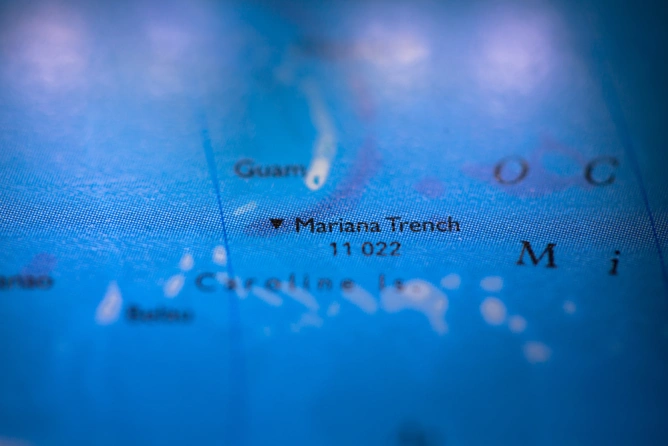
Researchers have discovered an “impossible volcanic eruption” in the Mariana Trench
Riana Gegiu


International
Foto: Shutterstock.com

Always see our news on Google
Researchers have identified the deepest volcanic pyroclastic-flow deposit ever discovered, at approximately 6,000 meters below the surface of the Pacific Ocean, on the walls of Challenger Deep, the deepest point in the Mariana Trench. The discovery, presented on November 23, 2026, in the journal Frontiers in Earth Science, contradicts expectations about volcanic activity at such depths.
The rocks were observed during a 2014 mission using the Jason/Medea remotely operated underwater vehicle. Researchers identified unusual formations in three areas along a sector approximately 100 kilometers long, while the recovered samples contained volcanic glass and textures characteristic of pyroclastic flows, formed by turbulent gases and volcanic materials.
The discovery is surprising because water pressure, equivalent to nearly 592 atmospheres, should prevent explosive eruptions. Scientists suspect that a supercritical fluid may have facilitated the phenomenon, but the mechanism remains unclear. The deposits appear relatively recent because volcanic glass erodes rapidly in the marine environment.
The study also suggests that the crust in the region is spreading through different mechanisms. Researchers are now examining whether the area could represent the beginning of a new subduction zone.
。/summary_long>,
Context: ocean conditions affected by record temperatures and ice loss in Greenland
Sources


Latest News
16:32
Petrișor Peiu compares Nicușor Dan to Vladimir Putin: “He must learn to accept that we live in a democratic state”
16:31
Border police discovered 4,019 counterfeit perfumes in a Bulgarian truck
16:28
The environmental industry brought nearly 48 billion lei to Romania’s economy in 2024, but lost over 15% of its employees
16:26
Mark Rutte calls on allies to present a credible plan to meet NATO’s target of 5% of GDP for defense by 2035
16:26
Igor Grosu to Visit Albania for Talks on European Integration and Attracting Investment
See more news
NEWS ON THE SAME TOPICS



Personalized news feed, AI-powered search, and notifications in a more interactive experience.












.webp)