



[2025 Explained] The Impossible European Army. Strategic autonomy, NATO and the political limits of European defense.



Always see our news on Google
Europe is increasingly talking about security, autonomy, and defense, but carefully avoids the question that connects them all. The Union is building military infrastructure, interoperability, and common capabilities, while political decisions remain national. Somewhere between NATO, strategic autonomy, and institutional silences, a question is taking shape that Europe still does not want to fully articulate.
Prologue: The Ghost of the European Army
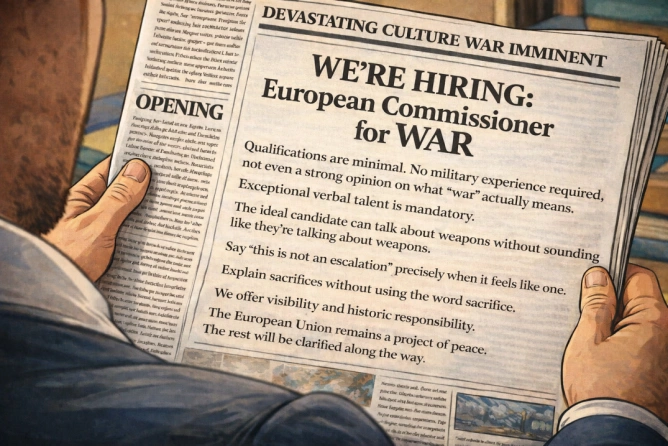
In an austerely furnished and barely heated room in the heart of the European quarter of Brussels, a group of people is discussing in whispers, in the chiaroscuro of a light set to minimum. It is lunchtime, but sunlight will not be accessible for another four days. Everything is on a budget, nothing extravagant, in a programmatic manner. The temperature is set at 18 degrees, the light barely flickering, and lunch consists of Dutch sandwiches and boxed yogurt.
The French representative grimaced discontentedly at the sight of the food, clearly not conforming to any standard that a hexagon resident could imagine. He huffed and told everyone that if they accept Mercosur, we will all end up eating boterham met kaas.
But let’s return to the European occult. Once it was a global occult, but now we are witnessing a narrowing of the occult to the adulators of regulations and the rule of law. In fact, it is not excluded that the economy of heat and light in European institutions is a side effect of the same dubious practices attributed, with ritual suspicion, to "greendealers".
"We need a Pete Hegseth,” is heard from the head of the table.
Due to the diffuse light, it is hard to say who formulated the idea, but it provokes an unexpected agitation among the representatives of the occult who believe in consensus because 2000 years of Europeanism have demonstrated that it exists, but that it is practically impossible to achieve.
"What do we need a talentless TV presenter for, who can make more bar transactions than any of our commissioners?" is murmured in the semi-obscurity of the room. Wopke Hoekstra, the Dutch commissioner for climate, already affected by the remark regarding boterham met kaas, protests.
"I train five times a week and practice fit boxing."
"No. We need a commissioner for war," continues the voice. "It is time to stop having commissioners for equality. Enough with so much equality."
From the back of the room, the sound of a body brushing against the cold floor is heard. It is Belgian Commissioner Hadja Lahbib, holder of the equality portfolio, who, although she has been a journalist for over 20 years, has never thought that it is important to make many bar transactions.
"To obscure our true intentions, through which we try to impose world peace, we need a commissioner for war. Haven't any of you heard that if you want peace, prepare for war?"
The Limits of Europe
Beyond irony, the stake of this text is not to mock European institutions, but to clarify one of their fundamental limits. The average European lives in a space that has known almost two millennia of conflicts and only a few decades of peace, and this peace is not the result of a moral reflex, but of extremely precise power architectures. That is why any discussion about Europe, and especially about a possible European Army, cannot be conducted in the register of conspiracy or desire, but in that of institutions, sovereignty, and political decision. There is an essential difference between what we would like Europe to be and what it can be without transforming into another type of state. The army is the place where this difference becomes unavoidable.
What is the army for a state
In the existential symbolism of a people, the army and religion occupy a special place because they concentrate, more than any other institution, the idea of continuity beyond the individual. Both operate with limit concepts: life, death, sacrifice, community, meaning, and transform them into belonging. The army does this through oath, discipline, and explicit willingness for the ultimate sacrifice in the name of the state. Religion operates through faith, ritual, and the promise of an order that transcends the present time. Unlike administrative or economic institutions, both are transmitted generationally not just through rules, but through narratives, symbols, and ritual practices that link the past to the future. Therefore, in moments of existential crisis, nations instinctively return to these two landmarks. The army and religion give meaning to resistance, justify sacrifice, and affirm the continuity of the community when the everyday order disintegrates.
A national army is not just a defense structure. It is the certificate of existence of the state in moments when law, economy, and diplomacy are no longer sufficient. It represents the state's ability to defend its territory, citizens, and constitutional order when all other instruments of public power cease. The army is not an optional attribute of statehood, but its ultimate condition, the one that transforms sovereignty from a legal principle into political reality.
Even when the army commits excesses in defiance of the oath to the constitution, or when it does not subordinate itself to civil power, institutional and symbolic continuity is so strong that it makes the army one of the few structures that traverse generations without losing legitimacy. It can be criticized, transformed, reformed, but not eradicated from the institutional construction of a state. The legitimate monopoly of force, exercised through the army, clearly delineates who has the right to decide the use of violence in the name of the political community and who does not.
Symbolically, the army concentrates the most sensitive elements of statehood. The flag, the uniform, the insignia, the oath, and military ceremony are not just traditions, but codified expressions of sovereignty. They link the individual to the state in an exceptional relationship, in which personal sacrifice can be demanded in the name of collective continuity. The army is the only institution in the world that can demand this sacrifice. That is why these symbols are carefully regulated and charged with political significance, not left in the realm of the arbitrary or the spectacle.
In this framework, any discussion about the integration or transfer of control over the armed force transcends the technical level of military cooperation. It touches the hard core of the state, where sovereignty, responsibility, and ultimate legitimacy are decided. Therefore, the debate about common armies or supranational structures is not, essentially, about military efficiency, but about who guarantees the political existence of the state when the normal order is suspended.
Why the army cannot be European in the classical sense
For the ordinary citizen, the European Union is an everyday reality, not a legal construct. The treaties that regulate its functioning are, at best, unknown and abstract, and in the most frequent case, simply nonexistent from the horizon of daily concerns. No one cares directly about articles, paragraphs, and competences, except for some officials in Brussels who defend them with almost theological rigor or some national officials burdened politically to find formulas of resistance against European decisions. Otherwise, the EU is perceived as a space of rules, money, and freedom of movement, not as a system of power.
In this context, when people talk about the "European Army," they are not actually talking about what it means to decide the existence of an army. For most, the expression is a vague slogan, a symbol of protection or unity, not a constitutional decision about sovereignty, command, sacrifice, and ultimate responsibility. Having an army does not just mean cooperation or efficiency, but the explicit assumption of the right to decide on the use of force, on life and death, on the ultimate loyalty of citizens in uniform. These are decisions that, in national states, belong to the hard core of political power.
That is why the gap between public discourse and institutional reality is so great. A "European army" is not a natural extension of the single market or common policies, but an existential leap that would transform the Union from a legal and economic framework into a political entity with a monopoly on force.
When ordinary people discuss this subject, they discuss, without knowing it, a change of nature of the Union, not a technical reform. And this misunderstanding explains why the debate is often superficial, emotional, and disconnected from the real implications of a decision that would rewrite the relationship between state, citizen, and power.
For conspiracy theorists who believe that the European occult resides in Berlaymont, it should be said that in the current architecture of the Union, defense is explicitly excluded from the executive competences of the Commission. The treaties establish that common security and defense policy remains in the intergovernmental domain, under the control of member states, not of the supranational institution. More specifically, the European Executive remains deliberately excluded from any decision regarding the use of force, its role being limited to the material conditions of defense.
A potential "Commissioner for Defense" in the classical sense would imply a competence over the monopoly of force, which would directly violate the principle of the sovereignty of states and the letter of the treaties. Moreover, there is also a democratic barrier. The Commission does not have the political legitimacy for life-and-death decisions. Commissioners are not directly elected, and the European Parliament does not hold military-type competences. Assigning defense to a commissioner would create a void of democratic responsibility between political decision and human sacrifice, which is considered unacceptable in most European capitals.
What does the Union do when it cannot have an army
The central question of the moment defined by Russia's invasion of Ukraine and the uncertainties regarding the strategic direction of the United States is not whether Europe wants a common army, but whether it can still afford to function without one. The Union has reached a point where its decisions produce real strategic consequences, yet the security of these decisions continues to be guaranteed by an alliance whose political functioning can no longer be considered automatic. In this context, more and more military and political analysts start from the same uncomfortable premise: it is not excluded that Russia may test NATO's functionality through a limited, calibrated action that puts pressure on the alliance's solidarity mechanisms.
Long before this shock, Europe had already begun to ask itself questions about its own defense capacity. Two years after Russia's annexation of Crimea, nine years ago from the day we find ourselves in, namely in 2016, the European Parliament adopted an initiative regarding the European Union of Defense. Like all parliamentary initiatives, the document had no executive force and did not obligate the Commission or member states, being more of a directional declaration than an action plan. However, the text was significant in its tone, visionary but cautious, formulated at a time when the security environment was visibly degrading, without the existential dimension of the risk having become evident yet.
The Parliament noted the simultaneous accumulation of threats, from terrorism and hybrid risks to the instability of the eastern and southern neighborhood, energy insecurity, and climate impact, and observed the increasingly blurred line between internal and external security. The central message was clearly formulated. Although the legal framework allows cooperation in security and defense matters, the Union constantly avoids the step that would transform this cooperation into a politically assumed decision.
The European executive confirms a year later, in 2017, through Federica Mogherini, Vice President of the Commission and High Representative for Foreign Affairs and Security Policy, that it unequivocally rejects the idea that it would build a supranational military force. Her statement, made in a debate in the European Parliament, was clear. A European army is not being built, even if the term continues to be used for political or propaganda reasons. The initiatives that followed in Parliament remained, to a large extent, confined to the area of discourse and debate, but indicated the existence of constant political pressure for common solutions.
In parallel with this debate, the European Commission acted where the treaties allow. The Union chose to treat defense as an exercise in material, infrastructural, and industrial organization. The Action Plan on Military Mobility, now at version 2.0, is the clearest expression of this approach. The document proposes the creation of a European military mobility zone by 2027, a first step towards what is politically described as a "Military Schengen", in a strictly functional sense.
The measures aim to harmonize cross-border military transport procedures, digitalize authorizations, reduce approval times, and establish an emergency framework that allows prioritization of military movements on civilian infrastructure in crisis situations. At the same time, the plan provides for a scale change in dual-use investments, by integrating military mobility into the TEN-T policy, defining priority corridors, and significantly increasing budgets dedicated in the future multiannual financial framework.
This logic is also found in the area of procurement and interoperability. Through instruments such as EDIRPA and ASAP, the Commission has begun to use the European budget to stimulate common procurement of equipment and ammunition, especially after 2022, without deciding what is purchased or holding its own military capabilities. The condition is cooperation between states and strengthening the European defense industry. Similarly, the European Defense Fund (EDF) finances joint research and development projects, with the explicit aim of reducing fragmentation and increasing the compatibility of military systems. European military compatibility appears as a secondary effect of industrial convergence, not as a result of a common political decision.
The problem with these measures is that they are almost invisible to public opinion. For the ordinary citizen, it is unclear whether Europe is safer, more prepared, or more capable of responding to an attack. No European leader explicitly questions NATO, and none speaks openly about a European Army. Yet, the slow and discreet accumulation of capabilities shows that the Union is trying to build its own military solution without crossing the political line of sovereignty. This discrepancy between what is done and what is said explains why Europe is about its strategic autonomy, and why this formulation inevitably becomes a point of tension for the entire debate.
Sorbonne 2017 and the Europeanization of Gaullism
The idea of Strategic Autonomy was politicized by Emmanuel Macron. Conceptually, strategic autonomy means the capacity of a political actor to decide and act alone when its vital interests require it, without being blocked by external dependencies. It does not imply breaking existing alliances. In the case of the European Union, strategic autonomy is not about isolation or separation from allies, but about the freedom to choose.
The freedom to act with partners when interests coincide and the freedom to act alone when they cannot or will not. It implies real military, industrial, technological, and energy capabilities, without which political decision remains symbolic. Understanding Emmanuel Macron's position on European defense is impossible without placing it in the Gaullist tradition of the French state, a tradition that is not anti-European but is deeply suspicious of delegating military sovereignty.
In the 1950s-1960s, France played a paradoxical role because it initially supported the project of the European Defense Community (proposed in 1950 by French Prime Minister René Pleven in response to the possibility of rearming Germany), but decisively rejected it in 1954, precisely out of fear of losing control over the armed force. Later, under Charles de Gaulle, France refused supranational military integration and left NATO's integrated military structure in 1966, not to exit the alliance, but to maintain total decision-making autonomy over the use of force.
This doctrine was built on the idea that the army is the ultimate expression of the state and that no collective mechanism can substitute for national political responsibility in matters of life and death. Macron inherits this intellectual matrix but projects it into a radically different European context.
His speech at Sorbonne in 2017 represents the moment when the Gaullist tradition is translated to the European level. Macron does not try to build a supranational European army in the classical sense of the term and does not do so out of tactical prudence, but out of doctrinal conviction. He knows that a common army, with supranational political command and collective decision on the use of force, would trigger exactly the same reflexes that led to the failure of the European Defense Community and to France's rupture with NATO's integrated military structure in the 1960s. That is why his language is calculated. He does not talk about the transfer of sovereignty, but about operational autonomy; not about immediate common command, but about Europe's ability to act when allies do not want or cannot. Essentially, Macron explicitly states that the European blockage is not military, but decisional.
The solutions he proposes are deliberately built on a functional logic, not a constitutional one. PESCO is designed as a mechanism of differentiated commitments, allowing advancement without unanimity. The European Defense Fund is designed to create positive dependencies between national industries and to force technological convergence. Intervention initiatives and exchanges between national armies are meant to create, step by step, a common strategic culture, without imposing a unique doctrine through treaties.
Even when he evokes, in the long term, a common force, a common budget, and a common doctrine, Macron does not speak about an immediate institutional leap, but about a horizon conditioned by the political maturation of member states. Sorbonne is not a call for military federalism, but an attempt to reproduce at the European level exactly what Gaullism did at the national level: maximum autonomy of action, without losing final political control.
Looking back, the European Union has taken from Sorbonne only those elements that do not directly touch the core of military sovereignty. Common capabilities, the defense industry, military mobility, interoperability, funding for research, and even common procurements have been relatively quickly integrated into EU policies because they do not require states to relinquish the decision to use force. In contrast, exactly those components that would transform capability into real political power, common decision, permanent force, common defense budget, unified doctrine, have remained blocked.
The reasons are structural and not due to a lack of vision. Eastern states are not willing to relativize NATO's role. Southern states do not share the same perception of the threat. National parliaments do not accept the delegation of the decision of war. EU treaties do not provide a legitimate democratic framework for such a move. Europe has reached exactly where France was in the 1960s, namely accepting the coordination of instruments but refusing to delegate the decision on their use. The Sorbonne speech did not fail, but demonstrated that the limit of European defense is the same historical limit of the European project. The army can be coordinated, but sovereignty over its use is still non-negotiable.
Why Macron has become a scapegoat
All of this also explains the intensity of the disinformation campaigns directed against Emmanuel Macron, which are not a simple political reflex or a personal disavowal. They arise exactly at the point where the discourse on European defense touches a sensitive area of the post-Cold War strategic order. Macron did not explicitly call for the creation of a European Army, but he questioned the structural dependence of Europe on external guarantees and the legitimacy to surpass it. This repositioning, even if prudently formulated under the concept of strategic autonomy, was enough to transform his message into a scapegoat. Disinformation has worked through simplification and caricature.
A complex political construction, based on capacity, decision, and responsibility, has been reduced to easily mobilized emotional slogans. The idea of strategic autonomy has been presented as military federalism, weakening NATO, or preparation for war, precisely because these interpretations activate deep-rooted fears in European societies. In this way, Macron has not been attacked for what he proposed, but for what he could symbolize in a debate that many actors preferred to avoid.
The effects have not been limited to France. The messages have been adapted to national contexts to discourage any political alignment with this vision. In Central and Eastern Europe, autonomy has been equated with abandoning NATO; in the South, with French hegemonic ambition; in the West, with the risk of militarization and loss of democratic control. Thus, Macron has become the symbolic figure through which the idea of strategic autonomy has been preventively delegitimized. In this sense, the disinformation campaign has not interrupted the debate about the European army, but has shown how uncomfortable it has become.
What does Europe look like militarily in reality
We do not have a European Army, but Europe is already deeply militarized, in an uneven and often misunderstood way. Militarization is not limited to budget levels, but results from a cumulative set of factors that include the size and structure of forces, combat capability, the existence of reserves, military doctrine, and the industrial base. Poland is the clearest example of accelerated militarization, with allocations exceeding 4% of GDP for defense, numerous ground forces, extensive reserves, and rapid acquisitions of tanks, artillery, and aviation, but with a predominantly defensive doctrine and a high dependence on the United States for technology and intelligence. The Baltic States and Finland consistently invest above the 2% threshold, have rapid mobilization, and significant reserves relative to their population, but lack force projection capabilities. In contrast, France and the United Kingdom are the only European states that combine the budget, doctrine, and logistics necessary for sustained external operations, from the Sahel to the Indo-Pacific, with autonomous command chains and nuclear deterrence capabilities.
Germany illustrates the difference between potential and reality, having a major defense industry and a growing budget, but facing documented problems of operational availability and political constraints related to the use of force. The difference between perceived militarization and actual militarization is often significant. Poland and Romania are frequently perceived publicly as hyper-militarized states due to budget increases and NATO presence, but cannot sustain autonomous operations in the long term without allied support.
Conversely, France is less vocal in European public discourse but maintains a continuous military presence in Africa and rapid intervention capability. Sweden, before joining NATO, was rarely perceived as a militarized state, even though it had a complete defense industry covering air, naval, and land domains, and a total defense doctrine. These examples show that real militarization is not a matter of rhetoric or isolated spending, but of proven capacity to act, sustain operations, and make autonomous military decisions.
Operational interoperability already exists in Europe, but it has been built outside the framework of the Union, mainly through NATO and stable bilateral or regional cooperations. The clearest examples are the Franco-German brigade, the British-Dutch joint amphibious force, the German-Dutch corps, and the almost complete integration of some Dutch units into German structures.
The Baltic States, Poland, Romania, and Germany constantly operate in NATO battle groups and in Enhanced Forward Presence structures, using common procedures, NATO command chains, and engagement rules tested in practice. In these cases, interoperability is not just doctrinal, but demonstrated through permanent rotations, real missions, and integrated command. The use of the same platforms and systems, such as F-35, Patriot, HIMARS, NATO command and control infrastructure, and STANAG standards, ensure immediate technical compatibility, regardless of the national flag.
The same interoperability is observed in recurring large-scale exercises, such as Defender Europe, Cold Response, Steadfast Defender, or BALTOPS, where the same armies train annually on similar scenarios, with identical procedures and command chains. In practice, NATO remains the real infrastructure of European interoperability, while the Union plays a secondary role, focused on material support, industry, and mobility, not on military command. Regional cooperations often function more efficiently than EU mechanisms precisely because they offer political and military clarity, in terms of defining responsibilities for command and execution without ambiguity.
For this reason, there is already de facto interoperability between numerous European armies, built before any common political decision, which explains the current paradox of Europe, that it has armies capable of fighting together, but still lacks a common political framework to decide when and why to do so.
The decision that cannot be delegated
Building a centralized decision-making apparatus for the use of force would require, above all, resolving the question that the Union stubbornly avoids, that of the legitimate right to send people to war. In the current architecture, this power belongs to the member states and is exercised through governments, often conditioned by national parliamentary votes.
A European model would imply either a decision made in the Council, which would remain in fact an intergovernmental decision, or a delegation to a common executive structure, both options raising serious legitimacy issues. Unanimity would almost certainly block rapid reaction. A majority decision would generate internal political contestation in states obliged to participate against their will, and delegating to an executive would imply a transfer of sovereignty that treaties and national constitutions do not currently allow.
To avoid paralysis, the only realistic model would remain that of coalitions of states willing to participate, with the possibility of withdrawal of others, exactly what is already happening in practice. At this point, the uncomfortable question arises whether such a structure would truly represent a European army or just cooperation between a few national armies under a common label. Any coherent system would require clarifications at the treaty level and, probably, constitutional amendments, as it would shift the decision from the national level to a common one. The most difficult threshold remains, however, the assumption of losses, since in democracies those who decide on war bear the political cost of death, and the Union does not yet have a legitimate mechanism through which a common decision can be assumed as such, not redistributed back to capitals.
For states with small armies or limited resources, the reaction to the idea of a European army would inevitably be ambivalent. A common structure could be perceived as an additional security guarantee, especially by geographically exposed states or those with reduced military capabilities, for whom collective protection is vital. At the same time, the same structure would be seen as a loss of control over one of the few remaining levers of national sovereignty. In the absence of clear decision-making mechanisms, the real risk would be that these states would be called to contribute troops or resources without having a proportional influence over the purpose, timing, or limits of operations.
The current experience in NATO shows that small states accept contributions precisely because the final decision remains national, a balance that is difficult to replicate in a centralized European structure. In a common architecture, small armies would risk being functionally integrated but politically marginalized, absorbed by the priorities of the major European military powers. Guarantees against such a scenario would need to be explicit and credible, in the form of the right to withdraw without political sanctions, real participation in planning, rotation in command functions, and protection of the role of national parliaments.
Without these guarantees, solidarity would quickly become asymmetric. Small army states would want to retain the right to refuse missions without being penalized and to preserve their national armies as instruments of territorial defense, not as mere personnel reserves. In the absence of these conditions, a common structure would be perceived not as a security multiplier, but as a mechanism for diluting influence and national military identity, which explains the constant caution towards any European army project.
NATO, the limit scenarios, and the limits of European security
To close the debate, we must also refer to the relationship with NATO, but also to the scenarios in which this relationship no longer functions as intended. A potential European army would not do anything fundamentally different militarily, but would generate new political problems. In the absence of a European political alternative, NATO remains the only framework with clear decision-making and credible deterrence. Under normal conditions, in the event of a conflict of priorities, European states would almost inevitably choose NATO, as that is where credible deterrence lies. The decision to act under a European or allied flag would remain a political one, made by capitals, not by Brussels, and an independent European decision would be accepted by the United States only to the extent that it does not undermine the alliance.
However, the problem arises in scenarios that the current architecture treats insufficiently. If the United States were to withdraw from NATO or suspend its political commitment under Article 5, the alliance would continue to exist formally, but would lose its core of deterrence. In a similarly destabilizing scenario, in which a EU and NATO member state were attacked, and Article 5 were not activated due to lack of consensus or political calculation, Europe would face an immediate strategic void. In both cases, the Union would have fragmented military capabilities, technically interoperable, but without a common political decision-making framework, without a legitimate command chain, and without a clear risk assumption mechanism. It is precisely these scenarios that explain why operational autonomy is no longer sufficient and why the debate inevitably shifts towards political legitimacy.
This is the real limit of the European security project. Europe can become more autonomous in terms of capabilities, mobility, and industry, but it cannot substitute a security alliance as long as it does not assume the ultimate political decision and the responsibility that derives from it. That is why the final question is not whether Europe wants a common army, but whether it is ready to build the necessary democratic, political, and strategic legitimacy to act at a moment when external guarantees are no longer automatic. Without this legitimacy, any common force remains an incomplete construction, and any autonomy remains conditional.
And the proof that the situation is at a major inflection point and that all parties know this fact is the end-of-year statement made by NATO chief, former Dutch Prime Minister Mark Rutte, who explicitly rejects the idea of a military detachment of Europe from the United States. Rutte insists that Washington remains "fully committed" to NATO, while emphasizing at the same time that Europe must take on more responsibility for its own security, including by increasing defense spending, but within the transatlantic framework, not outside of it. His message draws the current limit of the European project. Autonomy is acceptable as an effort, increased capacity, and responsibility, but not as a political or military rupture. Europe is encouraged to become stronger, but not to become independent in terms of ultimate decision-making. And this distinction, between assumption and separation, is precisely the space in which a European Army remains impossible, and strategic autonomy remains conditional.

Latest News
13:00
12:58
12:55
12:44
12:43
See more news










.webp)


