The European Parliament changes the rules of the game in the field of defense. Money, deadlines, and accelerated procedures for European investments.



Always see our news on Google
The European Parliament has adopted a legislative package that fundamentally changes the way the European Union finances defense. Through accelerated deadlines, simplified procedures, and the redirection of existing funds, the EU treats defense as an industrial and economic policy, not just a military domain. The decision opens a limited window for member states capable of reacting quickly.
Strasbourg – The European Parliament adopted on Tuesday a set of legislative measures that fundamentally redesign the way the European Union supports investments in defense. The decision does not introduce a new military budget but modifies the rules of some key EU programs to allow for the rapid redirection of existing funds towards defense and security projects, within the framework of the ReArm Europe plan.
In short The European Parliament has adopted a legislative package that allows for faster and more flexible use of existing EU funds for defense and security projects.
Defense is explicitly integrated into the EU's industrial policy, including through the creation of a new strategic domain for defense and security technologies.
Procedures are accelerated: authorizations for defense projects have a standard deadline of 50 working days, with a tacit approval mechanism.
SMEs and start-ups can more easily access the European Defense Fund, and testing projects in Ukraine becomes possible.
The measures are complementary to NATO and do not create a separate European military budget.
The new rules target major programs such as the Strategic Technologies for Europe Platform (STEP), Horizon Europe, the European Defense Fund, Digital Europe, and the Connecting Europe Facility. Following negotiations with the Council, the Parliament expanded the scope of measures to include resilience against hybrid attacks and foreign interference and secured additional support for Ukraine's defense industry, including its participation in the European Defense Fund.
For the first time, speed becomes a central criterion. Authorizations for defense projects will have a standard deadline of 50 working days. If national authorities do not make a decision within this timeframe, projects can proceed through the tacit approval mechanism. The measure shifts responsibility from the area of administrative delays to the area of action and sends a clear signal to the industry and European investors.
Procurement procedures are simplified, intra-European transfers of defense products and technologies are accelerated, and direct purchases become acceptable in emergency situations. The Parliament explicitly recognizes that replenishing stocks, increasing production capacities, and industrial cooperation can no longer be blocked by bureaucracy in a deteriorating security context.
A central element of the package is the opening of the European Defense Fund to SMEs and start-ups, with reduced documentation and simplified procedures. At the same time, the legislation allows for testing projects funded by European funds in Ukraine, providing the European industry access to technological validation in real conflict conditions, with significantly accelerated cycles of learning and adaptation.
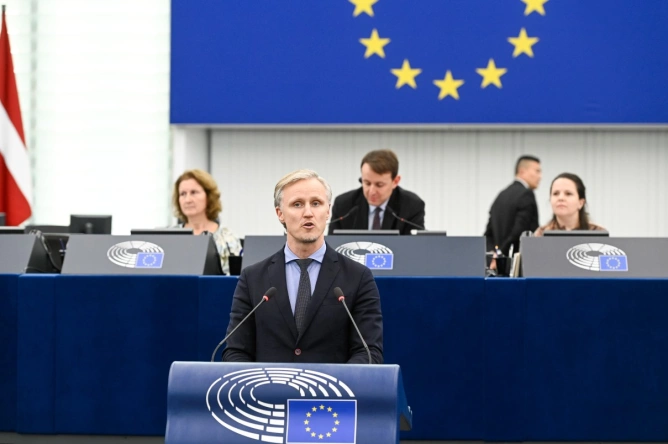
The Parliament's rapporteur, MEP Rihards Kols, emphasized that the change is one of substance, not rhetoric. "The EU is finally adapting its tools to today's security reality. We are not talking about new budgets, but about smarter and more strategic use of existing programs. The tools are now on the table, delivery must follow," he stated.
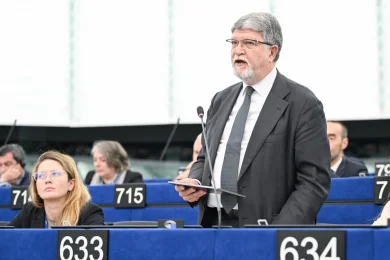
Romanian MEP Vasile Dincu insisted on the economic and industrial dimension of the decision. "The European Union explicitly assumes preparation for major security risks. Up to 800 billion euros in the next four years does not represent just a military effort. It represents a continental-scale economic and industrial policy," Dincu stated, emphasizing that defense becomes an integral part of the single market and European competitiveness.
For Romania, the stakes are strategic. "It is not just about security, it is about positioning. Those who react quickly attract investments, those who delay lose production chains," Dincu warned. He indicated immediate priorities include creating a single point of contact for defense projects, complete digitalization of approvals, aligning national legislation with new European deadlines, and actively supporting Romanian SMEs capable of participating in common European projects.
The report voted by the European Parliament is part of a broader effort to adapt European policies to a radically changed security context, marked by Russia's war against Ukraine, the intensification of hybrid threats, and pressure on the defense industrial capacities of member states.
The Commission's proposal does not create new financial instruments and does not increase the EU budget, but modifies the operating rules of some existing programs to allow for the financing of dual-use projects, civilian and military, in areas such as research, transport and energy infrastructure, digital technologies, and critical infrastructure protection.
A key element of the report is the explicit inclusion of defense and security technologies in European industrial policy, through the creation of a new strategic domain within the STEP platform. The objective is to strengthen the EU's defense industrial and technological base, reduce external dependencies, and stimulate cross-border cooperation.
The report emphasizes that the measures do not replace NATO's role and do not impose obligations on member states. The initiatives are complementary to the North Atlantic Alliance and are based on voluntary decisions, including regarding the use of existing national or European funds, in a logic where security is treated as the foundation of the functioning of the internal market and European economic resilience.
The text was adopted by the Parliament with a large majority and must now be formally approved by the Council, before publication in the Official Journal of the EU and entry into force.
Latest News
21:18
21:00
20:43
20:09
19:53
See more news
NEWS ON THE SAME TOPICS
.webp)