[2025 Explained] The mystery of Putin's ghost fleet. How the EU is trying to legally stop the fleet that no one can find.



Always see our news on Google
The phantom fleet of Russia is not a fleet, it is not phantom, and paradoxically, it is perfectly real. It is a network of ships that exist at sea but disappear in documents, in statistics, and in jurisdictions. The European Union is trying to stop it using written rules for a more orderly world, on a sea that has always been a gray area. This is not a story about ships, but about the limits of sanctions, of law, and of power in a global economy that has learned to hide in plain sight.
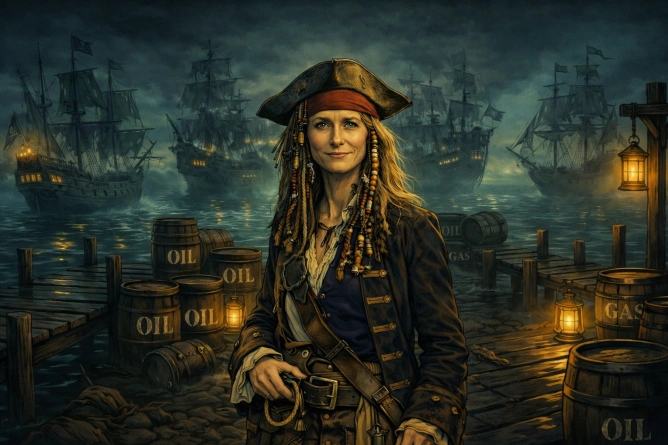
In the famous words of the most well-known pirate of pop culture in the last century, Captain Jack Sparrow, "the problem is not the problem, the problem is your attitude towards that problem." Much has been written about Moscow's phantom fleet, much ink has flowed on laptop screens, and official documents have piled up in stacks upon stacks. What we know is that numerous vessels, about which no one knows exactly how many there are, traverse the oceans of the world avoiding sanctions and fueling Russia's war economy.
We do not intend to treat this subject in an anecdotal or humorous key. On the contrary, the purpose of this article is to explain, rigorously and down to the last comma, what the so-called phantom fleet really means, how it operates, and why it constantly reappears in the communications of European institutions. It is not a media obsession, but a structural problem that mixes sanctions, security, environment, and international law.
It is not coincidental that Kaja Kallas, in her capacity as High Representative of the European Union for Foreign Affairs and Security Policy and Vice-President of the European Commission, frequently returns to this subject in public statements. A former Prime Minister of Estonia, a state on the eastern flank of the Union and directly exposed to the risks in the Baltic Sea region, Kallas speaks about the phantom fleet not only as a European diplomat but also from the perspective of a leader who has managed for years the concrete consequences of Russia's opaque behavior in proximity to the EU.
The impossible immensity of the world's oceans in which we live
Despite technological advances, the world's oceans remain largely opaque. Even by combining satellites, automatic identification systems (AIS), oceanographic sensors, and underwater infrastructure, only a small part of the ocean's surface is monitored frequently or almost in real-time. The areas that are densely and continuously monitored are mainly coastal and major trade routes. In the rest, monitoring is fragmented or non-existent, especially in international waters and in regions far from the main transport corridors. Where surveillance is limited, the greatest vulnerabilities arise. Ships that disappear from systems, illegal activities that are hard to prove, sabotage, or shipments that slip out of the control of authorities.
This is not about a lack of political will, but about structural limits of technology, costs, and the existing legal framework.
In this obscure space, there are ships that transport millions of barrels of oil daily, but which, from a legal and operational standpoint, seem to belong to no one. They have names, but they change them frequently. They fly flags, but the respective states do not seem to effectively respond for them. They appear on commercial maps but disappear from monitoring systems. They are perfectly real ships that operate in a zone where responsibility becomes unclear, and the rules seem negotiable.
This contradiction is the starting point of the discussion about what, in the last two years, has come to be called the "phantom fleet." The term appears increasingly in the communications of the European Union, in the statements of Western governments, and in analyses dedicated to sanctions against Russia. The Council of the European Union (referred to as the Council hereafter) speaks about ships that contribute to Russia's energy revenues, while the European Commission describes them as old and underinsured vessels, with risks to safety and the environment.
From here arises the central paradox. The European Union is trying to sanction something that exists in practice but does not exist as a unified legal entity. This ambiguity has become the key to the entire problem.
How phantom is the "phantom fleet" actually?
Contrary to popular perception, the "phantom fleet" is not a fleet in the classical sense. There is no command, no parent company, or centralized structure to coordinate it. According to a briefing from the European Parliamentary Research Service (EPRS), the term is used as a convenient label for a heterogeneous set of ships involved in sanction evasion practices, without them forming a unified legal category. EPRS explicitly emphasizes that definitions differ depending on the institution, purpose, and context, and this lack of uniformity is structural, not accidental.
In the EPRS analysis from 2024, the difference between concepts often used interchangeably in the public space is explained. "Shadow fleet" is the preferred term in political and media discourse because it suggests intent and concealment. "Dark fleet" emphasizes observable behaviors, such as stopping the AIS system or ship-to-ship transfers in poorly monitored areas. "Grey fleet" describes ships with high-risk profiles, old, poorly insured, and with opaque ownership structures, but which are not necessarily illegal or formally sanctioned. The distinction is essential because it shows that not every suspicious ship is automatically part of a sanctionable network.
The confusion deepens when the "Russian phantom fleet" is mixed with the global phenomenon of shadow shipping. Publications like The Guardian or Reuters sometimes use the term in a broad sense, including ships associated with Russia, Iran, and Venezuela in a single category. In contrast, specialized reports such as those from the Kyiv School of Economics (KSE Institute) or the Centre for Research on Energy and Clean Air (CREA) strictly delineate the ships involved in Russian oil exports, precisely to assess the effectiveness of European sanctions and the price cap mechanism. This difference in approach explains why some estimates speak of a few hundred ships, while others mention over a thousand. In reality, they are not counting the same thing.
Therefore, the "phantom fleet" is not a fixed list but an operational concept, used differently by the press, analysts, and institutions. This flexibility gives it strength as a political tool, but it weakens legal precision.
Why do we desperately cling to a definition?
In law, definitions are not an academic exercise but a condition for action. As legal experts analyzing recent cases on the EJILTalk platform and in studies published by the Lieber Institute for Law and Warfare explain, what is not clearly defined cannot be sanctioned without major risks of contestation. A listing based on vague criteria risks being annulled in court, and a boarding action carried out without a solid jurisdiction can quickly escalate into a diplomatic incident or a costly international litigation.
This legal vulnerability is implicitly recognized even by European institutions. In Q&A documents regarding sanction packages, the European Commission does not define the "phantom fleet" as a closed legal category but describes it through functional characteristics, such as old ships, opaque ownership structures, and evasive practices, including stopping the AIS or ship-to-ship transfers. The result is an operational definition, useful for communication and guiding national authorities, but fragile when tested in court or in the context of maritime law.
The fact that the term is accepted without being rigidly codified is not coincidental. Contrary to the idea that "shadow fleet" was invented by the press, the expression appears first in compliance documents, not in political communications. In October 2023, the Price Cap Coalition, a group formed by the G7, the European Union, Australia, and other partners, uses the phrase "sometimes referred to as the 'shadow fleet'" in a document addressed to the maritime industry, insurance sector, and service providers. The document describes sanction evasion practices but deliberately avoids creating a formal legal category. The goal is not automatic sanctioning but signaling risk and requesting increased diligence.
An important qualitative step occurs in December 2023 when the International Maritime Organization (IMO) explicitly uses, for the first time in a non-Western global framework, the terms "dark fleet" and "shadow fleet" in the context of maritime safety and environmental risks. The IMO warns that these ships undermine international rules and increase the risk of serious accidents by avoiding controls and operating outside standard monitoring circuits.
Subsequently, the term firmly enters European institutional language. The Council of the European Union uses it in sanction communications, and the European Parliament integrates it into resolutions and debates, including regarding risks to critical infrastructure and the environment. However, the "phantom fleet" remains a politically accepted term, not a rigid legal definition anchored in a precise regulatory act.
Ambiguity also has a political function. As analysts from the Digital Forensic Research Lab (DFRLab), part of the Atlantic Council, observe, the term is broad enough to tie together money, security, and the environment into a single narrative. It allows institutions to simultaneously speak about war financing, risks to critical infrastructure, and ecological dangers without delving into technical details that are hard to explain to the general public. It is an effective communication tool, but one that complicates the rigorous application of rules.
How do you sanction something you do not really know what it is?
The problem is that the European Union must act quickly, under political and media pressure, but it cannot afford to violate its own legal standards without consequences. Definition matters because it establishes the line between legitimate sanction and contestable abuse, between prevention and escalation. How do you effectively stop a fleet that you cannot define uniformly, without losing in court, without destabilizing the market, and without escalating at sea? The complexity of the question arises from the fact that it intertwines economy, security, and law, each with its own limits and risks.
In practice, the European Union tries to respond with a mix of tools that include sanctions on ships and facilitators, port access bans, restrictions on maritime services, and coordinated diplomatic pressure with G7 partners. The measures are designed to increase costs and risks for opaque operators without removing Russian oil from the global market. Each step is, however, constrained by structural realities. Maritime law limits intervention at sea, the application of sanctions remains fragmented at the national level, and overly aggressive measures can generate security or ecological incidents with politically hard-to-control effects.
Money, money, money
Beyond the legal dimension, the "phantom fleet" is a concrete economic problem. It affects how energy markets operate, logistics costs, insurance premiums, and ultimately, price stability. As shown by the monthly reports of the International Energy Agency (IEA), Russian oil exports remain a structural factor in the global market, and how they are transported matters almost as much as the volume or price.
European institutions have explicitly recognized this economic dimension. In communications about the price cap mechanism, the European Commission has emphasized that the goal is not the complete blocking of Russian oil but the reduction of Moscow's revenues without causing a shock to the global market. In this context, the phantom fleet becomes the infrastructure that allows the maintenance of flows outside Western circuits and, implicitly, diminishes the effectiveness of sanctions.
After the European Union's embargo on maritime imports of Russian oil, the sea has become the main strategic route for maintaining exports. According to reports and analyses published by Reuters, Russia has compensated for the loss of the European market by redirecting volumes to India, China, and other third countries, especially by sea. Pipelines offer little geopolitical flexibility, while ships can quickly change destination, route, and intermediaries. This adaptability has transformed shipping into the backbone of Russian economic resilience after 2022.
The price cap mechanism was designed precisely for this context. Access to essential Western services, such as transport, insurance, and financing, is conditioned on compliance with the cap. As long as oil flows through Western infrastructure, the cap should, theoretically, be applicable. In practice, however, the phantom fleet fractures this design. Ships operating outside Western infrastructure can transport oil at prices above the cap, assuming higher logistical costs, longer routes, and increased legal risks. As Reuters notes in several materials about the adaptation of Russian trade, these costs are considered acceptable compared to the complete loss of the market. The sea thus becomes the space where sanctions are tested daily.
This reality also explains the persistent confusion regarding figures. Some reports indicate significant declines in Russian revenues, while others speak of rapid adaptation and partial recovery. The IEA publishes monthly data on Russia's oil exports and estimated revenues but constantly emphasizes that these values are estimates built on average prices and reported volumes. They capture trends, not accounting certainties.
In parallel, independent organizations use different methodologies to understand what is happening beneath the surface. CREA combines trade data, spot prices, and route information to estimate what portion of maritime exports is transported by ships associated with the phantom fleet. During certain periods, CREA has concluded that the majority of Russian maritime exports were carried out with the help of these ships, suggesting a substantial undermining of the price cap mechanism.
The differences between these figures do not necessarily indicate errors or manipulations but opacity. Some data are public, some are commercial and accessible only through specialized tools, and some are impossible to verify in real-time. The economy of the phantom fleet operates precisely by moving transactions into a zone where transparency is limited, and the figures become more like ranges of probability than precise values.
Who wins and who loses, depending on the efficiency of the blockade
As long as the phantom fleet operates, Russia gains time and revenues, even if at higher costs than before sanctions. Analyses and reports published in several investigations show that exports continue through intermediaries, longer routes, and alternative services, and the losses are absorbed as the price of market access. In this ecosystem, opacity becomes an economic resource, as it reduces the authorities' ability to link a shipment to an actor, a jurisdiction, and clear responsibility.
Intermediaries win disproportionately. Traders, brokers, shipping operators, and alternative insurance providers can obtain significant profits from price differentials, from the lack of "clean" competition, and from the risks that others are not willing to take. It has been repeatedly documented how this gray area creates niche winners, even under an increasingly extensive sanctions regime, as part of the economy moves where verification is expensive, incomplete, or simply impossible.
If the blockade were to become more efficient, costs would be redistributed. The shipping industry would lose some short-term profits but would reduce legal and reputational risks. The European Union would gain in the efficiency of sanctions, but it would have to manage the risk of price tensions and the impact on industry and consumers. As analysts from Bruegel note, energy sanctions rarely produce only losses; they redistribute gains and costs unevenly, both between states and between sectors. This redistribution explains why sanctions are contested not only geopolitically but also economically, including within the European Union.
The European Union is not a uniform bloc in energy terms. Data published by Eurostat show significant differences between states regarding dependence on imports, the structure of refining capacities, and sensitivity to international prices. In this context, any logistical disruption or increase in transport costs affects member states unevenly. This economic reality inevitably reflects in political positions. As the Financial Times reported, some governments are more cautious in supporting measures that could strain the market precisely because the internal impact on industry, inflation, or consumers would be more severe. Economic vulnerability thus becomes a key factor in the pace and intensity of the European response, even when there is a political consensus in principle.
Markets do not react only to official communications or spectacular headlines but to the perception of risk. Sanctions that remove ships from the "clean" circuit reduce available capacity and increase the perceived risks for operators, leading to higher transport rates and higher insurance premiums. The mechanism is relatively simple. Fewer compliant ships mean reduced capacity, higher risk, and, implicitly, higher costs. These costs are gradually passed along the chain, to traders, refiners, and ultimately, to consumers. Even in the absence of front-page news, the phantom fleet acts as an invisible market factor, constantly present, fueling volatility and uncertainty.
All these economic effects inevitably lead to a fundamental question. How large is the phantom fleet, really? Why do some estimates speak of a few hundred ships, while others mention over a thousand?
How can a ship disappear?
At first glance, the disappearance of a ship from public maps seems like a simple technical trick. In reality, it is the result of a well-documented set of practices systematically used to reduce the visibility of shipments. According to the briefing prepared by EPRS, the most common tactics include stopping or manipulating the AIS, ship-to-ship transfers carried out without complete reporting, and fragmented routes designed to mask the true origin of the cargo.
These tactics are not recent inventions nor exclusively Russian. They have existed for years in global maritime trade, including in legitimate contexts. What changes after 2022 is the frequency and combination of them. In the compliance documents of the Price Cap Coalition, these practices are explicitly listed under the label "deceptive shipping practices." They are not considered evidence of illegality in themselves but are treated as risk signals that justify further investigations and increased diligence from service providers. Invisibility does not come from a single spectacular maneuver but from the overlap of seemingly mundane behaviors that, when put together, make tracking and legally demonstrating the oil's path difficult.
Official documentation also warns about a common trap, hasty interpretation. According to the IMO, there are perfectly legitimate situations in which the AIS can be temporarily stopped or malfunctioning. The reasons can stem from the ship's security, technical failures, or signal congestion in certain maritime areas. For this reason, the IMO emphasizes that stopped AIS is an indicator, not automatic proof of illegal activity.
It is precisely this ambiguity that is exploited by those managing the phantom fleet. As EPRS shows, practices that are legal when taken individually become problematic when they appear repeatedly and in combination. AIS is recurrently stopped, followed by hard-to-document ship-to-ship transfers, and everything is complemented by opaque commercial documents or frequent changes of route. At this point begins the real "detective work." One is no longer looking for a singular deviation but for recurring patterns that indicate the intent to avoid control. This is the essence of the maritime "gray zone." Law and international rules do not prohibit each individual element, but they were also not designed for a context in which these elements are orchestrated to undermine economic sanctions. For authorities and for the European Union, the challenge is not to demonstrate that a ship stopped its AIS once, but to show that it does so as part of a mechanism. And this difference makes the transition from suspicion to legal proof extremely difficult.
When the ship disappears on land
The disappearance of a ship does not only occur at sea. A significant part of the invisibility is built on land, through deliberate corporate architectures. Investigations published by Reuters and analyses conducted by the KSE Institute describe a recurring pattern, companies created to own a single ship, managers appearing simultaneously on dozens of different ships, rapid changes of flag and name, sometimes at intervals of a few months. Each layer, taken separately, is legal. Together, they break the link between the ship and the real beneficiary.
In European Union documents, this practice is described as opaque ownership and is treated as a functional criterion for identifying high-risk ships. The idea is not that SPV firms or flag changes are illegal in themselves, but that they are systematically used to complicate the attribution of responsibility. When a problem arises, from a sanctions violation to an accident, the chain fragments. The owner may be a firm without assets, the manager is in another jurisdiction, and the final beneficiary remains inaccessible. For authorities, this means lost time, litigation, and often the impossibility of holding someone accountable.
This fragmentation explains why sanctions are gradually shifting from ships to facilitators. The European Union is trying to close the chain not because each link would be illegal, but because, as a whole, they create a mechanism designed to avoid responsibility.
Another critical point in this chain is insurance. International reports show that many ships associated with the phantom fleet operate outside Western P&I clubs or with insufficient coverage for major risks. In maritime practice, the International Group of P&I Clubs functions as a true passport. Without recognized coverage, access to ports, terminals, and essential services becomes difficult or impossible.
Investigative press has documented cases of false insurances or policies issued by small entities with limited compensation capacity. If an old and underinsured ship causes a major spill, it is unclear who pays the costs. In the absence of solid coverage, the burden can quickly shift to coastal states and taxpayers.
That is why the European Union and the Baltic states increasingly insist on verifying insurance, not just as a compliance tool but as a preventive measure. At this point, the phantom fleet ceases to be just a sanctions problem and becomes one of safety and environment.
What can the EU realistically do?
In the European Union, sanctions do not come from a single office and are not the result of a simple administrative decision. They are the product of a political and legal mechanism at multiple levels, deliberately built to maintain member states' control over foreign policy. The Council is the institution that formally adopts restrictive measures, usually in the form of successive packages. In the case of the phantom fleet, these packages translate into amendments to the annexes of existing regulations, where the targeted ships are explicitly listed.
The official communications of the Council are clear. Every time ships are added to the list, the Council specifies that they automatically become subject to the ban on access to EU ports and the ban on benefiting from a wide range of maritime services. The political decision is made at the European level, by the unanimity of member states, and the legal effect is immediate and uniform across all 27 states. This is the moment when the blacklist takes shape.
The role of the European Commission (the Commission) is different and often misunderstood. The Commission does not list ships and does not decide who enters or exits the list. Instead, it plays an essential role in the daily functioning of the regime. The Commission publishes Q&A documents, interpretative guidelines, and technical clarifications that explain what the bans decided by the Council mean in practice. These materials are used by national authorities, ports, banks, insurers, and shipping companies to understand how the rules should be applied.
In all its materials on sanctions, the Commission repeats the same key message. The enforcement and penalization of violations are the responsibility of member states. National authorities investigate, verify, sanction, and, if necessary, send cases to court. The Commission positions itself as a guardian of coherence, monitoring implementation and intervening when divergent interpretations or evident gaps arise. This arrangement explains why the European regime is often perceived as slow or fragmented. Not because there is no political will, but because enforcement is decentralized, and each member state remains an essential link in the enforcement chain.
For the phantom fleet, the consequence is direct. The decision is European, but the daily confrontation with ships takes place at the national level, in ports, at borders, and in courts.
And then, what does a sanction look like and how effective is it?
For the general public, a sanction on a ship seems like a simple gesture, reduced to the idea that the ship no longer enters ports. In reality, this is just the visible aspect. In the official communications of the Council regarding recent listings of ships associated with the phantom fleet, it is explicitly stated that the sanction has two distinct components. The first is the ban on access to ports, and the second is the ban on benefiting from a wide range of maritime services. Often, the second component is harsher than the first.
The ban on services targets exactly what makes a ship operational. It affects commercial operation, chartering, brokerage services, technical assistance, and, in certain cases, management or supply services. Without these services, an oil tanker is no longer an economic asset but becomes a floating problem. At this point, the sanction does not just hit the ship but the entire ecosystem that keeps it operational, from brokers and managers to service providers and cargo buyers. This is where the EU tries to fracture the mechanism of the phantom fleet, which relies on a network of facilitators, not on a centralized structure.
This logic also appears in the explanatory documents of the Commission, which emphasize that maritime sanctions are designed to have a gradual suffocating effect, not a sudden stop. The ship may remain at sea for a while, but without access to essential services, it becomes increasingly difficult to use commercially.
The enforcement of sanctions remains, in practice, national. Port authorities, customs, police, maritime agencies, and, in certain cases, prosecutors check ships, documents, and services provided. This decentralization has led over time to significant differences between states. To reduce these discrepancies, the EU adopted Directive (EU) 2024/1226, which introduces a common framework of offenses and minimum penalties for violations of European sanctions. The goal is to avoid situations where the same act is treated as a serious crime in one state and as a minor administrative offense in another. The accompanying documents of the directive show that, without a more unified penal basis, enforcement remains inevitably a mosaic.
Concretely, this means that a listed ship can be rejected in one port, investigated in another, and legally contested in a third state. Every link matters, and the consistency of enforcement becomes as important as the initial political decision.
In theory, listing a ship should be the end of the problem. In practice, it is often the beginning of a war of attrition. Enforcement is fragmented, administrative capacities are uneven, economic interests are divergent, and over all this looms a fundamental legal problem, the idea of sufficient evidence. A member state may be convinced that a ship is part of the evasion ecosystem, but if the case does not withstand judicial scrutiny, the effect of the sanction can evaporate quickly.
Legal analyses regarding the EU's sanction regimes constantly emphasize that listings are subject to the control of European courts, and the Council must be able to justify measures based on clear and proportional criteria. This is the point where politics meets law. The more the EU wants to act more quickly and aggressively, the greater the legal risk, and this can produce challenges, suspensions, delistings, or precedents that weaken the entire regime.
Sanctions are necessary to increase the costs of evasion, but they operate in a narrow legal space where every misstep can be exploited. Hence the frequent impression in the public space that the EU moves slowly. It is not just a problem of political will but of balancing efficiency and legality in a domain where the rules were not designed for an economic war fought at sea with an invisible fleet.
In reflection, the US and UK appear faster and more efficient
Viewed from the outside, the United States seems to move faster and more decisively. The explanation is structural. The enforcement of sanctions is centralized through the Office of Foreign Assets Control (OFAC), which publishes guidelines, makes designations, applies penalties, and communicates within a unified framework. When OFAC speaks, the market reacts quickly because the risk of secondary penalties and exclusion from the US financial system is real and immediate. The economic press has repeatedly emphasized that this signaling effect is one of Washington's strongest tools.
The United Kingdom also seems faster than the EU, but for a different reason. After Brexit, London operates as a unitary state, without needing the unanimity of 27 governments. Through its national mechanisms, the UK can adopt sanctions, list ships and entities, and adjust the enforcement framework at a faster pace. This procedural advantage has also been noted by many analysts, who have compared the speed of British decisions with the inherent slowness of the European process. It is not necessarily a greater political will but a smaller number of decision-making links.
The European Union operates on the basis of unanimity in the Council. This rule ensures political legitimacy but slows down the reaction and produces compromises. The difference in speed is real and visible. However, the image of total fragmentation is misleading. Coordination exists and is constant. Through the Price Cap Coalition, the United States, the EU, the UK, and allied partners publish common documents, align risk definitions, and maintain a common framework of best practices. Even though enforcement remains different between jurisdictions, the strategic direction is coordinated and aims to reduce Russia's revenues without destabilizing the global market.
The problem arises when classic tools, such as lists, port bans, service bans, and penalties for violations, do not seem sufficient. When ships continue to operate outside Western circuits, when incidents in the Baltic Sea recur, when ecological risk increases, and public pressure demands action, the temptation is to move from sanctions to measures that show force. At that point, the question becomes inevitable. Where does sanctioning stop and where does force begin?
It is not just about money; it is about security above all
The Baltic Sea has become, in recent years, the place where this dilemma is most clearly seen. A series of incidents involving underwater infrastructure, telecommunications cables, and energy pipelines have shifted the discussion about the phantom fleet from the relatively abstract area of sanctions to the much more sensitive one of security. According to recent reports, national authorities have confirmed in some cases technical causes, such as damage caused by anchors, but have avoided publicly attributing intent. The difference is essential. The physical cause can be established through expertise; intent is much harder to prove legally.
Official attribution usually belongs to national investigative authorities, not political institutions. In several investigations in the Baltic region, as Reuters shows, decisive evidence is missing or incomplete. Access to the ship or crew is limited, jurisdictions are different and overlapping, and AIS data are inconclusive or impossible to definitively correlate with the moment of the incident. The result is a space of ambiguity in which political suspicion coexists with legal prudence.
This ambiguity fuels the term hybrid threat. There is no clear evidence of sabotage in every case, but neither is there the comfortable certainty that it is just isolated accidents. In a heavily trafficked maritime space, where old, poorly insured ships with opaque ownership transit sensitive areas, the difference between accident and deliberate action becomes hard to trace.
In the face of this situation, institutional roles separate. NATO has responded through its classic tools, presence, surveillance, and deterrence. Enhanced monitoring initiatives in the Baltic Sea aim to reduce the risk of incidents and increase response capacity. The European Union, however, operates on a different level, where the focus is on resilience, rules, and civil coordination. After the incidents of 2024 and 2025, the Commission and the European External Action Service presented dedicated plans for the security of submarine cables, and the European Parliament called for tougher measures against ships with problematic or non-transparent behavior. EU tools remain sanctions, safety standards, insurance requirements, and administrative cooperation between states.
A major accident would instantly change the political calculus. KSE Institute reports constantly warn that many of the ships associated with this ecosystem are old, poorly maintained, and underinsured. In the Baltic Sea, risks are amplified, being one of the busiest maritime routes in Europe and, at the same time, an extremely sensitive ecosystem. A major accident would not only be an environmental problem but an immediate economic shock. The temporary closure of ports would affect fishing, tourism, and coastal infrastructure. Politically, the subject would suddenly shift from avoiding sanctions to an ecological disaster on EU territory.
The key question would then become who pays. In theory, the international framework is clear; the shipowner and the insurer are responsible for damages. In practice, as KSE analysis emphasizes, if the insurance is inadequate or hard to enforce, costs can quickly shift to coastal states and, implicitly, to taxpayers. Even if there are international compensation mechanisms, recovery is often slow and incomplete, especially when ownership documents are opaque.
Intervention plans exist. Regional cooperation in the Baltic and European response mechanisms are active and tested through exercises. But a major incident would quickly exceed the logic of risk management and transform the phantom fleet issue into an environmental crisis with major political stakes. That is why the Commission has publicly insisted, in its communications about maritime sanctions, on verifying insurance not just as a compliance obligation but as a preventive tool.
Is force a viable solution?
When sanctions, controls, and preventive mechanisms no longer seem sufficient, the question inevitably arises that marks the red line of the entire file. How can you stop a suspicious ship at sea without violating international law and without provoking escalation?
Maritime law makes essential distinctions between territorial waters, the exclusive economic zone, and the high seas. In territorial waters, the coastal state has broad powers, similar to those exercised on its own territory. It can control, investigate, and, under certain conditions, detain a ship. That is why interventions are much easier to legally justify when a ship is in a port or in its immediate vicinity. Beyond this limit, the rules change radically. In the exclusive economic zone, the state has rights related to resources and environmental protection, but criminal jurisdiction over a foreign ship is limited. On the high seas, the basic principle is even stricter. The ship is almost exclusively under the jurisdiction of the flag state.
As IMO documents and guidelines emphasize, intervention without the consent of the flag state is only permitted in exceptional cases, such as piracy or lack of nationality. This legal architecture explains why states' competencies dramatically decrease exactly where the phantom fleet prefers to operate. Many suspicious ships transit the exclusive economic zone or the high seas, where the coastal state sees the risk but has limited tools to act. The discrepancy between the perception of danger and the capacity for intervention fuels political frustration, especially when public pressure demands quick results.
According to new information, the European Union is exploring frameworks for "pre-authorized boardings," based on prior agreements with flag states. The idea is simple in theory. If you obtain prior consent, the intervention becomes more solid legally, including in areas where maritime law is restrictive. It is an attempt to strengthen the legal basis before action, not to force the rules on the go. In practice, however, the effectiveness of this solution depends on the cooperation of flag states, and in the phantom fleet ecosystem, these states are often the weak link, either due to lack of capacity or lack of interest.
In parallel, the reality of conflict introduces a much more dangerous precedent. According to reports from international media, Ukraine has attacked ships described as associated with Russian oil exports, including outside the immediate theater of the Black Sea. Even if such attacks are presented as strikes against war funding, they create a precedent that goes beyond the sanctions framework. The risk of error increases, and the risk of escalation becomes real, especially if a civilian ship is mistakenly hit or if a state considers that freedom of navigation is under attack.
At this point, the line between sanction enforcement and escalation becomes extremely thin. Sanctions are, by definition, a market and legal tool. A forced boarding or an attack on ships inevitably appears as a military action, even if the declared purpose is economic. For the European Union, the dilemma is structural. It can control ports and services, but it cannot control the high seas without a solid legal foundation or without accepting escalation risks.
This is the red line of the entire story. The phantom fleet does not only test the effectiveness of sanctions but also the limits of maritime legal order. The European Union does not have the luxury of a simple solution. Maritime law was not designed to manage a global economic conflict fought through opaque commercial ships, and Russia and its networks of facilitators are betting precisely on this gray area. The verdict remains open. A realistic success does not mean the complete stopping of the fleet but increasing costs, reducing risks, and strengthening legality without turning the enforcement of sanctions into a spiral of escalation at sea.
***
The phantom fleet is not a transient anomaly nor a simple technical compliance problem. It is the result of a world where economic globalization has advanced faster than states' ability to govern it, and the sea remains one of the last spaces where responsibility can almost completely dilute.
For the European Union, the stake is not to "stop" every ship, which is unrealistic from a legal and operational standpoint. The real stake is to increase the costs of non-transparency, to reduce the maneuvering space of networks that profit from the gray area, and to limit the risks that can turn a sanctions file into a security or environmental crisis. Success will not be measured in the disappearance of the phantom fleet but in the fact that it becomes more expensive, riskier, and harder to use. Criticism of the EU must be constructed carefully, contextually, and realistically as long as the Union is neither a global gendarme nor does it have the technical and military means to play such a role.
Latest News
23:08
22:58
22:57
22:55
22:54
See more news