INSCOP Research Opinion Poll | National Youth Barometer: 35.5% of young people declare that they agree with abortion, while 58.4% are against it.



Always see our news on Google
National Youth Barometer
Representative national survey for the population of Romania aged 18-35
Yesterday, March 12, 2026, the study "National Youth Barometer" was presented at the Metropolis Theater in Bucharest - the first sociological research conducted by INSCOP Research among young people, at the request of the Greens/EFA group in the European Parliament.
Graphical presentation of the data is available here: National Youth Barometer
Methodology: The survey was conducted by INSCOP Research at the request of the Greens/EFA group in the European Parliament. Data was collected between October 20 - November 5, 2025. Research method: interview via questionnaire. Data was collected using the CATI method (telephone interviews), with a simple sample volume of 1,100 people. The sample is representative of the non-institutionalized population of Romania, aged between 18 and 35 years. The maximum allowable error of the data is ± 2.95%, at a confidence level of 95%.
Direction of the country
25.8% of Romanians believe that things in Romania are heading in a good direction. 65.2% believe that things are going in the wrong direction, while 9% do not know or do not respond.
They are optimistic about the direction of the country especially: young people aged 18 to 24, those with higher education, urban residents, and those with high income. They are pessimistic about the direction of the country especially: people with primary education, rural residents, and those with low income.
Share of expenses in the monthly budget
When asked which expenses affect their monthly budget the most, 35.7% of respondents indicated food expenses, 27.1% energy expenses, and 15.5% rent expenses. 5.6% declare that transportation affects their budget the most, while 4.8% mention health and 2.7% education. 4.8% indicate other types of expenses, while 2.5% state that no category significantly affects their monthly budget. The share of non-responses is 1.4%.
Ownership of personal housing
38.1% of participants state that they own a personal residence, while 61.8% deny this. 0.1% do not know or do not respond.
They state that they own a personal residence especially: young people aged 25 to 35, those with primary and higher education, and those with high income. They say they do not own a personal residence especially: young people aged 18 to 24, those with secondary education, residents of Bucharest, and those with low income.
Current housing situation
36.6% of all respondents say that they currently live with parents/in-laws/extended family, 19.2% live in rented accommodation, 3% with a host, 1.2% in social housing, and 1% live in a student dormitory/internship. 0.6% indicate another option, while 0.3% do not know or do not respond.
Housing in the next 5 years
When asked how they believe their housing situation will be in the next five years, 58.9% of respondents believe they will live in their own home/personal property, 18.8% in rented accommodation, 14.4% with parents/family, 1% in social housing, 0.8% with a host, and 0.8% in a student dormitory or internship. 1.1% indicate another option, while 4.2% do not know or do not respond.
Workplace
56.7% of participants currently have a job, while 43.2% are not employed. The share of non-responses is 0.1%.
They currently have a job especially: young people aged 25 to 35, men, those with higher education, residents of Bucharest and large urban areas, and those with high income. They are not currently employed especially: young people under 25, women, those with primary education, rural residents, and those with low income.
Salary relative to the cost of living
27.5% of survey participants believe that their workplace is well-paid relative to the cost of living in Romania. 28.3% think the opposite, while 0.9% do not know or do not respond.
They believe that their salary is well-paid relative to the cost of living especially: men, those with higher education, residents of Bucharest and large urban areas, and those with high income. They consider that their salary is not sufficient relative to the cost of living especially: young people aged 25 to 35, men, those with higher education, residents of Bucharest and small urban areas, and those with medium income.
Job search
28.8% of those interviewed intend to look for a job in the next year in Romania. 13.6% do not intend to do so, while 0.7% do not know or do not respond.
Obstacles in job search
43.6% of young people mention that the main obstacle they encounter in finding a job is low salaries, 25.6% lack of experience/seniority, 8.7% lack of opportunities in the area where they live, 8% lack of jobs in the desired field, 4.4% lack of information about available jobs, and 3.8% unstable contracts (fixed-term, without benefits). 2.5% indicate discrimination (gender, ethnicity, etc.), while 2.4% mention another reason. 0.8% do not know or do not respond.
Work abroad
27.5% of respondents consider to a very large extent that working abroad represents a solution for improving the standard of living. 38.7% believe this to a fairly large extent, 16.8% to a fairly small extent, while 13.8% to a very small extent or not at all. 3.2% do not know or do not respond.
They consider to a large extent that working abroad represents a solution for improving the standard of living especially: young people under 25, those with primary education, rural residents, and those with low income. They believe this to a small extent especially: young people aged 25 to 35, those with higher education, residents of Bucharest, and those with high income.
Intention to leave for abroad
27.6% of those surveyed intend to leave the country for a longer period in the next 12 months for work or studies, while 70.6% respond negatively. The share of non-responses is 1.8%.
They intend to leave the country for a longer period in the next 12 months for work or studies especially: young people under 25, men, those with primary education, rural residents, and those with low income. They do not intend to do this especially: young people aged 25 to 35, women, those with higher education, residents of Bucharest and large urban areas, and those with high income.
Motivation for leaving abroad
64.7% of young people mention that the main reason some choose to leave for abroad is the desire to obtain a better-paid job, 10% due to corruption, and 10% to start a new life. 6.1% of respondents indicate the desire to benefit from better public services (health, education, transport, etc.), 3.2% fear that Romania will no longer be a democratic country, and 1.5% fear of war. 1% specify more affordable housing, 2% another reason, and 1.3% do not know or do not respond.
What would be hardest to leave behind in case of emigration
76.9% of survey participants mention family (parents, siblings, grandparents) as the hardest to leave behind if they were to leave Romania. 10.7% indicate the country and familiar places, the feeling of home, 3.6% the possibility of contributing to change in Romania, 3.4% close friends, while 2.9% declare that they do not feel a strong connection to Romania and that it would not be hard for them to leave anything behind. 1.5% specify their workplace or professional activity, while 0.8% indicate something else. The share of non-responses is 0.3%.
Student scholarship
57.3% of young people believe that a student scholarship should cover all living expenses of a student (housing, food, transport), while 40.8% disagree, believing that it should only cover part of the expenses. 1.8% do not know or do not respond.
Difficulties faced by students
31.2% of young people believe that the main difficulty faced by a student in Romania is the cost of housing or rent, 26.7% the need to work to cover their expenses, and 15.1% university fees. 11.7% specify the cost of food and basic products, 6.3% expenses for study materials and equipment as the main difficulty, while 2.5% the cost of transport. 2.4% mention another difficulty, while 4.1% do not know or do not respond.
Measures for continuing university studies
27.2% of those surveyed believe that financial support for housing (dormitory or rent) would be the most useful measure to support the continuation of university studies. 25.3% mention higher scholarships, 24.7% the possibility of paid internships or part-time jobs within the faculty, 5.5% a more flexible course and exam schedule, 5.3% assistance for food costs (e.g. meal vouchers), 4.1% free public transport, and 3.3% mentoring and career counseling. 1.7% mention another option, while 2.9% do not know or do not respond.
Mental health in the last year
39.9% of those interviewed declare that in the last 12 months they have faced issues related to mental or emotional health (severe stress, anxiety, depression, panic attacks, or other difficulties). 58.7% state that they have not encountered such problems, while 1.3% preferred not to respond. There are no non-responses to this question.
They have faced issues related to mental or emotional health in the last year especially: young people under 25, women, residents of Bucharest, and those with low income. They have not faced such problems especially: young people aged 25 to 35, men, rural residents, and those with high income.
Frequency of mental health issues
28.6% of participants believe that mental or emotional health issues are very common among young people in Romania. 50.7% believe they are fairly common, 10.2% fairly rare, while 7% believe they are very rare/not at all. 3.5% do not know or do not respond.
They believe that mental or emotional health issues are common among young people in Romania especially: young people aged 25 to 35, women, those with medium and higher education, urban residents, and those with high income. They believe that mental or emotional health issues are rare especially: young people under 25, men, those with primary education, and rural residents.
State-funded therapy
84.4% of young people believe that the state should cover the cost of a minimum number of therapy or psychological counseling sessions per year for young people, while 15.1% disagree. The share of non-responses is 0.5%
Obstacles to psychological counseling
31.1% of respondents believe that the main obstacle for people who need psychological counseling or therapy is the high costs of sessions. 30.7% mention shame or fear of being judged by others, 10.4% lack of free or accessible services in their locality, 10% distrust in the effectiveness of therapy, 7.9% lack of specialists, and 6.8% lack of information about where they can go. 0.1% mention another reason, while 3% do not know or do not respond.
They consider the high costs of sessions as the main obstacle in accessing psychological counseling especially: women, residents of large urban areas, and those with lower income. Men, those with higher education, and those with high income believe to a greater extent than the rest of the population that shame or fear of being judged by others represents the main barrier in accessing therapy.
Free access to reproductive health services
12.6% of Romanians believe that women in Romania have access to reproductive health services (gynecological check-ups, contraception, or abortion) to a very large extent, 24.3% to a fairly large extent, 26.1% to a fairly small extent, while 29.3% to a very small extent or not at all.
The share of non-responses is 7.6%.
They believe to a large extent that women in Romania have access to reproductive health services especially: young people aged 18 to 24, those with primary education, residents of small urban areas and rural areas, and those with low income. They believe this to a small extent especially: women, those with higher education, residents of Bucharest and large urban areas, and those with higher income.
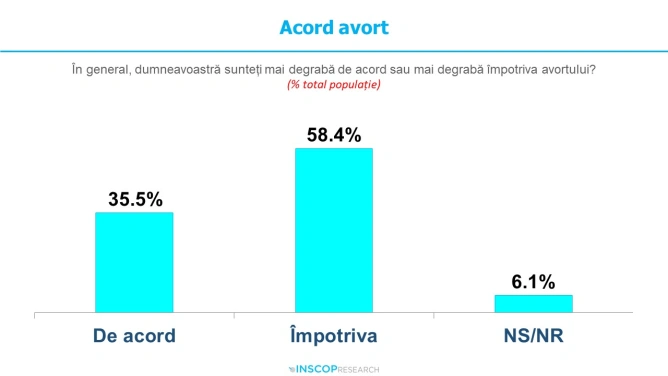
Abortion agreement
35.5% of respondents declare that they agree with abortion, while 58.4% are against it. 6.1% do not know or do not respond.
They agree with abortion especially: young people aged 18 to 24, those with higher education, urban residents, and those with high income. They are against it especially: those with primary education, rural residents, and those with low income.
Access to abortion in public hospitals
29.1% of survey participants believe that the state should guarantee by law access to abortion in public hospitals. 5.7% are against this, while 0.6% do not know or do not respond.
Among those who stated that they agree with abortion, 82.1% believe that the state should guarantee by law access to abortion in public hospitals, while 16.2% do not believe this. The share of non-responses is 1.8%. They agree with the legal guarantee of access to abortion in public hospitals especially: those with higher education, residents of Bucharest and large urban areas, and those with high income. They do not agree with this especially those with primary education and those with lower income.
Perceived safety in public spaces
21.3% of respondents state that they feel very safe in public spaces (on the street, in the subway, on campus, or in public transport), 42.8% fairly safe, 20.7% fairly unsafe, while 14.6% very unsafe or not at all. The share of non-responses is 0.6%.
They feel safe in public spaces especially: men, those with higher education, residents of large urban areas, and those with low income. They do not feel safe especially: women, those with primary education, rural residents, and those with lower income.
Protection of victims of violence in public spaces
23.4% of those surveyed believe that the Romanian state protects victims of violence, harassment, or aggression in public spaces, while 73.7% disagree. 2.8% do not know or do not respond.
They believe that the Romanian state protects victims of violence in public spaces especially: men, those with primary education, residents of small urban areas, and those with lower income. They do not share this opinion especially: women, those with higher education, residents of Bucharest, and those with higher income.
Protection of victims of violence in the family
22% of respondents believe that the Romanian state sufficiently protects victims of domestic violence, harassment, or aggression in the family environment, while 75.7% believe the opposite. The share of non-responses is 2.3%.
They believe that the Romanian state sufficiently protects victims of domestic violence especially: those with primary education, rural residents, and those with low income. They believe the opposite especially: women, those with higher education, residents of Bucharest, and those with higher income.
Escalation of the conflict in Ukraine
16.5% of those interviewed declare that they are very concerned about the possibility of the conflict in Ukraine escalating into Romania. 29% are fairly concerned, 28.2% fairly unconcerned, while 25.2% are not concerned at all. 1.1% do not know or do not respond.
They feel concerned especially: women, those with primary education, rural residents, and those with low income. They do not feel concerned especially: men, those with higher education, residents of Bucharest and small urban areas, and those with high income.
Threat to Romania
32.7% of Romanians mention corruption and lack of competence in public institutions as the biggest threat to Romania at this moment. 25% mention the state of the economy and rising prices, 17.2% disinformation and propaganda in the online environment, 9.6% Russia's aggression and the possibility of war in the area, 6.4% public health issues (pandemics, epidemics), 4% migration and refugees, 2.7% climate change and natural disasters, while 0.7% indicate something else. The share of non-responses is 1.7%.
Especially men, those with higher education, and residents of large urban areas indicate corruption and lack of competence in public institutions as the main threat. They mention the state of the economy and rising prices as the biggest threat especially: young people under 25, those with primary education, and those with lower income. People with higher education, residents of Bucharest and small urban areas, and those with high income believe to a greater extent than the rest of the population that disinformation and online propaganda represent the main threat.
EU assistance in case of a severe economic crisis
51.6% of Romanians believe that the European Union would help Romania in the event of a severe economic crisis, while 44.1% disagree. 4.3% do not know or do not respond.
They believe that the European Union would help Romania in the event of a severe economic crisis especially: young people under 25, those with higher education, urban residents, and those with high income. They disagree especially: young people aged 25 to 35, those with primary and secondary education, rural residents, and those with low income.
NATO defense in case of military attack
68.7% of respondents believe that NATO would defend Romania in the event of a military attack, while 23.3% believe it would not. The share of non-responses is 8%.
They believe that NATO would defend Romania in the event of a military attack especially: those with higher education, residents of Bucharest and small urban areas, and those with high income. They do not believe this especially: those with primary education, rural residents, and those with low income.
Level of information regarding the activity of the European Parliament
24.8% of those surveyed believe that they have sufficient information about the activity of the European Parliament, while 74.5% deny this. 0.7% do not know or do not respond.
Romania's sovereignty
56.8% of respondents believe that the legislative projects adopted by the European Parliament affect Romania's sovereignty, while 34.6% do not believe this. 8.6% do not know or do not respond.
They believe that the legislative projects adopted by the European Parliament affect Romania's sovereignty especially: young people aged 25 to 35, those with primary education, rural residents, and those with low income. They do not consider this especially: those with higher education, residents of Bucharest and small urban areas, and those with high income.
Tradition vs. Change
60.6% of respondents support change and new ideas, while 36.7% prefer things as they are and traditions. 2.7% do not know or do not respond.
They support change and new ideas especially: women, those with higher education, residents of Bucharest and large urban areas, and those with high income. They prefer things as they are and traditions especially: those with primary education, rural residents, and those with low income.
Political orientation
29.8% of those surveyed believe that the political orientation that suits them best is center-left (balance between market economy and social protection), 29% right (minimal state involvement, low taxes, individual responsibility), 15.9% left (involved state, focus on equality), while 13.7% center-right (private initiative and balanced social policies). The share of non-responses is 11.6%.
Latest News
12:49
12:46
12:45
12:33
See more news