SPECIAL Informat.ro / Romania, in the European press: The top topics from the last two weeks in the European press, about Romanians and Romania




Always see our news on Google
In the last two weeks, Romania and Romanians have appeared visibly in the European press and social media, predominantly present in news about crimes and various facts, but also in materials about culture, energy, and economy. The analysis is based on data collected by the media monitoring platform NewsVibe Romania for the period of March 7–20, which indicates 1,038 articles published in European countries, especially in Italy, Spain, and France.
Crime and Marginality in Europe
The largest volume of articles continues to come from Italy, Spain, Germany, and France, placing Romanians in the register of violence or exploitation. In Italy, the local press extensively reports on a 46-year-old Romanian man from Porto Sant’Elpidio who violates judicial measures, threatens and assaults carabinieri, ultimately being arrested for outrage, opposition to a public official, and disturbing public peace while intoxicated, which fixes the image of the recidivist and violent Romanian in front of the Italian state authority.
In the same register, the case of a 58-year-old Romanian father, sentenced to three years for mistreatment in the family, after years of abuse against his minor daughter and a previous record for domestic violence, reinforces the narrative of a dysfunctional family model, in which Romanians appear in the Italian mainstream through cases of abuse and social fragility. The case of Vasile Frumuzache, the Romanian security guard tried in Florence for the murder and dismemberment of two Romanian escorts, is extensively covered, with details about the motivations declared by the defendant and the biographies of the victims, amplifying the perception of extreme violence within the Romanian community.
Spain contributes to the same narrative through the case of the crime in Benimàmet, where the press explicitly emphasizes that the suspects in preventive detention are "the Romanian couple and their son, George Aurelian," focusing on the neighborhood conflict that degenerated into murder and the tense dynamics between neighbors. In France, a trial in Bobigny exposes how two Romanian families exploited children, forced to beg in the streets of Seine-Saint-Denis, according to the case documents; the article describes in detail the abuse and the role of the parents, with a clearly negative tone. The overall tone in this cluster is predominantly negative, with Romania represented by citizens in situations of violence, conflict with the law, exploitation, or social vulnerability.
Romania as a Regional Energy and Economic Actor
On the economic and energy front, the Greek press intensively covers the results of the PPC company for the year 2025, with a clear focus on regional expansion in renewables, including in Romania. The articles note that, out of the total revenues of 9.7 billion euros of the group, 25% come from markets outside Greece, and the strong increase in installed capacity in renewable energy (7.2 GW in 2025, compared to 5.5 GW in 2024) is partly due to projects completed in the fourth quarter in Romania, Bulgaria, and Italy.
A key detail is the evolution of the market share in electricity production: in Greece, it decreases from 34% to 32%, while in Romania it rises from 16% to 24%, a jump presented as a sign of "resilience" of the company's plan in the face of the new global energy crisis and the challenges generated by the war. The narrative is technical and predominantly neutral, with positive accents on investments, reducing CO2 emissions, and accelerated expansion in renewables.
In this context, Romania is presented as a strategic market in Southeast Europe for major energy companies, a space where capital and technology move, with potential benefits for regional energy security. Although the discourse is corporate, it has clear geopolitical implications: it positions Romania as a hub for the green transition and an essential partner in reconfiguring the European energy mix.
Culture, Memory, and Romanian History
In contrast to crime news, some cultural and historical materials give Romania a positive and sophisticated visibility. In Italy, the Sanremo Symphony Orchestra has "a new public success," under the baton of Romanian conductor Cristian Lupeș, praised for personal interpretations and for a "modern and unconventional approach" to the musical show.
In Portugal, the "Ovar em Jazz" festival relies on the concept of "jazz without borders" and includes Romanian percussionist Marius Preda in the program, alongside Portuguese and Brazilian artists and the Hot Clube de Portugal Jazz Orchestra. The official discourse of the organizers, quoted in the press, speaks of the "cultural ambition" of the municipality and the openness to new musical languages, which places Romania in the global jazz network through a top Romanian artist.
In pop music, Romania becomes a central subject in the German and British press through the controversy generated by the song "Choke Me," sung by Alexandra Căpitănescu for Eurovision 2026. The articles describe "massive controversies" regarding the limits of art and responsibility towards youth, citing an article from The Guardian, which reproduces warnings from a law professor about "a disturbingly low level of concern for the health of young women," in the context of lyrics perceived as glorifying violence and excessive sexualization.
In the area of memory and history, a Spanish article from the publication El Confidencial reports the discovery of 34 Roman graves and a Greek inscription in Constanța, under the coordination of the National History and Archaeology Museum, during works for a municipal hospital. The text emphasizes the "Roman treasures" and the scientific value of the discovery, which strengthens Romania's image as a space with relevant ancient heritage for European history.
In France, the profile of Nicola Jaller, a survivor of the Drancy camp, reconstructs a transnational biography in which her parents, Romanian Jews, settled in Normandy in the 1930s. Romania thus appears in the context of Holocaust memory and European Jewish migration.
General Tone in the European Press:
Of the 1,038 articles, 764 (74%) have a neutral tone, 144 (14%) negative, and 130 (13%) positive.
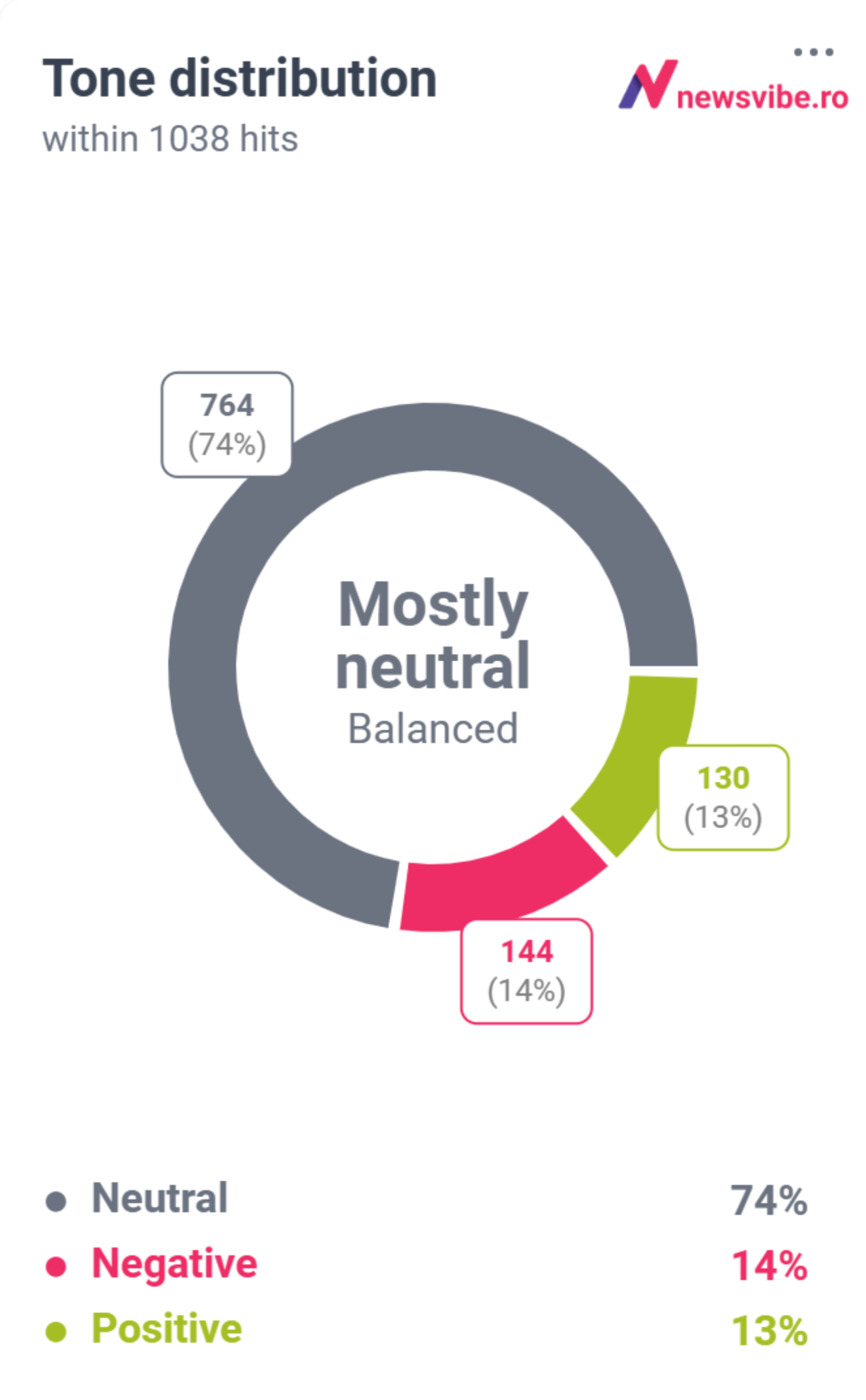
Graph: NewsVibe
****Synthesis made with the help of a data monitoring flow provided by the media monitoring platform NewsVibe Romania. The analysis, data, and images presented have been enhanced with the help of Machine Learning and Artificial Intelligence tools.
Latest News
22:52
22:51
22:27
22:24
22:23
See more news
NEWS ON THE SAME TOPICS