Who is Natalie Musteață, the Romanian-born director who won the Oscar in one of the rarest ties in the history of the awards



Always see our news on Google
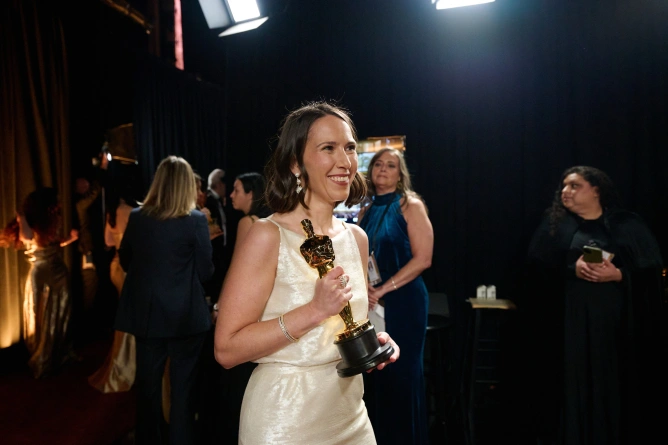
A Romanian-born director has made history in Hollywood: Natalie Musteață won, on Sunday night, the Oscar for Best Live Action Short with „Two People Exchanging Saliva”, in a category decided by a rare tie with the short film „The Singers”. This is only the eighth time in nearly a century of the Academy Awards that a category ends in a tie, making the moment when the name of a filmmaker of Romanian descent is announced on the Oscar stage a direct entry into the history books of film.
The short film can also be viewed on YouTube.
Who is Natalie Musteață
To the public, Natalie Musteață may seem like a name that appeared overnight in Hollywood, but her path has been built over time, between Romania, France, and the United States. Born into a Romanian family of artists and dissidents, who first emigrated to France and then to the USA, Natalie was born and raised in New York, with Romanian and French spoken at home, in the specific atmosphere of an immigrant child. „I often think about how my life would have looked if I had grown up in Romania instead of the USA. My childhood in New York was largely that of an immigrant child,” she confessed in an interview for Like5, speaking about how this dual belonging has shaped her identity.
Before reaching the Oscar red carpet, Musteață built her reputation in the world of contemporary art. She holds a PhD in art history, has worked as a researcher and curator in prestigious museums and galleries, and her professional path has included exhibitions, theoretical texts, and curatorial programs dedicated to the relationship between art, society, and politics. This experience is evident today in the way she constructs her films: attention to concept, visual detail, and how a personal story can actually speak about broader social tensions.
What is „Two People Exchanging Saliva” about, the film that brought the Oscar
„Two People Exchanging Saliva”, the short film that earned Natalie Musteață the Oscar for Best Live Action Short Film, is a dystopia with dark humor, created together with British artist Alexandre Singh. The action takes place in an imaginary society where gestures of intimacy are forbidden, a kiss can bring you death, and payment for goods and services is made with slaps to the face – a brutal inversion of norms that turns violence into currency and tenderness into danger. The film premiered at Telluride and had a spectacular run in festivals, gradually becoming one of the most discussed titles of the year in the short film category.
The film's aesthetics clearly bear the imprint of the environment from which Musteață comes: frames composed like installations, attention to scenography, costumes that tell a self-contained story. In an interview, the director recounts that the idea of imagining a world where people „pay by being slapped in the face” came almost instinctively, as an image pulled from her subconscious, upon which she then built the entire dystopia. Beyond the concept, the film also functions on an emotional level, through the relationship between the two protagonists and how the prohibition of intimacy becomes a metaphor for body regulation and social control.
A rare tie at the Oscars: why it matters
At the 2026 Oscars, the Best Live Action Short Film category provided one of the unexpected moments of the gala. The Academy of Motion Picture Arts and Sciences announced that the award was given ex aequo, both for „Two People Exchanging Saliva” and for „The Singers”, marking the eighth time in nearly 100 years of awards history that a category ends in a tie.
Ties at the Oscars are extremely rare, and the list of previous ones – from the tie for Best Actor in 1932 to Sound Editing in 2013 – is short and well-known among cinema enthusiasts. The fact that this short film category now enters that same list changes how the record will be read over time: history will not retain just one title, but two films, two aesthetics, and two different stories, forcing critics and audiences to put them in dialogue. Additionally, a „tie” suggests a deeply entrenched vote within the Academy, where two artistic visions are considered practically equally strong.
Why this is a historic moment for Romania
For Romania, Natalie Musteață's victory carries a weight that goes far beyond the simple mention of a „Romanian origin” in the Oscar records. It is the first time that a director of Romanian descent has won in the Best Live Action Short Film category, and this happens in one of the few moments of equality in the history of the awards. Essentially, her name will remain linked not only to an Oscar but to a rare and commented episode in every recap of the gala.
Her relationship with Romania is, however, more than just a biographical detail. In the interview for Like5, Musteață talks about growing up in a Romanian family of artists and dissidents and that her ties to the country have remained alive, even though her professional life has largely been built in New York. She says she has thought a lot about the Romanian New Wave, that films released after 2000 are among her favorites, and that she has „written a few scripts that she imagines she will film in Romania, including an absurd fable set in the world of theater towards the end of communism.”
For the audience in Romania, her success shows that international visibility no longer comes only through the realist-minimalist feature films that established the New Wave, but also through bold short films, with an aesthetic strongly influenced by contemporary art. At the same time, Musteață's victory confirms that new voices with Romanian roots can emerge from outside the local industry, from the cultural diaspora, but can maintain a symbolic and emotional connection with Romania at the moment they reach the center of global attention.
What’s next for Natalie Musteață
An Oscar won in a historic „tie” opens doors for Natalie Musteață that few debuting directors have at their disposal. From the possibility of transforming the dystopian universe of „Two People Exchanging Saliva” into a feature film, to developing the scripts she says she has written with Romania as a backdrop, the field of creative options is expanding spectacularly.
If one of those stories – „an absurd fable set in the world of theater towards the end of the communist era” – is indeed filmed in Romania, the current success could serve as a catalyst for collaborations and co-productions that bring together the resources of the local industry and the international networks built by Musteață. And for the Romanian audience, her name will now remain associated with the idea that a biography that began here can reach, through a winding path, all the way to the Oscar stage – and still in one of the few evenings in which the Academy recognizes, in equal measure, two films.
Read also:
Analysis conducted with the support of Perplexity
Latest News
21:24
21:11
20:59
20:42
20:22
See more news
NEWS ON THE SAME TOPICS