The geopolitical analysis of the conflict in Iran. Stakes and perspectives



Always see our news on Google
The current conflict between the USA and Iran has entered a dangerous escalation phase, with a combination of American military pressure, internal weakening of the Tehran regime, and a complex regional game in which neighboring states try to avoid an open war, but also a chaotic collapse of Iran.
From "maximum pressure" to the threat of a new war
Analyses of the US-Iran conflict show that Trump's "maximum pressure" doctrine – extreme economic sanctions, diplomatic pressure, and limited use of force – has resulted in strengthening the "maximum resistance" in Tehran, rather than bringing Iran back to the negotiating table on Washington's terms. The policy was motivated both by geostrategic logic (US credibility, protecting Israel, nuclear control) and by geoeconomic logic (controlling energy resources and limiting Iran-China ties). Over time, the conflict has evolved from indirect confrontations (cyberattacks, sanctions, "proxy war") to two key moments: the withdrawal from the JCPOA in 2018 and the airstrike in June 2025 ("Operation Midnight Hammer"), which hit three Iranian nuclear facilities. Although Trump claims to have "obliterated" the Iranian nuclear program, international experts emphasize that critical questions remain regarding enriched uranium stocks and the program's recovery capacity.
(The JCPOA is an international agreement concluded in July 2015 between Iran and the P5+1 group (USA, UK, France, Russia, China, and Germany), with the participation of the European Union. Its purpose was to limit Iran's nuclear program so that it could not develop nuclear weapons, in exchange for the gradual lifting of economic sanctions imposed on Tehran. The agreement came into force in early 2016 after the IAEA confirmed that Iran had fulfilled its initial obligations. In 2018, President Trump withdrew the USA from the JCPOA and reintroduced sanctions, accusing the agreement of not covering ballistic missiles and Iran's regional influence. Subsequently, Iran gradually began to no longer comply with the limits imposed by the agreement regarding uranium enrichment and stocks.)
In 2025-2026, massive anti-regime protests – violently suppressed, with thousands of deaths according to activists – created a new pretext for American pressure, and now the rhetoric from Washington combines two objectives: limiting the nuclear program and punishing the regime for repression.
Military escalation and Washington's options
President Trump publicly announced the deployment of a "massive armada" led by the USS Abraham Lincoln aircraft carrier towards Iran, stating that the fleet is "ready to carry out its mission with speed and violence, if necessary" and that "time is running out" for a new nuclear agreement that excludes nuclear weapons from Iran's arsenal. The carrier strike group, supported by destroyers, F-35s, F/A-18s, MQ-9 drones, P-8 patrol aircraft, and defense systems such as THAAD and Patriot, strengthens the American presence in the Gulf and around Iran.
Military experts note that this deployment has a strong defensive character – protecting American bases and troops, air support, and missile defense for allies – but that the same architecture can also support offensive campaigns: precision strikes against Iranian military infrastructure or a campaign lasting several days/weeks aimed at neutralizing air defense, airfields, and command nodes.
According to an Atlantic Council analysis, the White House has the following options:
• Symbolic strikes on the nuclear program or classic military targets;
• Strikes on the security apparatus (IRGC, Basij, special forces), including cyberattacks;
• Striking economic infrastructure (oil, gas terminals) to force the regime to make concessions;
• An extreme scenario: a strike on the supreme leader, which would create an unpredictable power vacuum.
In parallel, a BBC analysis presents seven scenarios from limited strikes to the regime's collapse followed either by an IRGC military junta or by chaos similar to Syria/Libya, with a major risk of ethnic civil war (Kurds, Baluchis, etc.) and humanitarian crisis.
The stakes of major state actors
USA
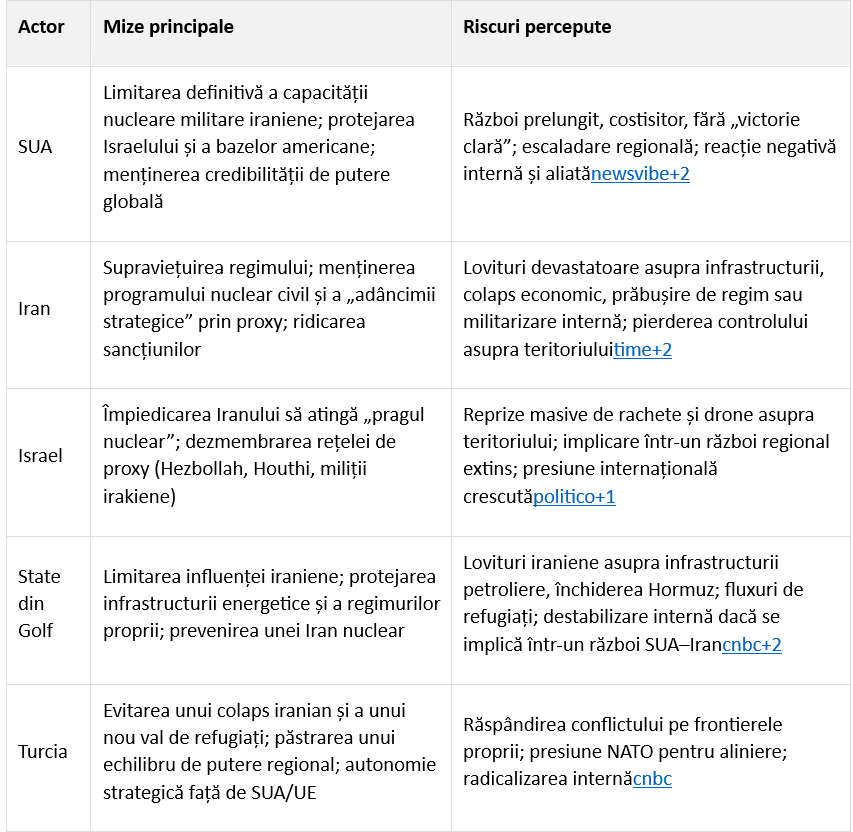
For Washington, the immediate stake is to prevent Iran from reaching military nuclear capability and to protect its own credibility after the president has drawn "red lines" on both internal repression and nuclear issues. Regionally, the USA aims to:
• Maintain Israel's de facto nuclear monopoly in the Middle East;
• Limit the Iranian proxy network (Hezbollah, Iraqi militias, Houthis) that challenges the position of the USA and its allies;
• Ensure the security of energy flows through the Persian Gulf and the Strait of Hormuz.
But the United States must balance these objectives with "war fatigue" after Afghanistan and Iraq, the financial and political costs of a new major intervention, and the risk that a war with Iran could bring more instability and extremism, not a clear strategic outcome.
Iran
For the Islamic regime, the conflict has an existential character. Iran sees military and economic pressure as an attempt at "regime change," not just an adjustment of behavior regarding its nuclear program or regional policy. Tehran's stakes:
• The survival of the regime and the "deep state" of security (IRGC, repression apparatus);
• Maintaining a civilian nuclear capability and a "latent option" for armament, without officially admitting a military component;
• Maintaining the network of allies/proxies in Lebanon, Syria, Iraq, Yemen, which gives it "strategic depth" and asymmetric deterrence capacity.
Iran conveys that it will not negotiate "under threat" or with preconditioned outcomes, but declares that it accepts a "fair" agreement that guarantees the absence of nuclear weapons and the lifting of "illegal" sanctions. At the same time, military institutions are preparing response scenarios: salvos of missiles and drones against US bases, striking American ships, and possibly "closing" the Strait of Hormuz, activating their proxies for attacks on Israel and American interests.
Israel
Israel views a nuclear-capable Iran and strong proxy networks as an existential threat and is in the midst of a "shadow war" with Tehran (strikes on Iranian infrastructure and allied militias). Netanyahu's government has relied on a more belligerent attitude from Trump to either obtain a direct attack on Iran or at least a "tougher" agreement than the JCPOA – including limiting ballistic missiles and "decoupling" Iran from the proxy network.
The announcement of US-Iran negotiations in Muscat has produced frustration in Jerusalem, with Netanyahu's close press criticizing that Iran continues to transfer weapons and missiles to militias while a possible agreement is being discussed. Nevertheless, Israel remains the actor most likely to push for escalation, either directly or by intensifying pressures on Washington.
Gulf States and Turkey
The Arab Gulf states – Saudi Arabia, the United Arab Emirates, Qatar – have an ambivalent position: they fear Iranian expansion but also a war that would blow up their energy infrastructure and trigger massive refugee flows. For this reason:
• They refuse to provide bases and airspace for a US attack on Iran or have publicly expressed their reservations;
• They position themselves as mediators (Oman, Qatar, UAE send messages between Tehran and Washington). Turkey, with experience from the Syrian and Iraqi refugee crises, has also warned against a US attack and urges that the missile and Iranian proxy issues be treated separately from the nuclear issue, to avoid blocking any negotiations. Ankara is also considering buffer zones at the border to manage a potential wave of migration from Iran in the event of prolonged war.
Scenarios for the evolution of the conflict
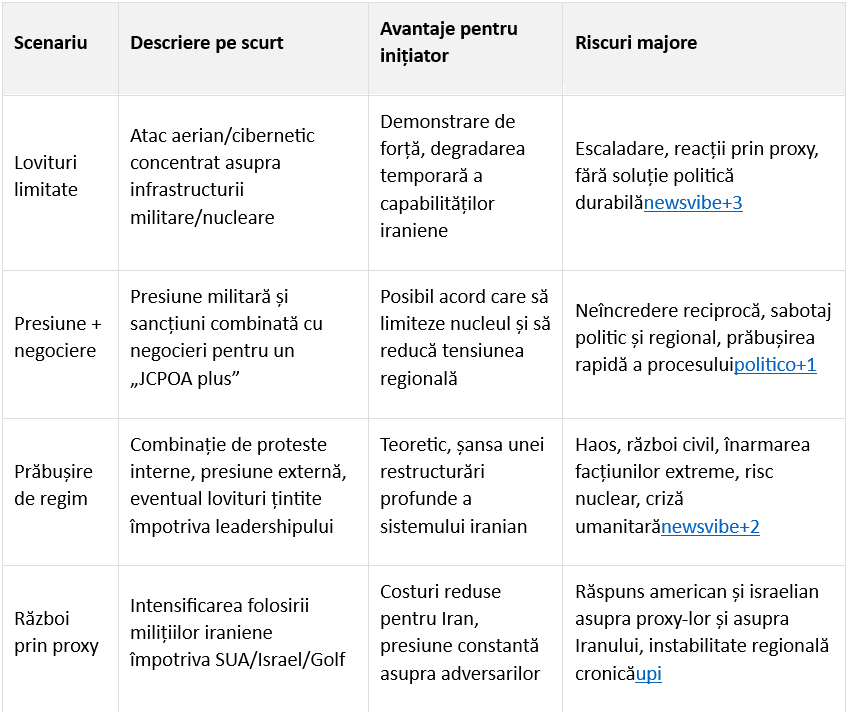
1. Limited strikes, without regime change
The scenario of a "limited strike" – hitting military or nuclear facilities, without a ground invasion – is considered by many analysts to be the most likely, precisely because it offers the White House "action" without a long-term commitment. It could resemble an expanded "Midnight Hammer," combining bombers, cruise missiles, and cyberattacks.
The stakes for the USA: demonstrating credibility, temporarily degrading Iranian capabilities, and a potential psychological effect on the repression apparatus. For Iran, however, this would likely not decisively change the regime's calculations, which has a high tolerance for costs and can quickly reconstitute dispersed capabilities.
The major risk: escalation "in a spiral" – Iran responds with attacks on American bases and oil infrastructure, the USA reacts again, the conflict prolongs, without a clear ending.
2. Maximum pressure + negotiation ("diplomatic coercion")
Another direction, already visible in the scheduled negotiations in Muscat, is the combination of military pressure and sanctions with an offer of agreement: a "JCPOA plus" that would include more intrusive IAEA controls, limiting enriched uranium stocks, and possibly some constraints on the ballistic program and Iranian regional involvement.
Both Washington and Tehran seem willing, at least declaratively, to explore this option – the USA to obtain guarantees regarding the absence of nuclear weapons and to relax regional pressure on Israel, Iran to obtain the lifting of sanctions and recognition of the right to a civilian nuclear program. But distrust runs deep: the Iranians insist that the USA was the one that violated the agreement in 2018, and the Trump administration is pressured by congressmen and the pro-Israel lobby not to sign an agreement perceived as "weak." The risk is that military pressure could sabotage the chances of negotiation, or conversely, that the diplomatic process could be derailed by regional actors who do not want a US-Iran compromise.
3. Regime collapse and internal militarization
BBC and Atlantic Council emphasize that any serious strike that overlaps with massive protests and cracks in the elite could lead to the regime's collapse, but not necessarily to a democratic transition. The two most plausible branches are:
• a military junta dominated by the IRGC, which takes control in the name of "saving the revolution" and may be even harsher and more interested in nuclear weapons than the current leadership;
• Internal chaos, civil war, and fragmentation, similar to Libya/Syria, with armed militants, ethnic and regional groups, and a power vacuum exploited by external actors.
Europeans and regional states warn that "Iran is too big to be allowed to break apart": a population of over 90 million, 13 land and maritime borders, critical nuclear and oil networks – collapse would generate refugees, nuclear risk (reactors, uranium stocks), and possibly the re-emergence of extremist formations.
4. Regional proxy war
Even without massive direct strikes, an intensified "proxy war" scenario is possible:
• Attacks by Shiite militias on American bases in Iraq and Syria;
• Missile and drone strikes by Hezbollah against Israel;
• Resuming Houthi attacks on maritime shipping and Israel;
• Sabotage against energy infrastructure in the Gulf.
FDD analyses show that Iran has strengthened its arsenal of ballistic missiles and drones, including through transfers to Iraqi militias, and that the rhetoric of proxy leaders goes as far as promises of "suicidal operations" against American and Israeli interests if the "Islamic Republic" is attacked. This scenario is attractive for Tehran as it allows striking adversaries without taking direct responsibility and keeps options open; for Washington and its allies, however, it is a management nightmare, with multiple fronts and high costs, but without strategic clarity.
Stakes and perspectives for the population in Iran
Repression, hope, and risk of instrumentalization
Recent protests – fueled by the economic crisis, corruption, resentment against clerics, and repression – have been met with exceptional violence, with estimates of casualties ranging from thousands to tens of thousands, the difficulty of verification being amplified by internet blockages and data secrecy. The presence of foreign militias (Iraqi units associated with the IRGC) sent to help with repression emphasizes the population's perception that the regime is willing to use any means to maintain its power.
For Iranian society, the immediate stake is physical survival and maintaining a minimal space for contestation; in the medium term, aspirations aim for a less repressive state, greater economic integration into the world, and a higher degree of political and cultural pluralism.
American military intervention is perceived ambivalently: it could theoretically provide a "moral boost" and weaken the repressive apparatus, but there is fear – well-fed by examples from Iraq, Libya, Syria – that such an intervention would lead to destruction, fragmentation, strengthening the hardest factions, and the confiscation of the revolt by armed actors.
The economic and social impact of the scenarios
• In the scenarios of limited strikes, the population would likely feel localized destruction, but especially worsening sanctions, currency instability, shortages, and unemployment.
• In the regime collapse scenario, the immediate costs – anarchy, insecurity, possible inter-ethnic and sectarian reprisals – would be enormous; the benefits of democratization would be uncertain and very distant.
• In the scenario of a US-Iran agreement, the population could benefit from the gradual lifting of sanctions, more investments, and a certain relaxation of internal control, but the risk is that the regime would use resources to consolidate its control and security apparatus – exactly the fear expressed by many activists.
Human rights organizations and European think tanks recommend a package of non-kinetic measures focused on the population: ensuring access to the internet and digital security tools, supporting the documentation of human rights violations, facilitating asylum for activists, using international courts to increase the cost of repression. These tools do not guarantee the success of protests, but reduce dependence on a possible external military intervention.
Fundamental conclusion
In the short term, the combination of American military mobilization, internal weakening of Iran, and pressure from allies and adversaries makes the risk of a military episode – even if limited – real, but not irreversibly determined; the window for "negotiated coercion" remains open, although narrow. In the medium and long term, the central stake is not just the configuration of the Tehran regime or the nuclear architecture, but how the Iranian population will succeed – or not – in claiming political space in a context where both great powers and regional actors are tempted to use Iran as a theater for their own strategic agendas.
Synthesis made with the help of the NewsVibe platform and Perplexity
Latest News
07:30
07:18
23:08
22:58
22:57
See more news
NEWS ON THE SAME TOPICS