EXCLUSIVE The attacks in Bistrița and Pitești, from news about violence to a debate about safety in schools / How visible the two cases were in the Romanian online press and how they were covered




Always see our news on Google
The attack at the school in Bistrița and the machete attack at the high school in Pitești generated extensive coverage in the relevant online press, according to the media monitoring platform NewsVibe. There were 488 relevant mentions, distributed across 163 sources, about the two attacks in Romanian sources. The coverage was predominantly negative, while the central emotion conveyed by the headlines and testimonies was fear: for children, teachers, and the possibility of such incidents recurring. Alongside this came indignation at allegedly ignored warning signs and solidarity with the victims and those who intervened.
The Pitești attack brought school violence back into the media spotlight after the Bistrița case
The first peak in visibility occurred on the day of the attack in Bistrița. Coverage continued over the following two days through information about the victims’ condition, the aggressor’s conduct, the preliminary investigation results, and the authorities’ reactions. The new attack in Pitești brings the issue of school safety back to the forefront. On October 22, by 1:51 p.m., the feed recorded 113 relevant mentions about the two cases and the associated reactions, compared with 62 throughout October 21. This is not a comparison between two complete days, but it clearly indicates a renewed editorial interest.
The importance of the second incident is not limited to the additional volume. It changes the framework of the coverage: from a serious case localized in Bistrița to the question of whether schools are facing a broader risk. Phrases such as “another attack,” “the second attack in three days,” or “two violent incidents” explicitly link the events and construct a narrative of recurrence. This is an observation about media coverage; the two cases alone do not demonstrate a statistical increase in school violence.
Local media sustained continuity, while national publications broadened the subject
After filtering, most mentions came from Bistrițeanul.ro and News.ro, followed by Știrile ProTV, Ziare.com, and several general-interest publications.
Bistrițeanul.ro followed the case through successive reports on the intervention, victims, investigation, return to classes, and community reactions.
In Pitești, sources such as ePitești.ro and Pitești24 provide statements from school management, clarifications from the authorities, and eyewitness accounts. News.ro supplies successive updates, visible in the feed through expanded headlines and versions of the same story.
Therefore, the breadth of the coverage results both from the diversity of sources and from the continuous updating of the same cases.
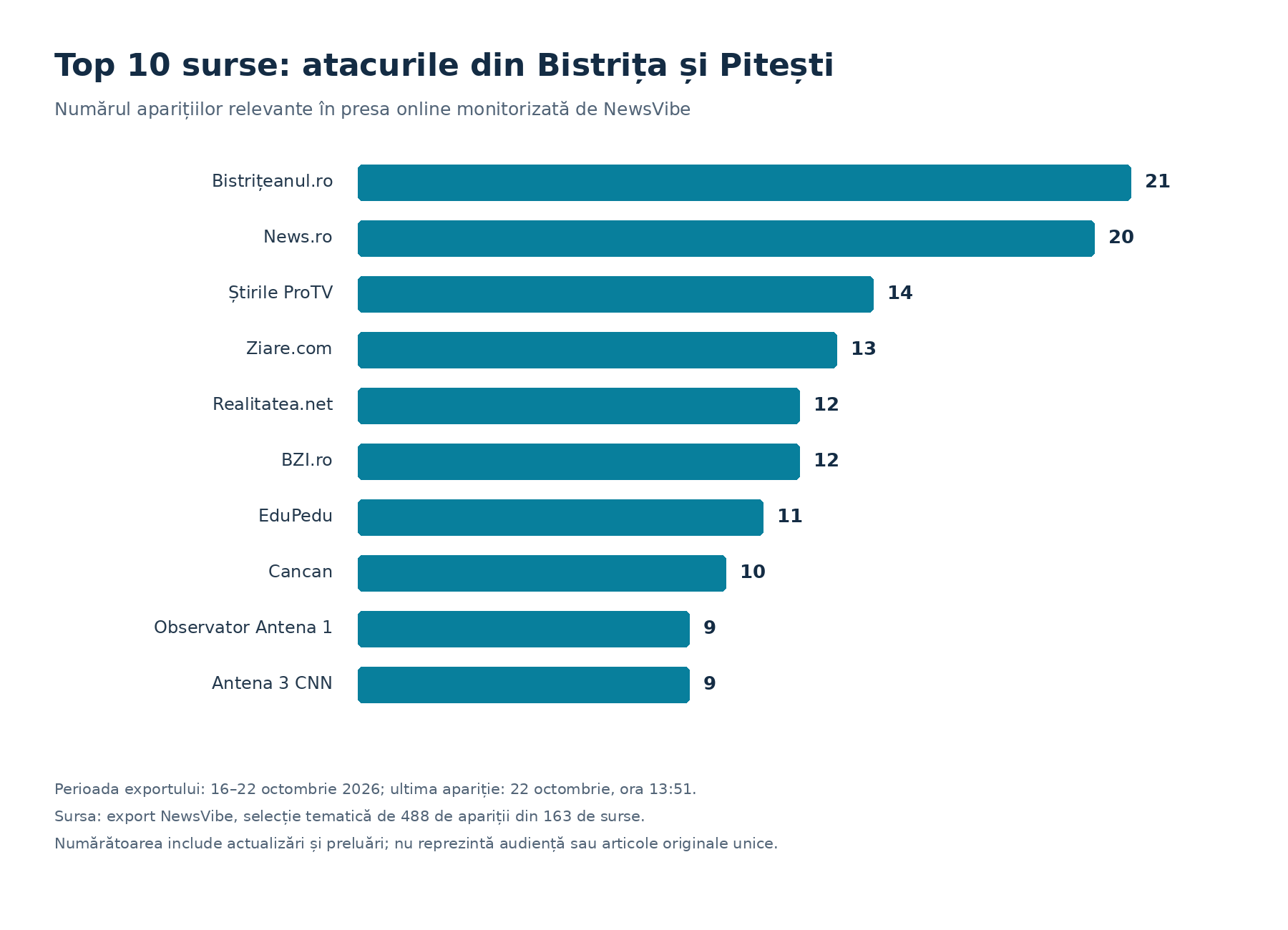
ePitești.ro appears in the ranking of relevant sources, with 8 mentions, but does not rank among the top 10 positions represented in the chart.
How the subject was covered: urgency, dramatization, and the search for explanations
Three editorial directions that coexist can be distinguished in the relevant materials.
The first is urgent reporting: what happened, who was injured, who intervened, and what the police, doctors, or school inspectorates say. Updates on the condition of the teacher in Bistrița, the aggressor’s hospitalization, protection orders, and the situation of the students in Pitești kept the subject in the news flow after the initial alerts.
The second direction is dramatization. Headlines repeatedly use expressions such as “horrifying scenes,” “shocking,” “shattering testimonies,” or “bloody attack.” In Pitești, the witness’s statement that the aggressor “came with a machete and started swinging it” is repeated by several publications.
In Bistrița, surveillance footage and the reconstruction of the moment of the attack likewise became separate subjects. These choices bring the victims’ experience closer to readers, but also heighten the sense of threat.
The third direction is explanatory: how the attack happened and what might have prevented the incident. RFI, EduPedu, Digi24, and other selected sources introduce discussions about online radicalization, bullying, the relationship between family and school, counseling, and the identification of warning signs.
Thus, the press does not remain exclusively within the realm of crime reporting, but broadens the subject to the functioning of the prevention system.
The dominant emotion: fear that schools no longer provide sufficient protection
In the filtered selection, the automatic sentiment labels in the export are distributed as follows:
454 negative mentions — 93.0%;
30 neutral mentions — 6.1%;
4 positive mentions — 0.8%.
These percentages describe the classification of the content, not the proportion of readers who were frightened, indignant, or supportive of a particular measure. Moreover, the negative tone is influenced by the nature of the reported facts; on its own, it does not prove that an article is sensationalist. The emotional register is more clearly visible in the headlines, testimonies, and recurring questions about protecting children and teachers.
Fear takes two forms. The first is immediate, expressed by witnesses who describe the attack, the panic, and attempts to avoid harm. The second is anticipatory: concern that a similar incident could occur in another classroom or another school. Reports about returning to classes, protection orders, and requests for security or access control sustain this second dimension.
Indignation is directed at allegedly unnoticed warnings, the effectiveness of prevention programs, and adults’ ability to communicate with one another. At the same time, materials about the student from Bistrița who intervened to defend his teacher and about the support offered by the community introduce a counterpoint of solidarity. The four mentions labeled positive concern such reactions, not a favorable assessment of the incidents.
From emotion to pressure for measures
Along with updates about the investigation, the coverage turns into a debate about institutional responsibility. The articles compiled and analyzed by NewsVibe include requests for additional legal protection for teachers, proposals for checking school bags, metal detectors, restrictions on minors’ access to social networks, and calls for psychological support.
A tension thus emerges between two responses: securing schools through control and sanctions, and prevention through counseling, communication, and the identification of threats. Several materials discuss them together, while the statement that problems cannot be solved “just by checking school bags” expresses this limitation of an exclusively security-based response.
*****Summary prepared with the help of a data feed provided by the media monitoring platform NewsVibe Romania. The analysis, data, and images presented were enhanced with the help of Machine Learning and Artificial Intelligence tools.
Latest News
08:07
07:55
07:42
07:39
07:30
See more news
NEWS ON THE SAME TOPICS