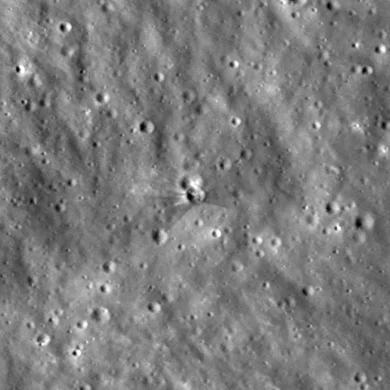
Artemis II, the link between the "Apollo era" and the first human settlement on the Moon



Always see our news on Google
Artemis II is the first crewed flight of the new American SLS–Orion system and the first return of humans to the vicinity of the Moon since 1972: a ten-day mission that tests, in real conditions, the "infrastructure" for a future permanent presence on the Moon and, further, towards Mars.
What the Artemis II mission consists of
Artemis II launched on April 1, 2026, at approximately 6:30 PM EST, from Kennedy Space Center, Florida, using the Space Launch System (SLS) rocket, one of the most powerful ever built, to send the Orion capsule on a flyby trajectory around the Moon and back to Earth, in a flight of about ten days. After an initial segment in low Earth orbit, a critical maneuver, translunar injection (TLI), pushed Orion – named Integrity by the crew – onto a trajectory that exits the Earth's gravitational field and into the sphere of influence of the Moon, at speeds of over 39,000 km/h during the TLI burn.
The trajectory is of the "free-return" type: the spacecraft uses the gravity of the Earth and then the Moon to describe an arc around it and return to Earth without the need for major course corrections – a safety philosophy inherited from the Apollo era. The mission includes, in the first two days, a proximity demonstration and "ship-to-ship" maneuver in relation to the upper stage ICPS, treated as a proxy for future modules or orbital stations with which Orion will need to dock. The flight will conclude with a high-speed reentry into the Earth's atmosphere and splashdown in the Pacific, off the coast of California, an essential test for the thermal protection and the partial reuse concept of the Orion capsule.
The strategic objectives of the promoters
Officially, Artemis II is described as a "verification flight" of the SLS–Orion architecture, but the stakes are much higher: validating the entire technical and operational infrastructure without which Artemis III and IV – the first landing missions and, subsequently, with a semi-permanent presence at the lunar south pole – cannot take place. NASA also aims to demonstrate that the propulsion, navigation, life support, and communication systems of Orion operate stably in "deep space", at distances where no human crew has been sent for over fifty years, paving the way for a lunar base and, in the longer term, for crewed missions to Mars.
In the long term, Artemis is envisioned as a "cosmic infrastructure" program: exploiting water resources frozen at the lunar south pole for the production of oxidizer and fuel, using the Moon's reduced gravity as a springboard for interplanetary missions, and building a network of orbital stations and surface bases. Artemis II serves as a "proof of concept", demonstrating that humans can safely return in proximity to the Moon in a repeatable flight regime and, ideally, less costly than the architectures of the Apollo era.
In political and symbolic terms, the mission also marks the renewed commitment of the USA and its partners – including Canada and Europe – to a cooperative presence on the Moon, with a crew that deliberately reflects the demographic and international diversity that NASA wants to transform into "norm" for the coming decades.
How the mission is progressing so far
After TLI, performed on April 2 with a burn of nearly six minutes, Artemis II left Earth orbit, with the crew becoming the first group of humans to exit the Earth's gravitational field since the end of the Apollo program. On the third day of flight, Orion was stable enough on its trajectory that the first "outbound trajectory correction burn" – one of the three maneuvers initially scheduled for fine-tuning – was simply canceled, a sign that navigation and trajectory modeling worked almost flawlessly.
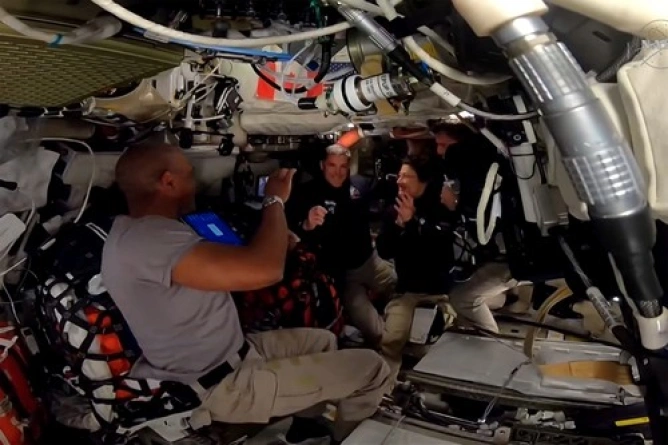
The third day was mainly dedicated to "deep space routine": medical and CPR tests in microgravity, checking the medical kit, emergency communication system tests via the Deep Space Network, and reconfiguring the cabin for the lunar flyby sequence scheduled for April 6. Commander Reid Wiseman transmitted images of Earth seen as a blue crescent, and Christina Koch described to the press the "breathtaking aspect of seeing your home planet", admitting that the crew was "glued to the window" in front of these first distant panoramas.
On the fourth day, the agenda includes "selfies" of the Orion spacecraft taken with cameras on the solar panels, tests of attitude control modes – six degrees of freedom versus three, to calibrate fuel consumption – and a 20-minute window reserved exclusively for photographing celestial objects from distances unprecedented for a recent crewed mission. On April 5, the spacecraft enters the sphere of influence of the Moon, and on April 6, the flyby is scheduled at about 6,000 miles above the surface, with a period of 30–40 minutes of total communication blackout when Orion passes behind the Moon, an intense moment both psychologically for the crew and technically for the ground teams.
Who are the four astronauts of Artemis II
The crew brings together three NASA astronauts and one astronaut from the Canadian Space Agency: Reid Wiseman (commander), Victor Glover (pilot), Christina Hammock Koch (mission specialist), and Jeremy Hansen (mission specialist), all with experience on the International Space Station or in top test pilot programs. Wiseman, a former US Navy test pilot, has already spent six months on the ISS as a flight engineer in Expedition 40, and now leads the first crewed mission of Orion, after previously being the head of NASA's astronaut office.
Victor Glover becomes the first African American sent on a mission around the Moon and returns to space after being the pilot of Crew-1 and a member of Expedition 64 on the ISS, now responsible for piloting Orion and testing attitude control and fuel consumption modes. Christina Koch is the first woman to participate in a lunar mission and already holds the record for the longest continuous space flight by a woman – 328 days – an experience that qualifies her for monitoring health aspects and for communication tests via the Deep Space Network at long distances.
Jeremy Hansen, a colonel in the Royal Canadian Air Force, is the first non-American heading to the Moon, embodying Canada's symbolic role as a strategic partner of the USA in the Artemis architecture – including through contributions to robotics and navigation systems provided by Ottawa. The crew selection was announced in 2023, and NASA has consistently emphasized that it includes "the first woman, the first person of color, and the first Canadian in a lunar mission", a message of diversity and sharing the benefits of space exploration.
Risks, controversies, and broader significance
One of the central technical discussions surrounding Artemis II concerns the decision to launch during the peak of solar activity, at a time when solar particle radiation can reach "almost lethal" levels for astronauts in the absence of adequate protection. Astrophysicist Patricia Reiff, quoted by LiveScience, emphasizes that there is a trade-off: during solar maximum, stronger solar wind "pushes away" some of the galactic cosmic ray radiation, reducing another type of risk, and launch windows can be scheduled to avoid periods of major eruptions, with the help of real-time monitoring of "space weather".
Beyond the risks, Artemis II reconfigures how the public experiences a "moonshot": the mission is broadcast almost continuously, with high-resolution images from the cabin and solar panels, and the four astronauts share their time between critical maneuvers and media interactions, from live streams to messages to families. For NASA and its partners, the success of this mission would mean validating an architecture that promises – in the vision of its promoters – a new model of human presence in space: not just flags and occasional steps on the Moon, but infrastructure, resources, and continuity.
Analysis conducted with the support of Perplexity
Latest News
12:30
12:20
12:16
12:13
12:04
See more news
NEWS ON THE SAME TOPICS