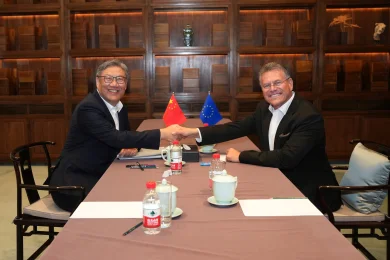
The EU and Mexico sign a new partnership agreement after more than a decade without a bilateral summit.



Always see our news on Google
The European Union and Mexico signed two agreements in Mexico City that modernize the bilateral relationship and can open new opportunities for companies, farmers, investments, and political cooperation. The new framework promises the near-complete elimination of remaining tariffs, the protection of 568 European geographical indications, and over 5 billion euros in European investments through Global Gateway. However, the full implementation of the agreement depends on the approval of the European Parliament, the decision of the Council of the European Union, and the necessary ratifications.
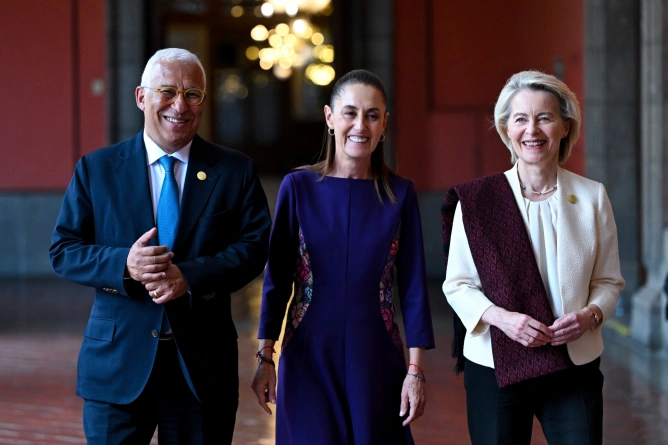
The European Union and Mexico signed the Modernized Global Agreement and the Interim Agreement on Trade in Mexico City during a summit that relaunched one of the EU's oldest trade relationships in Latin America. The meeting on May 22, 2026, was the first EU-Mexico summit since 2015 and brought together António Costa, President of the European Council, Ursula von der Leyen, President of the European Commission, and Claudia Sheinbaum, President of Mexico.
In brief
The EU and Mexico will eliminate almost all remaining tariffs in bilateral trade, which can reduce costs for companies and increase the product offering for consumers.
Over 45,000 European companies already export to Mexico, and bilateral trade exceeded 86 billion euros in 2025.
The agreement protects 568 European geographical indications, meaning that European food and drink products with protected origin cannot be sold in Mexico as imitations.
Global Gateway is expected to mobilize over 5 billion euros in European investments in Mexico, including in clean energy, infrastructure, health, education, research, and the circular economy.
The agreement is not limited to trade. The EU and Mexico announced closer cooperation in security, migration, health, energy, digitalization, human rights, climate, and the fight against organized crime.
The European Union and Mexico signed the Modernized Global Agreement and the Interim Agreement on Trade at the eighth bilateral summit, held in Mexico City on May 22, 2026. The two agreements update the framework that came into force in 2000 and extend the relationship beyond trade, towards political cooperation, investments, security, energy, digitalization, climate, and human rights.
António Costa described the EU and Mexico as "natural allies and trusted partners," united in defending common values. The President of the European Council stated that, through the modernized agreement, the two parties are "better prepared to jointly address the challenges of our times."
Ursula von der Leyen stated that "the EU and Mexico are committed to a close strategic partnership." According to the President of the European Commission, the modernized agreements establish a common vision for the future and will support trade, investments, jobs, and cooperation across a wide range of policies.
The signing of the agreements marks an important political milestone, but does not automatically lead to the full implementation of the new framework. The European Parliament must give its approval, and the Council of the European Union must adopt the decision to conclude. The Modernized Global Agreement will require ratification by the EU member states and Mexico, while the Interim Agreement on Trade allows for faster implementation of the trade part that falls under the exclusive competence of the EU.
For companies, the trade part is the most immediate element. Mexico is the EU's second-largest trading partner in Latin America, and bilateral trade exceeded 86 billion euros in 2025, with approximately 53 billion euros in European exports and nearly 34 billion euros in imports from Mexico.
The European Commission states that the agreement will support over 45,000 European companies that export to Mexico. Over 11,000 European companies are already active in the Mexican market and support, according to the Commission, 5.5 million jobs.
For European farmers and agri-food producers, the agreement promises the elimination of 95% of the high Mexican tariffs on EU agri-food exports. In 2025, Mexico imported European agri-food products worth 2.5 billion euros, being the second-largest importer of such products from Latin America.
The agreement also protects 568 geographical indications. This protection makes it illegal to sell imitations of certain European food and drink products related to specific regions of the EU in Mexico.
The agreements also target access to public procurement, services, investments, telecommunications, transport, financial services, environmental services, and digital trade. The Commission states that the new rules will simplify procedures for small businesses and reduce technical barriers affecting bilateral trade.
The joint statement from the summit presents the modernization of the relationship as a continuation of a mature economic relationship built over more than 25 years. According to the text, the new framework will strengthen political dialogue, cooperation, trade flows, investments, science, technology, and innovation, while simultaneously supporting industrial complementarities and economic security.
The political dimension of the agreement is as important as the trade aspect. Leaders announced a high-level dialogue on security and migration, the relaunch of the EU-Mexico digital dialogue, the launch of a new strategic dialogue on foreign policy, the strengthening of energy cooperation, and the continuation of high-level dialogue on human rights.
The summit also included broader international themes. The EU and Mexico reaffirmed their support for multilateralism, international law, and a rules-based global order. The joint statement asserts that this cooperation, based on international law, common values, compatible interests, and open economies, remains the best way to strengthen common security and prosperity.
Leaders also discussed developments in Ukraine, the Middle East, and Cuba. In the case of Russia's war against Ukraine, the summit statement mentions support for efforts aimed at achieving a just and lasting peace.
Global Gateway was another pillar of the summit. The EU-Mexico investment agenda aims to mobilize public and private resources, technology, science, and innovation in projects of common interest, from sustainable infrastructure and transport to green and digital maritime corridors, energy, health, education, research, digital economy, and circular economy.
Ursula von der Leyen stated, in the context of the summit, that Global Gateway mobilizes 5 billion euros in Mexico, in line with President Claudia Sheinbaum's Mexico Plan. The President of the Commission linked these investments to the transition to clean energy, the circular economy, and the fight against violence against women.
The agreements come in a context where the EU seeks to strengthen and diversify its trade and political partnerships. The Council of the European Union presented the package as part of the European effort to strengthen global trade relations, at a time of geopolitical instability and protectionist pressures.
The signing of the agreements opens the stage for final approvals. On the EU side, the European Parliament and the Council of the European Union remain the main actors in the procedure, and the full implementation of the Modernized Global Agreement depends on the necessary national ratifications.
EU-Mexico relations have until now been governed by the Economic Partnership, Political Coordination, and Cooperation Agreement, known as the Global Agreement, which came into force in 2000. Negotiations to modernize this framework began in 2016 and were concluded on January 17, 2025.
Mexico is one of the EU's strategic partners in Latin America and the Caribbean. The European External Action Service describes the EU-Mexico relationship as being at a moment of opportunity and notes that Mexico is the second-largest country and the second-largest economy in Latin America.
The Council of the European Union authorized the signing of the agreements on May 11, 2026. After signing, the process continues through the agreement of the European Parliament, the Council's decision on the conclusion of the agreements, and, for the Modernized Global Agreement, the necessary ratifications in the EU member states and in Mexico.
Latest News
18:33
18:12
17:48
17:31
17:17
See more news
NEWS ON THE SAME TOPICS