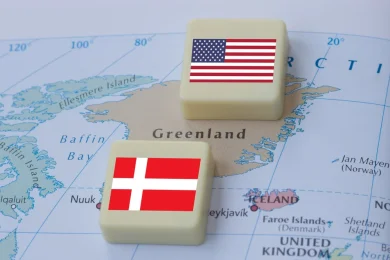
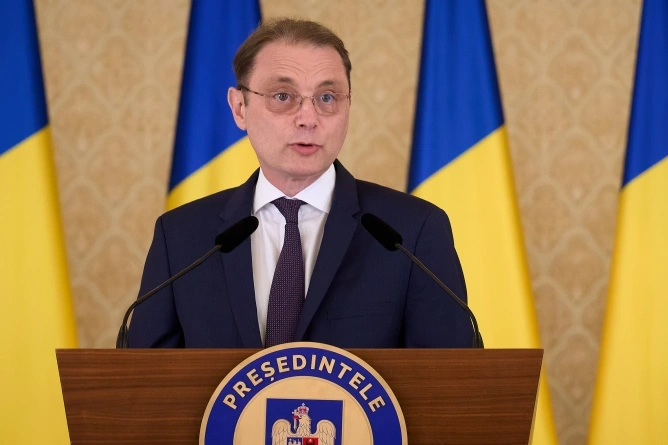
Greenland’s Parliament examines agreement to expand the U.S. military presence




Always see our news on Google
Signed on September 22, the agreement provides for the expansion of activities at Pituffik and new defense areas at Narsarsuaq and Mestersvig. Its entry into force depends on the completion of parliamentary procedures in Greenland and Denmark and on diplomatic notification to the United States.
Greenland’s parliament, Inatsisartut, is examining the agreement signed on September 22, 2026, by the United States, Denmark, and Greenland to expand military cooperation in the Arctic. Following the first reading on October 12, the document was sent to the Foreign and Security Affairs Committee, and the second reading is scheduled for November 3. The signing did not conclude the procedure for its entry into force.
In brief
The agreement would allow the expansion of U.S. activities from Pituffik and new defense areas at Narsarsuaq and Mestersvig, with details to be agreed between the parties.
Entry into force is linked to the diplomatic note informing the United States that the necessary parliamentary procedures in Greenland and Denmark have been completed.
The text limits certain investments in sensitive sectors and provides for defense obligations in the event of possible Greenlandic independence.
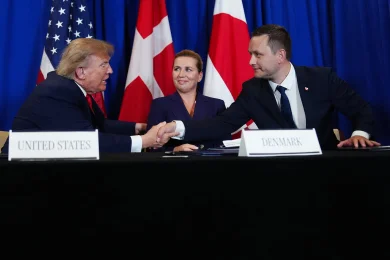
Greenlandic authorities cite the protection of communities and opportunities for local suppliers. Naleraq is calling for a referendum and criticizing the lack of guaranteed fixed payments. The agreement was signed at the UN headquarters in New York by U.S. President Donald Trump, Danish Prime Minister Mette Frederiksen, and Greenlandic Prime Minister Jens-Frederik Nielsen. It also modifies and supplements the defense framework established in 1951 and subsequent agreements. The preamble reaffirms the sovereignty and territorial integrity of the Kingdom of Denmark and the right of the Greenlandic people to self-determination.
Article XII establishes the condition for entry into force. The agreement will enter into force on the date of the diplomatic note informing the United States that Denmark and Greenland have completed the necessary parliamentary procedures. The explanations accompanying the proposal submitted to Inatsisartut specify that the consent of the Folketing, the Danish parliament, is also required. November 3 therefore represents a scheduled stage in the Greenlandic examination, without itself being the date on which the agreement takes effect.
Regarding the military presence, the text would allow the United States to modernize and expand activities at the Pituffik Space Base. According to the U.S. Space Force, it already carries out missile-launch warning and orbital-object surveillance missions. The agreement also provides for additional defense areas at Narsarsuaq and Mestersvig, although the arrangements and technical details must be agreed between the parties. It does not establish final troop levels, costs, or a complete construction schedule.
For other defense areas, proposals must describe the location, dimensions, activities, and protection measures. Details are negotiated in the Permanent Committee on Military Cooperation. If no agreement is reached within 90 days, consultations move to higher governmental levels, up to the ministerial level. The expiration of the deadline does not constitute automatic approval. Military installations without personnel outside the defense areas would follow an accelerated approval procedure by Denmark together with Greenland.
The text supports greater involvement by the North Atlantic Alliance (NATO) in the Arctic through planning, presence, exercises, and joint intelligence gathering. It supplements military access and movement rights that already existed within the framework of cooperation. It also provides for submarine access by U.S. vessels into territorial waters. The exercise of these rights must respect, to the greatest extent possible, Greenlandic society and way of life, including hunting and fishing.
A separate component concerns investments in sensitive sectors, including critical infrastructure and resource extraction. The clause refers to states or investors from countries that are not NATO members, NATO partners, or EU members. It limits control, significant influence, and access to non-public information under the security conditions set out in the agreement. The parties may agree that certain activities do not pose a threat to national security or public order. The agreement does not automatically grant U.S. companies resource-exploitation licenses.
The agreement has no end date and may be amended by mutual consent. If Greenland becomes independent, the Danish and Greenlandic governments would be expected to ensure that the new state accepts continued NATO membership, including through an application for membership if necessary, and assumes the defense rights and obligations provided for in the agreement. This clause does not decide independence and does not replace the procedure for changing the territory’s status.
The Government of Greenland maintains that the agreement strengthens local participation and the protection of communities and the environment in establishing the new areas. Regarding the economy, the text provides for contracts for goods and services to be awarded to Greenlandic suppliers to the greatest extent possible, taking into account their capacity to carry out the work. It does not guarantee a number of jobs or a fixed annual income for the budget.
In the parliamentary intervention on October 12, Pele Broberg, of the Naleraq party, supported security cooperation with the United States but criticized the lack of guaranteed fixed financial compensation and the long-term obligations, including those that would fall to an independent state. The party called for the population to express its view in a referendum before Inatsisartut’s final approval of the agreement. This is a political demand, not a referendum that has already been approved.
European interest also has a distinct economic dimension. On September 7, the European Commission announced a €200 million Global Gateway package for investments in 2026–2027, including connectivity, energy, and critical raw materials. This package does not represent financing for the military agreement. The analysis published on October 12 by the European Parliament Research Service, signed by Angelos Delivorias, provides Arctic and economic context without constituting an adopted position of Parliament.
Latest News
08:10
07:59
07:52
07:42
07:33
See more news
NEWS ON THE SAME TOPICS
.webp)