


MEPs call for closer anti-drug cooperation with Colombia; Bogotá proposes links between Latin American ports and the European Ports Alliance



Always see our news on Google
Following the visit of a delegation of nine MEPs to Bogotá and Cartagena, judicial cooperation and port security are priorities. Colombia is seeking links with the European Ports Alliance and progress on the Eurojust agreement. Negotiations on this agreement concluded in June 2026, according to the Commission; however, the conclusion of negotiations does not amount to its implementation.
A delegation of nine MEPs, led by the Chair of the Committee on Civil Liberties, Justice and Home Affairs (LIBE), Javier Zarzalejos, called for stronger police and judicial cooperation between the European Union and Colombia against drug trafficking and organised crime. In the conclusions of the visit to Bogotá and Cartagena from 26–28 October 2026, presented by the European Parliament on 29 October, the delegation highlights the role of cooperation with Eurojust and port security. The Colombian Government proposed links between strategic Latin American ports and the European Ports Alliance and called for progress on the institutional stages of the Eurojust agreement.
In brief
1.The nine MEPs held discussions with authorities, UN organisations and civil society and observed risk-based controls and anti-drug demonstrations, including at the CONTECAR terminal in Cartagena.
2.Colombia proposes cooperation between Latin American ports and the European Ports Alliance, real-time information sharing, and investment in scanners, artificial intelligence and risk analysis for goods. This is a request for cooperation and resources, not an integration that has already been decided.
3.The European Commission specifies that negotiations on the agreement with Colombia on cooperation with Eurojust concluded in June 2026. Signing, institutional approvals and the conditions for application are distinct stages.
4.The proposed agreement would allow systematic exchanges of judicial information, with personal-data protection, and the appointment of a liaison prosecutor in The Hague, under its terms.
5.The Colombian Government attributes the seizure of 162 tonnes of cocaine in international operations in 2026, up to the meeting on 26 October, to cooperation with six European states. The national total of 734 tonnes for January–September is reported separately; the figures must not be added together.
6.Cooperation with Europol already has an operational framework. Colombia reports 34,399 information exchanges and 260 joint operational initiatives over 22 years of cooperation; this period does not represent the age of the operational agreement, which entered into force in 2014.
7.The conclusions will be discussed at a future LIBE meeting and will contribute to the Parliament’s legislative and scrutiny work. Zarzalejos stressed the importance of respecting human rights and the rule of law in combating crime.
The delegation’s programme included meetings in Bogotá with Foreign Minister Omar Bula Escobar, representatives of the ministries of defence and justice, the public prosecutor’s office and the Colombian Congress. The MEPs also held discussions with UN agencies, including the United Nations Office on Drugs and Crime, as well as civil-society organisations and think tanks.
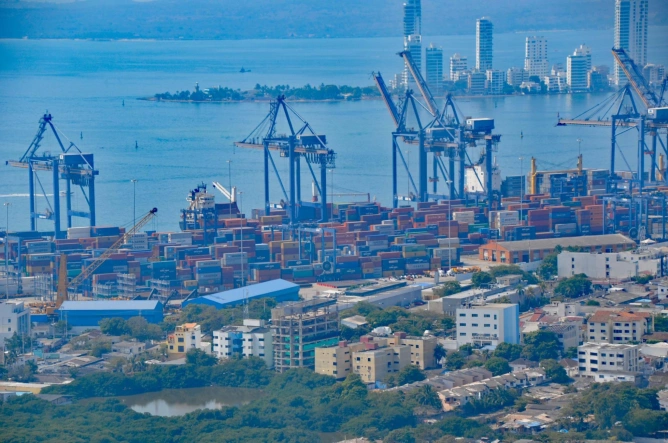
The technical component of the mission included a visit to the Colombian National Police’s anti-drug target-selection unit, CASOB, to observe risk-based controls. In Cartagena, the delegation visited the CONTECAR container terminal, where it attended anti-drug demonstrations and met with representatives of the US customs-control and homeland-security investigation authorities. Discussions were also held with the International Maritime Centre against Drug Trafficking, CIMCON.
In his post-visit statement, Zarzalejos described Colombia as an EU strategic partner and said that observations from the field would contribute to improving judicial and police cooperation. He linked the mission’s results to the Eurojust agreement, future European rules against organised crime, and parliamentary scrutiny of EU strategies in the area of drugs and ports. He also stressed that the fight against crime must respect human rights and the rule of law.
At the meeting on 26 October, the Colombian Government proposed connecting Latin American port cooperation to the European Ports Alliance. Colombia’s Foreign Ministry indicates that the request concerns strategic ports, real-time information and cooperation with the private sector. Bogotá is seeking resources for scanners, artificial intelligence and risk-analysis capabilities related to goods, to guide controls without placing unnecessary burdens on legitimate trade.
The European Ports Alliance, launched on 24 January 2024 by the European Commission together with the Belgian Presidency of the Council of the EU, brings together customs cooperation, law-enforcement activity and a public-private partnership. The latter involves port administrations and transport companies in protecting logistics, information, personnel and processes in ports. The Colombian proposal concerns expanding cooperation with ports in Latin America; it is not an already approved accession to a single European security system.
The Colombian Foreign Minister also presented results of anti-drug cooperation. According to his government’s communiqué, international operations coordinated with the authorities of Germany, Belgium, France, Spain, the Netherlands and Portugal led to the seizure of 162 tonnes of cocaine from the beginning of 2026 until the meeting on 26 October. This is a figure attributed to the Colombian authorities, not a statistic of seizures carried out exclusively on EU territory.
Separately, for January–September 2026, the same communiqué reports, at national level, the seizure of 734 tonnes of cocaine, the destruction of 4,309 drug-production facilities, and the impounding of 100 aircraft and 179 vessels associated with trafficking. The national total and that of the international operations are not presented as distinct statistical series without overlap and must not be added together to obtain a total.
In the judicial field, Bogotá requested support for signing the EU–Colombia agreement on cooperation with Eurojust and for its subsequent approval. The status of negotiations must be distinguished from these formalities: in a document dated 10 September 2026, the European Commission specifies that negotiations with Colombia were completed in June. The document is a recommendation concerning new negotiations with eight other countries and mentions Colombia when presenting cooperation that has already been negotiated; it does not itself constitute approval of the Colombian agreement.
According to Eurojust, international agreements create the framework for systematic exchanges of operational information, including evidence and personal data, and may allow for the appointment of a liaison prosecutor at the agency’s headquarters in The Hague. The Commission negotiates on behalf of the Union, based on authorisation from the Council, and the conclusion of agreements follows the European institutional procedure. For effective application, the agreement’s conditions and data-protection safeguards must be met; the conclusion of negotiations does not replace them.
Judicial cooperation already exists in specific cases. On 8 and 9 April 2026, the authorities of Albania and the Attorney General’s Office of Colombia, with Eurojust support, established two joint investigation teams concerning trafficking in persons from Latin America to Europe for the purpose of sexual exploitation. These teams have their own cooperation framework and do not amount to the entry into application of the general agreement on systematic data exchanges.
Police cooperation has a separate basis through Europol. The Colombian Government reports 34,399 information exchanges and 260 joint operational initiatives over 22 years. The relationship began with a strategic agreement signed in 2004; the operational and strategic cooperation agreement, signed in 2010, entered into force on 24 February 2014. The 22 years therefore do not represent the period of application of the operational agreement, and the exchanges and initiatives are not a number of convictions.
The Government in Bogotá also called for measures to identify and trace assets derived from crime, secure information exchanges, and stronger financial and crypto-asset analysis. The request includes the possibility of adopting asset-freezing measures in a timely manner. These are Colombian proposals addressed to MEPs in the context of modernising European legislation, not new powers granted through the visit.
The mission forms part of the context of the EU drugs strategy and the action plan against trafficking for 2026–2030, which comprises 19 actions. The European file on the control of drug precursors, substances with possible both legal and illicit uses, is also under examination by Parliament. Before the visit, the ECR group had announced that Paolo Inselvini, a member of the delegation and shadow rapporteur for this file, would also follow this issue.
The conclusions are due to be discussed at a future meeting of the LIBE Committee and to contribute to Parliament’s positions on the relevant legislative proposals. The visit strengthened dialogue and identified cooperation priorities; requests concerning ports and the Eurojust agreement require subsequent decisions and measures. They do not in themselves represent approval of European funds or implementation of the agreement.
Latest News
22:51
22:27
22:21
21:53
21:21
See more news
NEWS ON THE SAME TOPICS








.webp)


