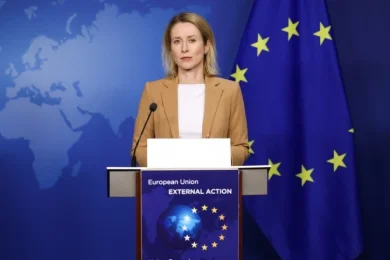
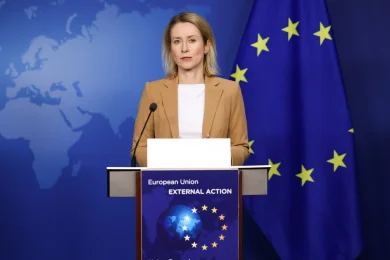
Kaja Kallas calls for a common European position before any negotiations with Russia


.webp)

Always see our news on Google
Before the informal meeting of the foreign ministers of the European Union in Cyprus, Kaja Kallas said that member states must clarify European interests related to Russia, Ukraine, and the security of the continent. The head of European diplomacy warned that the discussion about who would negotiate with Moscow should not replace the debate about the substance of a possible peace.
Kaja Kallas stated on Thursday, before the informal Gymnich meeting of the foreign ministers of the European Union in Cyprus, that member states must define their common interests regarding Russia before any peace negotiations that might involve Moscow.
In short
Kaja Kallas said that foreign ministers are discussing European interests related to Russia, in the context where peace negotiations are not advancing.
The head of European diplomacy stated that any potential lifting of sanctions against Russia is a European decision, which is why the European Union has a direct interest in discussions regarding peace.
Kallas said that the substance of the negotiations is more important than the question of who would sit at the negotiating table with Russia.
The agenda of the meeting also includes the situation in the Middle East, the Strait of Hormuz, cooperation with India and Saudi Arabia, as well as the European security strategy.
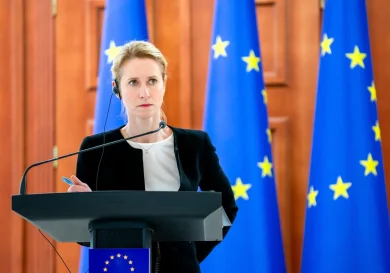
Kallas also mentioned Russian troops in Georgia and Moldova as part of European security interests.
Kallas said that foreign ministers were to discuss the "core interests" of the European Union regarding Russia, under the conditions where the peace process is not making progress, and the European Union wants to know clearly what objectives it would pursue in any discussions. She linked a lasting peace to elements such as accountability for aggression and the violations committed.
In responses to the press, the High Representative rejected the idea that the main issue would be whether the European Union would be invited to the negotiating table. Kallas explained that one of Russia's stakes could be the lifting of sanctions, and this is a European decision.
"It's not about being invited to the table," Kallas said, emphasizing that many of the themes of a possible solution directly concern Europe. She added that the issues related to Ukraine must be negotiated and agreed upon by Ukraine and Russia, but that there are also themes that concern European security.
Kallas warned that Russia would try to shift the debate towards the question of who would negotiate with Moscow. "Let’s not fall into this trap," she said, arguing that negotiations are a team effort and that "the substance is much more important than who" participates in the discussions.
When asked what the substantive elements would be, Kallas mentioned Russia's respect for international obligations, including the obligation not to attack neighboring states and to respect their sovereignty. She said that any military limitations requested of Ukraine should also be reflected in the case of Russia, if it were part of an agreement.
Kallas included in this discussion the presence of Russian troops in Georgia and Moldova, as well as interference in elections. According to the head of European diplomacy, these issues are of interest to European security, even if the approach is a maximalist one.
The Gymnich meeting also has a broader agenda. Kallas said that ministers are discussing the situation in the Middle East together with guests from India and Saudi Arabia, at a time when the Strait of Hormuz is, in her words, between war and peace. She emphasized the general interest in respecting freedom of navigation in the area.
The High Representative also said that sanctions against some Israeli ministers, requested by France and Italy in the context of the treatment of activists from the flotilla, are already on the discussion table, but that the substantive debate would take place at the Foreign Affairs Council in June.
Regarding Ukraine, Kallas said that representatives from Hungary are in Brussels for discussions related to the opening of negotiation clusters. She stated that she hopes for "good news" regarding the advancement of the process, but did not announce a result.
The Gymnich meetings are informal gatherings of the foreign ministers of the European Union, without formal legislative decisions, but important for coordinating the political positions of member states. In the case of the meeting in Cyprus, the discussion combined immediate foreign policy files, Russia's war against Ukraine, tensions in the Middle East, the Strait of Hormuz, relations with regional partners, and the future European security strategy.
Latest News
09:48
09:42
09:36
09:26
09:01
See more news
NEWS ON THE SAME TOPICS