A report for the Committee of the Regions presents the Iași–Ungheni example in cardiovascular prevention



Always see our news on Google
The CEPS analysis examines 30 local and regional initiatives, including the CARDIOSCOPE project from 2020–2021. Its organizers reported that 300 healthcare professionals were trained and 1,000 people were included in a pilot screening program.
Iași–Ungheni cooperation is presented in a recent report for the European Committee of the Regions as an example of organizing cardiovascular prevention and care at the local level. The analysis, available on the EU Publications website from October 8, 2026, brings together practices through which authorities and healthcare professionals can bring services closer to communities. The Romanian-Moldovan case concerns the CARDIOSCOPE project, carried out in 2020–2021.
In brief
The report analyzes 30 initiatives, ranging from prevention and early detection to care for people living with cardiovascular disease.
CARDIOSCOPE linked the Iași branch of the professional organization of nurses with Ungheni District Hospital.
In 2021, the organizers reported that 300 healthcare professionals had been trained and 1,000 people included in screening.
Eurostat data for 2023 show a ratio of 7.7 between the extreme regional mortality rates from circulatory diseases in the EU.
The study was carried out by the Centre for European Policy Studies (CEPS), at the request of the European Committee of the Regions, and presented on the CEPS website on October 15. The document inventories local policies and practices, and the conclusions belong to the authors. In itself, it does not represent a decision by the Committee or the launch of a new program for patients.
Territorial differences explain the interest in such initiatives. According to Eurostat, in 2023 the standardized mortality rate from diseases of the circulatory system was 1,014.9 deaths per 100,000 inhabitants in Bulgaria’s Severozapaden region, compared with 132.1 in Île-de-France, the French capital region. The ratio between the two values is approximately 7.7. Age adjustment allows populations with different structures to be compared and should not be confused with the raw number of deaths.
Prevention involves both identifying risk factors and being able to act on them. The World Health Organization lists smoking, an unhealthy diet, physical inactivity, harmful alcohol consumption and air pollution among the modifiable factors. High blood pressure, blood glucose and blood lipids can be assessed in primary care so that people at risk can receive appropriate care.
The CEPS report organizes the 30 examples into three areas: prevention, early detection and living with the disease. The authors recommend services adapted to local needs, community involvement, cooperation between institutions and impact assessment. The collection illustrates possible solutions without constituting a comparative clinical study of the effectiveness of all programs.
CARDIOSCOPE was coordinated by the Iași branch of the Order of General Medical Assistants, Midwives and Medical Assistants of Romania, in partnership with Ungheni District Hospital in the Republic of Moldova. The project was funded through the Romania–Republic of Moldova Joint Operational Programme 2014–2020, with support from the European Neighbourhood Instrument. The activities aimed to establish a joint framework for cardiovascular screening, monitoring and care in Iași County and Ungheni District.
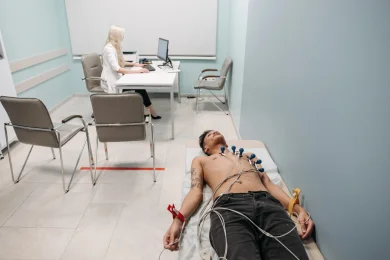
In the final statement of June 18, 2021, the beneficiaries announced that 300 healthcare professionals had participated in theoretical and practical training. They also reported that 1,000 people had been included in the pilot screening program. After the assessment, participants received information about the risks identified, their risk score and recommendations on adopting a healthy lifestyle.
These figures are presented as activities completed in the beneficiaries’ statement, which the recent report cites. The initial documentation provided for the training of 100 doctors and 200 nurses, while the final statement reports the 300 trained professionals in aggregate. The number of people assessed or trained alone does not measure the project’s effect on mortality or the number of illnesses prevented.
The partners also announced the development of tools for medical activity, including a risk-assessment methodology, risk maps, screening and monitoring protocols, training materials, and a prevention and early-detection guide. A joint strategy and an institutional agreement sought to ensure the use and expansion of the network’s results after the project ended.
For the report’s authors, the lesson of this case is the link between institutional cooperation and the practical tools available to family doctors and nurses. They recommend integrating detection into routine care and formalizing cooperation so that resources developed through a project can also be used afterward. However, the report does not assess the continuity of CARDIOSCOPE services in 2026.
Separately from the CEPS study, the European Committee of the Regions unanimously adopted, on October 13, 2026, an opinion on the European cardiovascular health plan. The document, whose rapporteur is Carmine Pacente, a councillor of the City of Milan, calls for a greater role for local and regional authorities in prevention and access to care. It is a consultative position and does not relaunch the Iași–Ungheni project or, in itself, provide it with new funding.
The CARDIOSCOPE example brings the experience of a project completed in 2021 into the current discussion. The recent report’s contribution is to make such practices available to other communities and recommend that they be adapted and evaluated. The current availability of a screening service for patients remains distinct from the project’s inclusion in this collection.
https://2eu.brussels/ro/news/studiul-european-despre-bolile-cardiovasculare-prezinta-cooperarea-iasi-ungheni
Latest News
23:05
22:54
22:36
22:25
21:59
See more news
NEWS ON THE SAME TOPICS