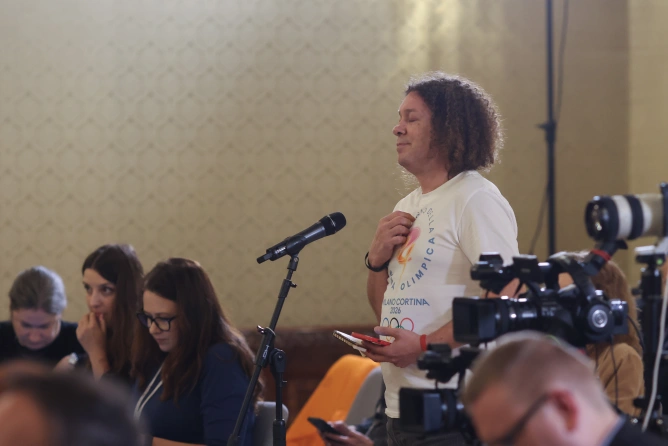
EP committees call for a European mechanism for paired kidney exchange




Always see our news on Google
The ENVI and SANT committees call for expanded European cooperation for patients who have a living donor but are incompatible with them. Exchanges between pairs can create other transplant possibilities, with medical assessments and the participants’ consent. The request is part of the legislative position voted on 10 November; it does not yet open a new enrollment program for patients in the EU.
The European Parliament’s committees on the environment (ENVI) and public health (SANT) are calling on the European Commission to develop a European mechanism for kidney paired exchange, following the model of existing agreements between some Member States. The request, approved on 10 November 2026, seeks to expand the possibilities of finding a compatible kidney for patients who have a living donor willing to help them but with whom they are medically incompatible. It is a legislative proposal, with no new European program already open to patients.
In brief
1. The ENVI and SANT committees are calling on the Commission to create a European kidney paired-exchange mechanism, following the model of existing cooperation between states.
2. A donor incompatible with the patient they wish to help may be compatible with a patient from another pair. The exchange involves assessing both pairs and confirming compatibility.
3. Participation is voluntary and does not guarantee a transplant. Consent, donor protection, and the organization of the procedures remain essential conditions.
4. The 54–18–16 vote concerns the same directive reported in the article about microorganisms. The text is due to be examined in plenary, provisionally on 23 November; no launch date has been announced for the kidney mechanism.
In a kidney paired exchange, two pairs consisting of a donor and a patient can overcome incompatibility between the members of each pair. The donor from the first pair can give a kidney to the patient from the second, while the donor from the second can donate to the first patient, if medical assessments confirm compatibility. The exchange concerns the donated kidneys, without each donor being compatible with the person for whom they initially wished to donate.
The NHS Blood and Transplant guide, the UK authority for donation and transplantation, explains that incompatibility may relate to blood type or immunological characteristics, including HLA tissue type. The mechanism may involve two pairs or a larger group. Participants undergo medical assessments before inclusion, and an identified combination must be confirmed through additional compatibility tests.
A larger number of participating pairs may increase the chances of finding a suitable combination. This is also the meaning of the cross-border cooperation pursued by MEPs: the search should not be limited to pairs within a single national system. The outcome is not guaranteed. The NHS states that some participants do not find a match, even in an organized program, and that identifying a donor does not eliminate the risks of the procedure or the possibility that the transplant may not take place.
Cooperation also requires organizing the procedures, transportation, and exchange of medical information. In the British scheme described by the NHS, operations generally take place at local centers, while kidneys are transported between the centers involved; the travel of a donor or patient may be arranged in certain situations. This is an example of how an existing program operates, not a transportation rule adopted for the EU’s future mechanism.
Consent and donor protection remain essential. The NHS states that participation in an exchange does not remove the donor’s right to withdraw before the operation. Organizing a cross-border exchange requires compliance with the medical and legal requirements of the participating programs, coordination between centers, and continuity of care. The committees’ vote does not establish common enrollment criteria for all patients in the EU.
MEPs call for voluntary and unpaid donation to be maintained and for the commercial use of organs to be excluded. Separately, in a 2018 position, the Council of Europe’s Committee on Transplantation supported fair kidney-exchange programs and warned against exploiting financial inequalities between pairs or countries. The warning particularly concerned exchange models in which access to treatment for a financially vulnerable person is conditional on bringing a donor into the program. It is not a new assessment of the Parliament’s proposal.
The request concerning kidney exchanges is part of a broader directive that updates the rules for genetically modified microorganisms and for the preservation or processing of organs. In the medical component, the committees also support simplifying authorization in situations of urgent medical need, as well as a European alert system for the rapid exchange of information about complications, including organ rejection and allergic reactions. These proposals concern the safety framework for transplants and do not represent a general change in the priority of patients on waiting lists.
The joint ENVI–SANT position was approved by 54 votes in favor, 18 against, and 16 abstentions. It is the same vote reported by 2eu.brussels in the article about genetically modified microorganisms, not a second decision on transplants. The Council of the EU established its own negotiating mandate on 16 June; this clarifies, among other things, the rules for organ processing and data protection, without meaning that all parliamentary amendments have been accepted.
The committees’ text must be submitted to the Parliament’s plenary before negotiations with the Council on the final form. The legislative observatory provisionally indicates 23 November for examination at first reading. The calendar is not a launch date for the kidney mechanism: the Parliament’s statement calls for its development without announcing a mandatory European registry, uniform participation rules, or a date for opening enrollment.
Latest News
13:25
13:17
13:08
13:00
12:59
See more news
NEWS ON THE SAME TOPICS










 (1).webp)