António Costa says global rules for AI cannot remain in the hands of a few major companies



Always see our news on Google
The President of the European Council calls for an international architecture for artificial intelligence based on responsibility, transparency, and common rules, and assigns the UN a central role in establishing standards. The intervention comes after the launch of the first Global Dialogue on AI Governance and the operationalization of the mechanisms created through the Global Digital Compact.
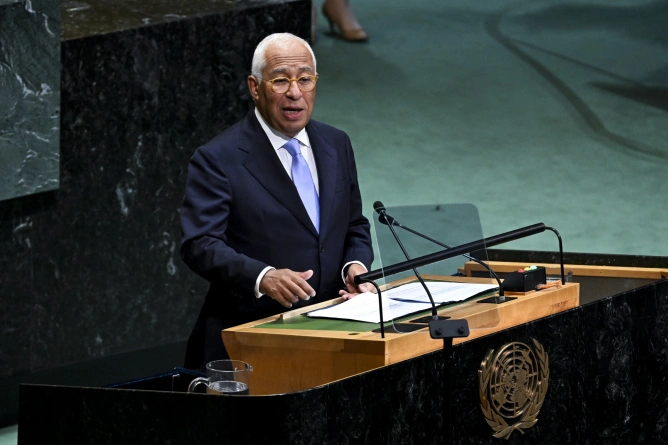
Artificial intelligence should not be governed through rules effectively set by some of the world’s largest technology companies, and the United Nations must play a central role in developing global standards, said European Council President António Costa in a speech delivered on behalf of the European Union at the UN General Assembly. He called for an AI architecture that is responsible, transparent, and regulated, and linked this approach to the governance mechanisms already created through the Global Digital Compact.
In brief
1. António Costa says that the AI industry cannot be left to self-regulate through the decisions of a few major global companies.
2. He calls for an international architecture for AI that is responsible, transparent, and regulated.
3. Costa assigns the UN a central role through the Global Digital Compact, the Independent International Scientific Panel on AI, and the Global Dialogue on AI Governance.
4. The first Global Dialogue on AI Governance took place in July 2026 and brought together governments, companies, researchers, and civil society.
5. The speech expresses the political position presented by the President of the European Council on behalf of the EU; it does not create new legal obligations for AI companies.
Costa introduced artificial intelligence into a broader argument about the limits of individual state action. He placed pandemics, climate change, supply chains, financial stability, and sustainable development in the same category. The central idea of the speech is that problems with global effects require multilateral institutions capable of establishing rules that states and economic actors cannot produce separately.
In the case of AI, his formulation goes beyond a generic call for cooperation. Costa says that a governance architecture is needed that can demand accountability, operate transparently, and be based on rules. He also puts forward a political principle concerning the relationship between society and technology: people and public institutions must retain control over the pace and direction of AI development.
The message concerns, in particular, the concentration of decision-making power. Companies developing the most advanced models control computing infrastructure, data, models, distribution, and access to products that can quickly reach hundreds of millions of people. Costa challenges the idea that global norms could result primarily from the internal policies, safety standards, or commercial terms established by these companies.
However, the speech does not call for excluding industry from rulemaking. The UN framework invoked by Costa is explicitly multi-stakeholder and includes governments, the private sector, the scientific community, civil society, and international organizations. The difference concerns who holds political authority over the process. In the vision presented in New York, companies must participate in governance without controlling it.
Much of the infrastructure Costa discusses already exists. The Global Digital Compact was adopted in 2024 as part of the Pact for the Future and establishes common objectives for digital cooperation and the international governance of artificial intelligence. The document calls for an inclusive, risk-based approach, with the participation of all states and respect for human rights.
Two mechanisms explicitly mentioned by Costa emerged from this framework. The first is the Independent International Scientific Panel on AI, designed to provide a common scientific basis concerning the opportunities, risks, and impact of artificial intelligence. The second is the Global Dialogue on AI Governance, where states and other relevant actors can discuss priorities for international cooperation.
The first global dialogue took place in Geneva in July 2026. According to the UN, the meeting attracted delegations from 163 countries and more than 3,000 participants, including representatives of governments, companies, academia, and civil society. The mechanism is intended to be a recurring process, and the next session is scheduled to take place in New York in May 2027.
This framework attempts to address a representation problem that frequently arises in the debate about AI. The largest companies and most of the technological infrastructure are concentrated in a small number of states, while the effects of the technology extend to economies and populations that have so far had far less influence over the rules.
The Global Digital Compact starts precisely from the requirement that all states, including developing countries, should be able to participate in the international governance of AI. The UN describes the Global Dialogue as a forum in which every country has a seat at the table, and where differences in technological capacity should not automatically determine differences in political influence over global standards.
There is, however, a difference between establishing global principles and creating legally binding rules. The Global Digital Compact, the UN dialogue, and the scientific panel do not constitute a global artificial intelligence regulator comparable to a national authority or to the enforcement mechanism of the AI Act in the European Union. They create a framework for cooperation, common standards, information exchange, and possible convergence between national and regional regimes.
The EU starts from a different position than many other regions because it already has binding legislation on artificial intelligence. The AI Act establishes rules differentiated according to risk and includes obligations for certain systems and models. Costa’s call for global governance does not replace this European framework; it seeks to extend internationally the principle that AI development must be accompanied by public rules and accountability mechanisms.
Nor does the speech at the UN establish that the European model should be copied in full worldwide. Costa speaks of global standards, accountability, and transparency, but he does not propose a global equivalent of the AI Act and does not define which institution should verify companies’ compliance worldwide.
This reservation is important because states already have different approaches to AI. Some use horizontal legislation, others sectoral rules, voluntary standards, or combinations of these. The Global Digital Compact recognizes this diversity and speaks of coordinating and ensuring the compatibility of emerging frameworks, rather than replacing them with a single global law.
In this respect, the role of the Independent International Scientific Panel is distinct from that of a regulator. The panel is meant to synthesize scientific evidence concerning AI’s development and provide a common starting point for political decisions. It may publish reports and thematic analyses, but it cannot impose sanctions on companies and does not approve or ban models.
The Global Dialogue likewise has a deliberative function. It is intended to facilitate discussions between governments and stakeholders, identify areas of convergence, and enable the exchange of practices. The first meeting in 2026 was structured around the social, economic, ethical, cultural, linguistic, and technical implications of artificial intelligence.
This linguistic and cultural dimension is also relevant for the EU. AI models are developed and evaluated under conditions in which languages with large volumes of data and major technology markets may benefit from better performance and greater attention from developers. An international standards system that includes more states can raise issues that are not priorities for companies focused on the most profitable markets.
Costa links this issue to the broader concept of multilateralism. In his speech, AI is not an isolated technological subject, but a test of the international system’s ability to produce rules in an area where technology is advancing faster than institutions and where economic power is highly concentrated.
At the same time, he does not present the UN as a structure that is sufficient in its current form. The speech calls for reforming, renewing, and strengthening the organization and links AI governance to a broader agenda for more effective and representative multilateralism. In the same intervention, Costa also supports reform of the UN Security Council.
For European AI policy, the intervention therefore has two levels. Within the EU, the AI Act and European institutions establish binding rules for the European market. At the international level, Costa advocates a system in which standards are negotiated multilaterally and based on scientific expertise, while technology companies participate in the process without dominating it.
The speech does not resolve the fundamental issue of enforcing these rules. The UN can build consensus, standards, and cooperation mechanisms, but the capacity to impose obligations on companies continues to belong mainly to states and regional organizations that have legislative and enforcement powers.
The political stakes of the intervention lie precisely in this distribution of power. Costa argues that the direction of a technology with global effects cannot be determined solely by the states that possess the greatest AI capabilities or by the companies building the most powerful models. The global governance he proposes is not yet a world regulator, but it seeks to build a space in which more states can participate in setting the rules before the industry’s commercial standards become, de facto, global standards.
Latest News
21:01
20:56
20:31
20:25
20:22
See more news
NEWS ON THE SAME TOPICS