


SUMMARY Earthquake alerts: why Japan warns the population before the arrival of strong seismic waves, while Romania does not use RO-Alert



Always see our news on Google
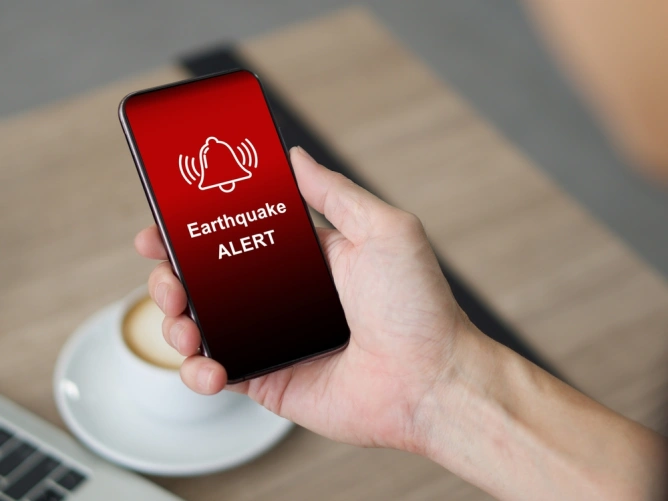
Japan, Mexico, Taiwan, Canada and the states along the western coast of the United States issue early earthquake warnings designed to reach the public before strong seismic waves arrive. The messages are issued after an earthquake begins, but may give communities some distance away a few seconds or tens of seconds to take protective measures. Romania does not use RO-Alert for this type of warning, although it has earthquake detection and warning technology. Why do some states choose to send an early message while others do not, and what does it guarantee?
The difference concerns how the systems are used, not merely technical capability. After the earthquake on November 18, DSU chief Raed Arafat explained that a warning issued shortly before the shaking would not allow evacuation or effective measures and could cause panic. Japan and other countries, however, primarily aim for immediate sheltering, not leaving the building.
Warning before the earthquake is felt, not before it begins
None of the systems described predicts earthquakes. They detect the first waves of an earthquake that has already begun and estimate where strong ground movements will reach. Faster P waves make it possible to identify the event before the waves that generally produce more dangerous shaking arrive. Electronic information can travel the distance to users before those waves do.
This is the difference between early earthquake warning and a message sent after the effects occur. The former attempts to gain time for protection. The latter may announce damaged buildings, evacuations, aid points or a subsequent hazard such as a tsunami.
The time gained is not guaranteed. Near the source there is a “blind zone,” where shaking may begin before the message is received. Distance, sensor placement, and processing and transmission delays all matter.
Google and RO-Alert: two different components of warning systems
Android Earthquake Alerts can use the accelerometers in Android phones to detect earthquakes. In California, Oregon and Washington, Android notifications use data from the public ShakeAlert system. Google and the authorities are therefore not necessarily competing solutions: they can participate in the same warning mechanism.
The service requires Wi-Fi or mobile data and compatible devices. Google states that not all earthquakes are detected, estimates may contain errors, and the notification may arrive before, during or after the shaking. Messages received by users in Romania were not issued by IGSU but were received through Android Earthquake Alerts.
RO-Alert, like other European systems, uses cell broadcast technology: authorities send messages to compatible phones connected to antennas in an area. Reception does not require internet access or installation of an application. The system distributes warnings; by itself, it is not a seismic detection network.
Japan: a few seconds to protect oneself on the spot
The Japan Meteorological Agency, JMA, has provided public earthquake warnings since 2007. Messages are distributed via phones, television, radio and emergency communication infrastructure, including J-Alert. The objective is for the warning to precede strong movements in the affected areas.
The reasoning is concrete: even a few seconds may allow people to protect their heads, move away from unstable furniture and take shelter under a sturdy table. JMA explicitly warns people not to rush toward exits. The warning is not an instruction to evacuate buildings generally.
The information can also support automatic responses by equipment and installations. Japan nevertheless communicates the system’s limitations: initial estimates may be inaccurate, and near the source the message may arrive too late. The authorities issue warnings despite these limitations, not because they have eliminated them.
United States: ShakeAlert targets brief actions and automation
ShakeAlert, administered by the U.S. Geological Survey, serves California, Oregon and Washington, not the entire United States. The system rapidly estimates the likely shaking, while partners distribute warnings through channels such as Wireless Emergency Alerts and phone services.
For people, the intended response is to drop to the ground, take cover and hold on. For infrastructure, the warning may slow trains, operate valves or open fire-station garage doors before deformation blocks them.
USGS does not promise an identical interval for everyone. In the case of nearby earthquakes, the time may be very short, and the message may arrive after the movement begins. The recommendation is for people to protect themselves as soon as they feel the shaking, without waiting for their phones.
Mexico: distance can provide a greater advantage
SASMEX issues warnings when detections justify an alert for covered communities. For certain earthquakes off the Pacific coast, the distance to Mexico City allows longer intervals than those available to cities near the source.
For the earthquake on September 19, 2022, operator CIRES reported approximately 98 seconds of warning for the capital. This was the result of a specific event, not a promise for the next earthquake.
The alert is not issued for every earthquake or every city. The decision depends on network detections and the thresholds established for the area concerned. The absence of a warning does not automatically indicate a malfunction: the event may not meet the relevant criteria.
Taiwan and Canada: public warnings with defined coverage and criteria
Taiwan issues early earthquake warnings through the public system and other channels, followed by more detailed reports. National exercises include earthquake and tsunami messages: the first assumes protection from shaking, while the second may require coastal evacuations after an earthquake.
Canada integrates earthquake warning into the national alerting system for covered regions. The eastern segment, intended for risk areas in Ontario and Quebec, was launched in November 2025. The authorities justify the warning by the possibility of reducing injuries and triggering automated measures. However, not every detected earthquake generates a public message.
Europe has no single policy
The existence of a national alerting system does not prove that it warns before shaking begins. The documents consulted do not provide an explicit justification for every European country, so the absence of a confirmed service should not be turned into an official decision attributed to the authorities.
Italy: IT-alert does not warn about seismic shaking. Civil Protection explains that the message could not be transmitted in time. Earthquake-triggered tsunamis are treated separately. The published argument concerns the time available, not panic.
Germany: the federal authority BBK describes warnings about effects and subsequent measures, including avoiding damaged buildings, but does not issue early warnings. Cell broadcast and NINA are distribution channels.
France: FR-Alert includes earthquakes in official test scenarios. The documentation consulted confirms its use in seismic emergencies, not an automatic service that guarantees warning before strong movements. Thus, the system is not designed for early warning, but for warning after a significant earthquake has been detected and validated by duty seismologists.
Switzerland: testing, with limitations explained by geography
The Swiss Seismological Service is testing early warning but says that its practical usefulness for the country remains to be determined.
Swiss seismologists explain that electronic information can arrive before strong seismic waves. The advantage, however, depends on distance, the speed of detection and transmission delays. Near the source there is a “blind zone,” where the warning may arrive too late.
Romania: the technology exists, but RO-Alert is not used for early warning
IGSU states that RO-Alert does not issue early earthquake warnings. After an earthquake with serious consequences, protective instructions and information may be communicated to the public. Arafat presents this approach as a decision: there would be insufficient time for evacuation or other measures, and the warning could cause panic.
At the same time, INFP has REWS, a system dedicated to Vrancea earthquakes that can also support automated responses, such as controlling gas shutoff valves. Therefore, the correct distinction is not “Japan can issue warnings, Romania cannot,” but how information is used and distributed to the public.
Geography affects the useful time in both countries. Japan does not always have tens of seconds, and Romania does not always have zero. For Bucharest, INFP describes a window of approximately 25–31 seconds in the configuration analyzed for Vrancea earthquakes. This value is not the time guaranteed for every phone and does not apply to all earthquakes in Romania.
The decisive difference: evacuation or sheltering?
The comparison with Japan must begin with the intended action. DSU cites insufficient time and the risk of panic; JMA focuses on protective actions that can be taken immediately, without rushing toward exits. The lack of time for evacuation does not, by itself, demonstrate that every warning is useless.
When evaluating a public warning in Romania, the relevant question remains how much time would actually exist between receipt of the message and strong shaking, and what safe response it could trigger. International systems show that the interval can be valuable, but only together with clear messages, preparedness and acceptance of technological limitations.
Japan does not promise that people will be able to evacuate a building. The aim is to protect oneself on the spot: taking shelter, protecting the head and avoiding objects that may fall. It also accepts and communicates that the warning may be delayed or that initial estimates may be inaccurate.
A warning is more useful when the threatened areas are sufficiently far from the first detections. Near the source, the time may be practically nonexistent. The Swiss Seismological Service explains its reservations about public warning in this context: for relevant earthquakes, the area experiencing strong movements may be limited and close to the epicenter, leaving only a very short advantage.
Latest News
11:55
11:52
11:47
11:47
11:45
See more news
NEWS ON THE SAME TOPICS

.webp)








.webp)


