Green Romania on paper, Romania choked by smoke in the evening



Always see our news on Google
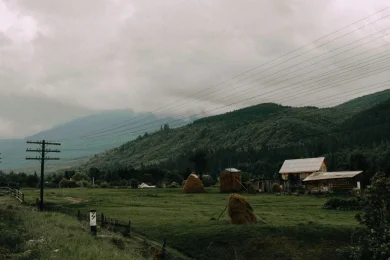
There is a scene that repeats obsessively when the frost appears in the localities of Transylvania. During the day, the graphs look good. Prosumers, panels, investments, transitions, billions. In the evening, however, when the cold and silence fall, the localities fill with smoke. Not from poor neighborhoods, not from improvised shacks, but from new residential areas, from large, beautiful houses with "Western" architecture, where the chimneys burn brightly, and natural gas remains a solution for adjustment, safety, and emergencies.
This is the Romanian reality; we have massively invested in modern energy and have ended up burning more wood. Not accidentally. Not marginally. But systemically.
The public reflex is wrong almost every time. There is talk of "people's irresponsibility," of "backward mentalities," of "the need for prohibitions." The moral finger is raised, harsher rules are demanded, controls and fines are dreamed of. But the smoke does not come from ignorance. The smoke comes from the great pressure on electricity and gas.
Wood is not the cause. Wood is the answer. Romanians do not burn wood because they do not know what pollution is. They know it. They feel it in their lungs. They see it in their children. They burn wood because it does what any rational household does in a poorly designed system: it optimizes cost and risk.
The chain is simple and ruthless. We have invested billions in renewables, in grids, in electrification, but we have done it in the wrong order. We have put expensive technology (favored by large commissions obtained) on an inefficient construction. We have added capacity without storage. We have created a system that produces cheap energy when you do not need it and expensive energy exactly when you need it: in winter, in the evening.
All these costs – capital, balancing, transport – do not disappear. They enter into the tariff. And the tariff becomes large, volatile, unpredictable. The bill is no longer a number, but a risk. And in the face of risk, the Romanian household reacts logically; wood offers control, predictability, and an apparently low cost.
This is not a cultural failure. It is a failure of energy economic design.
Why has the "transition" made energy more expensive instead of cheaper?
In the public discourse, an illusion has been sold: that green investments will automatically reduce the bill. In reality, any large investment in energy infrastructure has a cost to recover and especially an efficiency of the money actually invested. Grids, stations, parks are not free. They are paid for, slowly and surely, through regulated tariffs. No matter how green the discourse is.
Moreover, Romania has predominantly invested in sources where the production profile does not match the consumption profile of heating. The sun produces during the day, in summer. The wind is capricious. Heating, however, requires energy in winter, in the evening, at peak times. Without storage and flexibility, this imbalance translates directly into high prices exactly during critical hours. And the bill is made at peak, not on average.
All this time, energy efficiency – real insulation, reducing consumption – has been treated as an annex, not as a foundation. Romania has put heat pumps in houses that lose heat through walls. It has electrified without reducing losses. The result is an even higher peak of consumption and an even higher system cost.
Prohibitions on the use of firewood are a lazy and dangerous solution. The idea of banning wood is not only inefficient but dangerous. The prohibition without a functional alternative does not reduce consumption; it pushes it into the gray area. It creates a black market, distrust, and a rupture between the state and the citizen. Romania's history is clear; when energy becomes expensive and imposed, people replace gas with wood (a similar period existed in Transylvania in the 80s).
You cannot remove wood from the stove through administrative orders as long as electricity and gas remain expensive and unpredictable. The smoke does not disappear. It hides.
The real solution is not moral. It is economic. If you want clean air, you need to make modern energy cheaper, safer, and more predictable than wood. That's it. Without ideology. The first leu must be spent on efficiency: serious insulation, real windows, correctly sized installations. The cheapest kilowatt-hour is the one you do not consume. Only then the electric or gas ones. Gas must be treated as a transition tool, not as an ideological enemy. In the real world, it is cleaner than most fuels currently burned in stoves. Its role is to take wood out of the game, not to be demonized from offices.
Electricity must be cheap exactly when the house is heated: in winter, at night. Seasonal tariffs, aggressive night tariffs, incentives for thermal storage. If electricity is cheap at night, the wood stove becomes unnecessary.
Storage must come before new capacities. Without storage, you add volatility and cost. With storage, you cut the peak, expensive imports, and panic from bills. And subsidies must be moved to equipment. Not "giving money for pumps," but "I guarantee you a small bill for heating." When a person sees the result in the bill, they no longer look for shortcuts.
Romania does not pollute with wood because it is ignorant. It pollutes because modern energy has become too expensive and too unpredictable, as a result of investments made in the wrong order. When efficiency is real, energy is safe, and the price is low, wood disappears on its own. Without prohibitions. Without fines. Without speeches. Smoke is not combated with morality. It is combated with fair bills.
Latest News
20:20
20:15
20:10
19:55
19:45
See more news
NEWS ON THE SAME TOPICS