The year in which efficiency capitulated



Always see our news on Google
For three decades, the global economy has been performing acrobatics on a tightrope at great heights, without a safety net. In theory, the world called this phenomenon "globalization", but in practice, it was the religion of minimum cost. Together, we built a world where the components of a smartphone crossed oceans ten times before reaching the consumer's pocket and where the term "inventory" was considered almost a managerial impurity. This was the era of the "Peace Dividend" — a period in which the absence of major conflicts between great powers allowed us to trade security for profit margins, to the music of money in a grand ballroom called the global economy.
In 2026, the music did not simply stop; the ballroom was fortified. From the desolate maritime routes of the Strait of Hormuz to the bustling munitions factories on the banks of the Rhine, the global economy is undergoing a violent reshaping. We are witnessing the birth of a new model, the "fortress economy", a structural change defined by two new commandments: resilience in the face of profit and autarky in the face of integration.
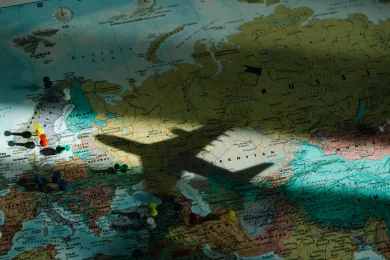
The catalyst for this new era is no longer theoretical. Following the attacks at the beginning of 2026 and the subsequent blockade of the Strait of Hormuz, the planet's most vital energy artery has become a graveyard of maritime ambitions. In March, oil traffic through the strait dropped to nearly zero. For a global economy that depends on the Persian Gulf for 20% of its oil needs and a massive portion of liquefied natural gas (LNG), this was not just a "supply chain blockage". It was a heart attack. "The era of easy growth, fueled by cheap energy and global cooperation, is permanently in the rearview mirror," notes a recent analysis by investment house Charles Stanley. "The strategy manual of 2026 is no longer about forecasting outcomes, but about designing shock-immune systems," adds the same analysts.
In boardrooms from Seoul to Stuttgart, the phrase "Just-in-Time" — the "Holy Grail" of 20th-century logistics — is now uttered like a curse. It has been replaced by "Just-in-Case". Companies are now forced to maintain massive, costly inventories and to build redundant factories. It is an inefficient model, it is inflationary, and in the eyes of business leaders in 2026, it is the only way to survive.
The "Peace Dividend" represented the money we did not spend on tanks so we could invest in technology, health, and tax cuts. That dividend has been exhausted. In 2026, defense spending has moved from the periphery of the budget to its center. NATO members no longer negotiate the 2% of GDP threshold; they sprint towards a target of 5% by 2035. Poland, now the largest ground army in the EU, allocates over 4% of GDP for defense, while Germany undergoes the most significant military expansion since the Cold War.
We are witnessing a global regrouping. While consumer-oriented sectors are crushed by cost-push inflation — driven by the high prices of the three big "C's": Fuel, Cereals, and Containers — the defense and aerospace sectors are entering a period of revival. We observe a pivot from the "welfare state" to the "military state", where the industrial base is being retooled not to provide better consumer goods, but to ensure national survival.
The most profound change, however, is the psychological migration towards autarky — the desire for national self-sufficiency. For years, "protectionism" was an insult used by economists to describe regressive policies. In 2026, it has been rebranded as "strategic sovereignty".
The world is fragmenting into "trust corridors". The US and its allies practice "friend-shoring" for critical minerals and semiconductors, moving production away from geopolitical rivals and into politically aligned blocs. As highlighted by the World Economic Forum's Global Risks Report 2026, "geoeconomic confrontation" has risen to the top of the global risk index. We no longer ask "Where is it cheaper to produce?", but rather "Will the country producing this still be our friend in six months?" The war in Iran and the fragmentation of trade are not "events" from which we will eventually recover to return to the status quo. They are milestones of a new era.
This transition to resilience comes with a huge bill. By choosing to build a factory in a "friendly" but expensive location, instead of a "risky" but cheap one, companies are integrating a permanent inflation into the global system. Central banks are discovering that old tools for raising interest rates are ineffective in a world where the cost of a shipping container has quadrupled because it must circumvent the Cape of Good Hope to avoid the Red Sea.
We are learning, the hard way, that resilience is expensive, and autarky is inefficient. Yet, in a world defined by the "shadow war" in Eastern Europe and the open conflict in the Middle East, the global economy has decided that efficiency is a luxury it can no longer afford.
Although the music still echoes, the ballroom is closed. The fortress is under construction. And, looking towards the second half of the decade, the goal of the global economy is no longer to grow to the stars, but simply to maintain the front line.
Latest News
20:33
20:20
20:15
20:08
20:01
See more news
NEWS ON THE SAME TOPICS