Supplier offers for gas after April 1, 2026, show that the price of gas is no longer a figure, it is an exercise in decoding.



Always see our news on Google
I conducted an analysis of gas supplier offers after April 1, 2026. The first conclusion is that there is a danger that on April 1, 2026, the household gas consumer in Romania will not enter a "liberalized" market, but rather an opaque market, where the real price is no longer a displayed value, but the result of an interpretative process. Officially, we would have talked about competition. Practically, it is a commercial puzzle where proper comparison becomes a sport for the initiated.
The ANRE offer comparator, designed as a protection tool for consumers, risks becoming a source of confusion. Not out of malice, but out of construction. Offers that were published before April 1, 2026, but which have commercial effects after this date do not appear in searches on the comparator. The consumer sees a "list", but not a complete list. And a comparison made on an incomplete set of data is not information, but an illusion of information. The price of gas is no longer strictly the price of gas.
After April 1, 2026, in a free market, suppliers no longer compete only through lei/kWh, but through the architecture of the offer. Gas comes bundled with daily subscriptions, "free" verification or maintenance services, technical assistance, additional discounts, and clauses that shift attention from the essential to the accessories. Thus, two offers with a price per kWh can have radically different annual costs, depending on how many and what services are, in reality, necessary.
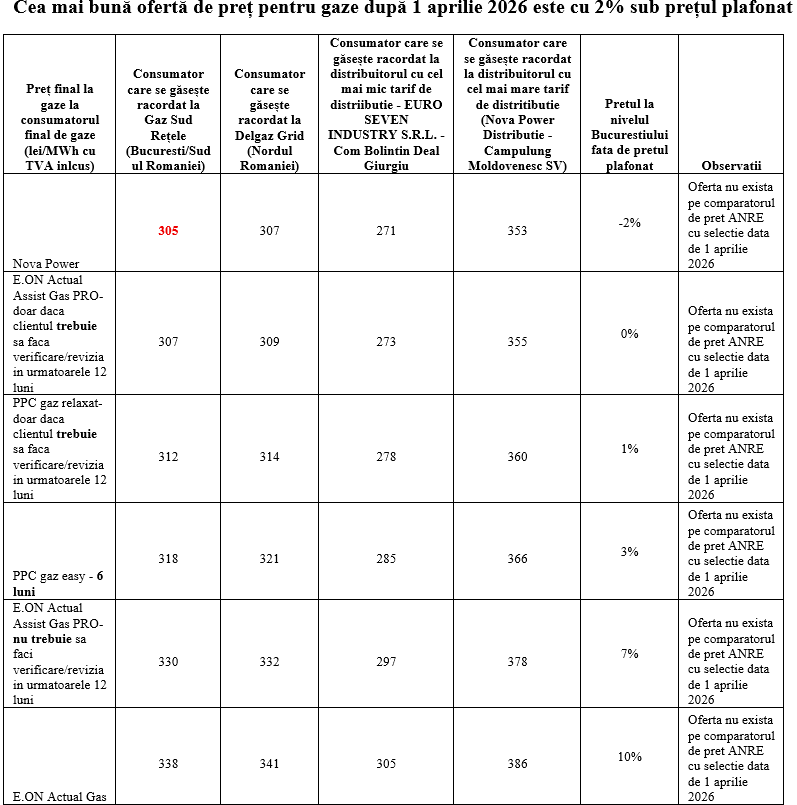
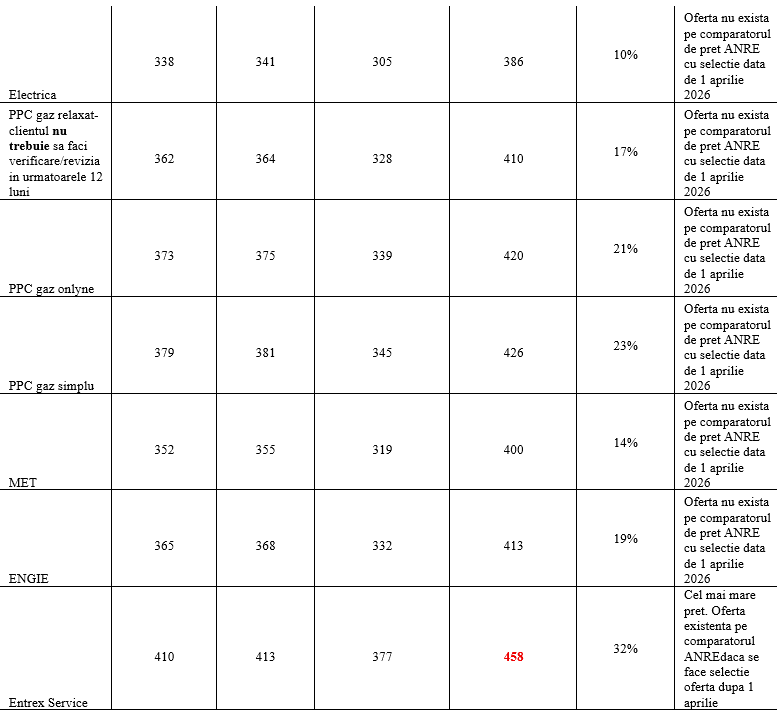
Analyzing the table with the "deciphered" offers, we can observe that the lowest offer (taking into account the differentiated distribution tariffs in different areas of the country) would have been -2% for the Nova Power offer with delivery in Bucharest and the southern area of Romania, and the highest would have been +47% for the Entrex Service supplier with delivery in Câmpulung Moldovenesc, Vatra Dornei, and the commune of Moara in Suceava, Huedin in Cluj, and Ștei in Bihor.
In theory, "gas + services" packages can be advantageous. In practice, they are advantageous only in a very precise context, when the client knows for sure that they will need verification or maintenance in the next 12 months. In that case, the service includes a real saving. In any other situation, it becomes a hidden cost, paid in the form of a higher subscription or an apparently "competitive" price per kWh.
The problem is that most consumers do not calculate price conditions based on technical verification cycles. Customers look for "the lowest price". And the market, very rationally, understood this and shifted the competition from the area of transparency to the area of packaging.
Liberalization is not a problem. The lack of readability is. A functional market assumes not only the freedom of suppliers to create sophisticated offers but also the consumer's ability to understand without becoming a financial analyst or ANRE expert. From this point of view, giving up the removal of the cap without putting anything in exchange is salutary.
In the absence of a real standardization of how offers are presented, the price of gas will no longer be a figure, but a test of patience, competence, and attention. And in an essential market, such as energy, this should not be the norm.
Latest News
22:59
22:55
22:44
22:40
22:40
See more news
NEWS ON THE SAME TOPICS