The historic Trump–Xi–Putin trilateral has begun: “Let’s see if we can achieve something,” says Trump / Why Shenzhen is not Yalta



Always see our news on Google
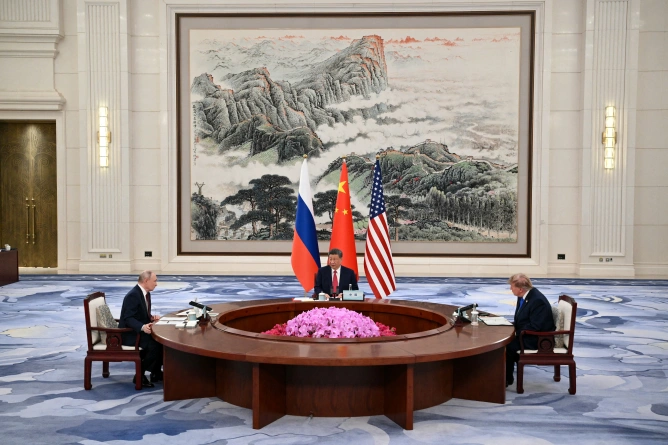
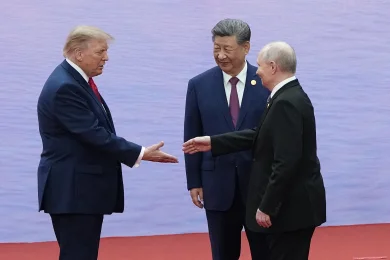
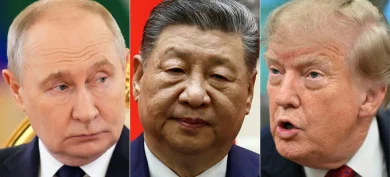
The leaders of the United States, China and Russia, Donald Trump, Xi Jinping and Vladimir Putin, met on Thursday in Shenzhen in a historic meeting in terms of its format. It is the first formal three-way meeting of the leaders of the United States, China and Russia.
“It is an honor to be here with you,” Trump said at the start of the trilateral meeting.
“As presidents of three of the largest countries in the world, we have a special responsibility to maintain an open, respectful and productive dialogue on issues that affect not only our peoples, but the entire planet,” he said at the beginning of the historic discussions.
“Too often, leaders in the past have avoided speaking with nations with which they had disagreements; we approach things in exactly the opposite way and are convinced that this is the right path,” he further emphasized.
Trump stated that “no problem has ever been solved” by refusing to hold discussions with leaders with whom there are disagreements. “Let’s see if we can accomplish something,” Trump added.
Putin spoke about a “balance of interests”
“I am convinced that Russia, the United States and China — our peoples — are capable of making a significant contribution to strengthening peace and stability worldwide if we cooperate constructively, on the basis of mutual respect, equality and a balance of interests,” Putin said.
For his part, Chinese leader Xi Jinping, speaking before the much-anticipated trilateral meeting, said: “China, Russia and the United States should set an example in terms of cooperation to address global challenges, jointly maintain peace and stability worldwide, and make more meaningful contributions to humanity’s progress.”
The three leaders appeared together at Kylin Villa, where the discussions are taking place, in Shenzhen — a technology hub in southern China. Earlier today, Trump held separate face-to-face talks with both Putin and Xi.
It is not their mere presence at the same summit that is new, but a joint discussion devoted to issues that go beyond bilateral relations: wars, nuclear weapons, trade and technology.
However, the importance of the moment does not guarantee a historic agreement.
For now, the three are coming with different priorities and unequal negotiating power.
Trump dominates media visibility, Xi controls the diplomatic stage, while Putin is trying to use his participation to counter the image of isolation.
Access to the table does not, however, mean equal treatment: the special attention given to the American president shows where Beijing is placing its emphasis.
What makes the meeting historic
The trilateral meeting brings together, in a single framework, three nuclear powers that can decisively influence international security but do not share the same vision of the world order. Washington and Beijing compete economically and technologically. China and Russia have a close partnership, fueled in part by opposition to American influence. Trump is trying to negotiate simultaneously with both, publicly relying on personal relationships.
The format allows interconnected issues to be discussed: arms control cannot be completely separated from strategic rivalry, while trade in semiconductors and critical minerals has security implications. The historical significance therefore lies in the possibility of direct dialogue among the three, not in the demonstrated existence of an understanding about the world.
The meeting also raises the issue of representation. Ukraine is not participating, although the war is on the anticipated agenda. Nor are European allies at this table. This absence fuels fears that major powers may discuss the security of others without their participation. However, the parallel consultations announced in Germany show that Shenzhen is not the only channel for negotiations.
Xi controls the stage, Putin does not receive the same treatment
Xi personally welcomed Trump at the airport, a rare departure from protocol. The gesture gives the American president special attention and allows the host to present the relationship with Washington as the diplomatic center of the event. CNN describes Xi as entering the trilateral meeting from a position of strength, while Russia is the weaker economic and diplomatic partner.
The difference also appears in the classification of the discussions. The Trump–Xi meeting is a formal bilateral; the Trump–Putin exchange is described by American officials as a “pull-aside,” a less formal discussion on the sidelines of the summit. The American president’s cordiality does not erase this distinction.
For Putin, there is a limited advantage: he can show that he is speaking directly with the American and Chinese leaders. But participation does not prove that he is being treated as their equal. The summit offers him an image opportunity and, at the same time, exposes the imbalance between Russia and China. The public display of the nuclear briefcase recalls, in this context, the main strategic argument Moscow retains.
What the leaders say and what they seek
Xi proposes an American-Chinese relationship based on “strategic stability,” respect and reciprocity. He presents his country as a partner capable of managing competition without permanent confrontation. The $20 million commitment to Asia-Pacific cooperation completes the image of a China offering predictability and regional cooperation.
Trump emphasizes the personal relationship. He calls Xi an “incredible” leader and argues that their “extraordinary” relationship serves the citizens of both countries. Beyond the praise, he is calling for more Chinese purchases of American agricultural products and invokes a shared interest in reopening the Strait of Hormuz. Regarding the trilateral meeting, he expresses optimism without presenting a prepared agreement.
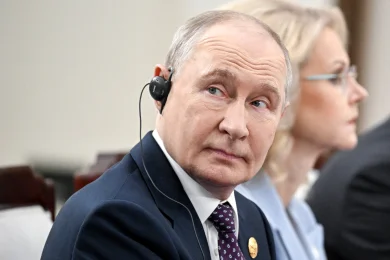
Putin speaks of Russia as an “integral” part of the Asia-Pacific region and promotes logistics infrastructure, energy and food supplies. He is trying to shift attention away from war and isolation toward Moscow’s economic usefulness. After the discussion with Trump, he made no public statements, but reportedly left in an “excellent mood,” according to adviser Yury Ushakov.
Why this is not Yalta and what Trump’s “friendship” means
In recent days, the trilateral meeting has been compared with Yalta.
But at Yalta, in 1945, wartime allies discussed victory and the postwar organization. In Shenzhen, rivals are meeting, without a common adversary and without a shared project. The analogy is useful as a warning against decisions about absent states, not as proof that the world has already been divided into spheres of influence.
The terms of address “friends” used by Trump belong to a personalized diplomacy: the president suggests that closeness between leaders can overcome tensions between states. Xi is leveraging the attention for prestige, while Putin is using access to challenge his isolation.
Sources


Latest News
11:10
11:07
11:02
10:58
10:55
See more news
NEWS ON THE SAME TOPICS
.webp)
.webp)