The coalition to support Ukraine conditions peace on robust security guarantees
2eu.brussels


International
Accorsini Jeanne/Pool/ABACA / Abaca Press / Profimedia

Always see our news on Google
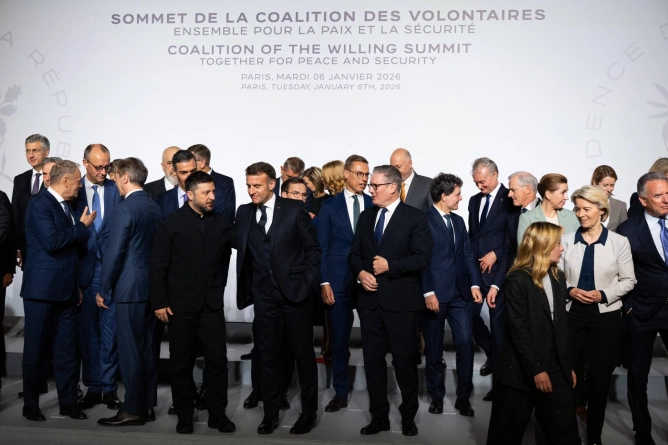
The states in the Coalition of the Willing, together with Ukraine and the United States, have agreed that any peace agreement must be supported by political and legal security guarantees, activated after a ceasefire and intended to ensure the long-term sovereignty and security of Ukraine. The member states of the Coalition of the Willing, alongside Ukraine and the United States, established in Paris that peace in Ukraine can only be achieved if it is supported by robust security guarantees, of a political and legal nature, which will come into effect after a ceasefire.
In short
Any peace agreement must include security guarantees for Ukraine.
The guarantees are to be activated after the entry into force of a ceasefire.
Military support for Ukraine is defined as essential in the long term.
The Coalition decides to create a coordination cell in Paris.
In the statement adopted in Paris, the members of the Coalition of the Willing emphasized their commitment to a just and lasting peace in Ukraine, in accordance with the principles of the United Nations Charter. The document explicitly states that Ukraine's ability to defend itself is crucial not only for its own security but also for the collective Euro-Atlantic security.
According to the statement, any peace agreement will need to be supported by a system of "political and legal" security guarantees, which will be activated once a ceasefire comes into effect. These guarantees are designed as a complement to existing bilateral agreements and will respect the legal and constitutional frameworks of the participating states.
The text details five main components of the proposed security architecture. These include participation in a monitoring and verification mechanism for the ceasefire, long-term military support for the Armed Forces of Ukraine, the creation of a multinational force for support and deterrence, binding commitments of support in the event of a future Russian attack, and deepening long-term defense cooperation with Ukraine.
A new operational element announced is the decision to create a joint coordination cell for the U.S.-Ukraine-Coalition at the Coalition's operational headquarters in Paris. This structure is intended to coordinate the implementation of the guarantees and ensure coherence of actions among partners.
The statement marks a shift in focus from general political support to an explicitly conditioned security architecture. The Coalition links peace to Ukraine's ability to maintain its defense and the existence of verifiable commitments, avoiding vague or strictly declarative formulations. The approach reflects the intention of the participating states to build a post-conflict framework based on deterrence and ongoing support, not just on the cessation of hostilities.
In short
Any peace agreement must include security guarantees for Ukraine.
The guarantees are to be activated after the entry into force of a ceasefire.
Military support for Ukraine is defined as essential in the long term.
The Coalition decides to create a coordination cell in Paris.
In the statement adopted in Paris, the members of the Coalition of the Willing emphasized their commitment to a just and lasting peace in Ukraine, in accordance with the principles of the United Nations Charter. The document explicitly states that Ukraine's ability to defend itself is crucial not only for its own security but also for the collective Euro-Atlantic security.
According to the statement, any peace agreement will need to be supported by a system of "political and legal" security guarantees, which will be activated once a ceasefire comes into effect. These guarantees are designed as a complement to existing bilateral agreements and will respect the legal and constitutional frameworks of the participating states.
The text details five main components of the proposed security architecture. These include participation in a monitoring and verification mechanism for the ceasefire, long-term military support for the Armed Forces of Ukraine, the creation of a multinational force for support and deterrence, binding commitments of support in the event of a future Russian attack, and deepening long-term defense cooperation with Ukraine.
A new operational element announced is the decision to create a joint coordination cell for the U.S.-Ukraine-Coalition at the Coalition's operational headquarters in Paris. This structure is intended to coordinate the implementation of the guarantees and ensure coherence of actions among partners.
The statement marks a shift in focus from general political support to an explicitly conditioned security architecture. The Coalition links peace to Ukraine's ability to maintain its defense and the existence of verifiable commitments, avoiding vague or strictly declarative formulations. The approach reflects the intention of the participating states to build a post-conflict framework based on deterrence and ongoing support, not just on the cessation of hostilities.
Latest News
18:17
EU Council approves lifting budget restrictions on Hungary
18:07
Sorin Costreie received a favorable endorsement for Education, while the vote on the Niculescu Cabinet is scheduled for Tuesday
18:03
Alexandru Nazare received a favorable endorsement for the position of Minister of Finance, advocating for reducing the deficit and maintaining the country's rating
17:58
Proposed Energy Minister Challenges Gas Market Liberalization from April 1
17:43
The Ukrainian army evacuated a wounded soldier for the first time with the help of an aerial drone
See more news

Personalized news feed, AI-powered search, and notifications in a more interactive experience.