BAROMETRUL Informat.ro - INSCOP Research - Edition VIII, March 2026. Chapter 8: Artificial Intelligence | A quarter of Romanians say they use platforms, technologies, or applications based on artificial intelligence daily.



Always see our news on Google
BAROMETER Informat.ro - INSCOP Research - Edition VIII, March 2026
Chapter 8: Artificial Intelligence
According to the BAROMETER Informat.ro – INSCOP Research, edition VIII, conducted between March 2-6, 2026, a quarter of Romanians say they use platforms, technologies, or applications based on artificial intelligence daily.
BAROMETER Informat.ro – INSCOP Research is a monthly opinion poll conducted by INSCOP Research on behalf of the news platform Informat.ro in partnership with the Strategic Thinking Group think tank.
BAROMETER Informat.ro – INSCOP Research aims to bring to the public's attention topics of interest to stimulate national conversations about various subjects and essential public policies for the present and future of Romania, based on the opinions of Romanians in partnership with think tanks and prestigious academic institutions. It is an initiative through which we aim to contribute to the strengthening of democracy by using scientific and credible tools that bring the voice of citizens to the forefront of public debate.
Methodology: Data was collected between March 2-6, 2026. Research method: interview via questionnaire. Data was collected using the CATI method (telephone interviews), with a simple, stratified sample volume of 1100 people, representative of significant socio-demographic categories (gender, age, occupation) for the non-institutionalized population of Romania, aged 18 and over. The maximum allowable error of the data is ± 3%, at a confidence level of 95%.
Graphical presentation of the data is available at: BAROMETER Informat.ro - INSCOP Research - Edition VIII, March 2026 / Chapter 8: Artificial Intelligence
Remus Ștefureac – director INSCOP Research: "Romania is structured into two distinct digital worlds: an educated, urban, and active minority that integrates AI tools into daily life and a majority that remains completely outside this ecosystem. The age divide is central: young people not only use AI more frequently, but they normalize it as a daily tool, while the elderly perceive it as a distant technology, difficult to integrate and potentially disruptive. Additionally, the relationship with AI tools is one of cautious utility, not trust, including among active users who coexist openness with skepticism, indicating a still fragile cultural adoption. Fears about job loss are concentrated among older and socio-economically vulnerable individuals, suggesting that anxiety about AI reflects existing insecurity rather than a direct assessment of technological risks."
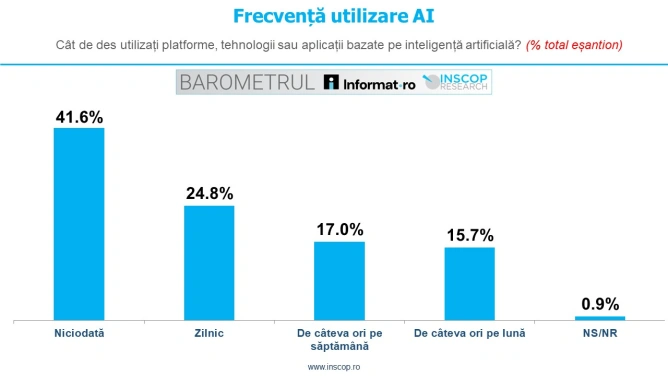
Frequency of AI usage
41.6% of survey participants declare that they never use platforms, technologies, or applications based on artificial intelligence. 24.8% say they use them daily, 17% a few times a week, and 15.7% a few times a month. 0.9% do not know or do not respond.
They say they never use platforms, technologies, or applications based on artificial intelligence especially: PSD voters, people over 60, those with primary education, residents of rural areas. They use artificial intelligence daily especially: USR voters, people aged 18 to 44, those with higher education, residents of the capital and large urban areas. USR voters, people aged 18 to 44, those with higher education, residents of the capital, and employees in the private sector use AI a few times a week in greater proportion than the rest of the population. Especially young people under 30 and employees in the public sector use artificial intelligence a few times a month.
Trust in AI results and information
2.9% of interviewees declare that they have a lot of trust in the information or results provided by artificial intelligence systems. 21.4% say they have quite a lot of trust, 44.1% have little trust, and 26.7% have no trust at all. The proportion of non-responses is 4.9%.
They trust the information or results provided by artificial intelligence systems especially: PNL and USR voters, people aged 18 to 44, those with higher education, residents of the capital, and employees in the private sector. They do not trust the information or results provided by artificial intelligence systems especially: PNL and AUR voters, people over 45, those with secondary education, residents of rural areas, and employees in the public sector.
Job loss due to AI
19.1% of Romanians declare that they are very worried about the prospect of losing their job due to artificial intelligence platforms. 14.6% are quite worried, 14.2% are somewhat worried, and 49.4% are very little or not at all worried. 2.7% do not know or do not respond.
They are worried about the prospect of losing their job due to artificial intelligence platforms especially: AUR voters, people over 60, those with primary education, residents of rural areas. PNL and USR voters, men, people aged 18 to 44, those with higher education, residents of the capital and large urban areas, AI users are the least worried about the prospect of losing their job due to artificial intelligence platforms.
Latest News
07:29
07:27
07:16
07:05
23:00
See more news