The European Commission launches a new strategy that places the reduction of illegal migration at the center of EU policy.



Always see our news on Google
The new strategies on migration and visas establish a political framework for five years, linking migration control to security, competitiveness, and talent attraction.
The European Commission has adopted the Strategy on asylum and migration management and the first European Union Visa Strategy, establishing a five-year political framework that places the reduction of illegal migration at the center of EU policy and links this objective to security, competitiveness, and talent attraction.
In short
The reduction of illegal migration is explicitly stated as a political priority.
The migration strategy pursues three equal objectives: preventing illegal migration, protecting refugees, and attracting talent.
The EU launches its first comprehensive visa strategy, treated as a tool for security and competitiveness.
Complete digitalization of visa procedures is planned by 2028.
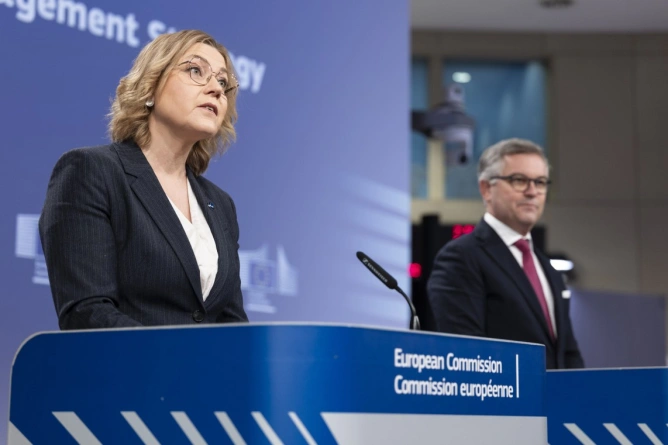
Executive Vice-President Henna Virkkunen stated that the two strategies adopted by the College establish "a clear political plan for five years regarding migration," built on the Pact on migration and asylum and operational cooperation with member states and partner countries outside the European Union.
She specified that EU policy will be based on "three equally important and mutually reinforcing objectives: preventing illegal migration, protecting those in need of protection, and attracting the talent that Europe needs." At the same time, Virkkunen emphasized the need to intensify returns and drew attention to the "instrumentalization of migration by Russia and Belarus," stating that "this undermines the credibility of our system" and that "citizens expect Europe to combat abuses, manage migration, and provide concrete solutions."
Referring to the labor market, Virkkunen stated that a "paradigm shift" is necessary, as "Europe is facing serious skills and labor shortages." She added that addressing these deficits is essential for "our economic growth and our competitiveness." In this context, she mentioned the Memorandum of Understanding on mobility with India and the opening of a Legal Gateway Office, "starting with skills in the ICT field."
Regarding the EU Visa Strategy, Virkkunen explained that its purpose is for visa policy to reflect "today's realities: major geopolitical changes, global competition, and evolving security challenges." She emphasized that the EU proposes "the first comprehensive strategy on visas" to use visas "in a more strategic, coordinated, and firm manner," at the intersection of security, diplomacy, and competitiveness. The strategy provides for the complete digitalization of the system, with ETIAS in the course of this year and fully digital procedures by 2028.
Commissioner Magnus Brunner stated that "2025 was the year in which Europe showed that it can deliver in the field of migration," mentioning that illegal border crossings have decreased by 55% in the last two years, and asylum applications by 21%. He stated that, through the two strategies, the EU establishes "a new course for who can come, who can stay, and who must leave the European Union."
Brunner emphasized that it is "for the first time that we prioritize the reduction of illegal migration" and that this is expressed "in clear language." He added that this change provides the "political space and public support" necessary to provide protection to those in need and to attract the talents needed for the European economy. Referring to visa policy, Brunner stated: "Traveling without a visa in the European Union is a privilege, not a right," specifying that the visa-free regime will be conditioned on objective criteria and can be suspended if obligations are not met.
The strategy on asylum and migration management is based on the Pact on migration and asylum, the full implementation of which is expected to start in June. The document aims to keep illegal migration at a minimum level, strengthen external border control, and cooperate with third countries, while respecting fundamental rights and the values of the European Union.
The EU Visa Strategy represents the first comprehensive approach at the European level in this area. The European Union is the most visited destination in the world, with about 40% of global tourist flows, and member states issue about 10 million visas annually. The strategy introduces a more strategic use of visa policy, complete digitalization by 2028, and exploration of accelerated procedures for trusted companies, start-ups, and scale-ups, in the context of global competition for attracting talent.
Latest News
20:42
20:22
20:02
19:40
19:26
See more news