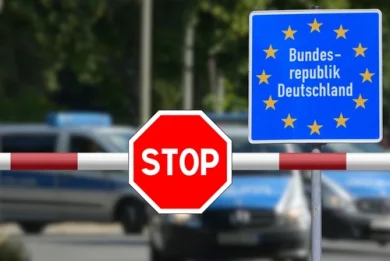
The European Commission calls for the gradual removal of controls at the Schengen internal borders.


Always see our news on Google
The European Commission has issued opinions regarding the temporary border controls reintroduced by Austria, Denmark, France, Germany, Italy, the Netherlands, Norway, Slovenia, and Sweden. Brussels states that these controls must remain exceptional and temporary and recommends their gradual replacement with alternative measures to protect free movement within the Schengen area.
The European Commission calls on Austria, Denmark, France, Germany, Italy, the Netherlands, Norway, Slovenia, and Sweden to work towards the gradual elimination of temporary controls at the internal Schengen borders and to use more alternative security measures.
In short 1. The European Commission has issued opinions regarding temporary controls at the internal borders of Schengen states again.
2. The targeted states are Austria, Denmark, France, Germany, Italy, the Netherlands, Norway, Slovenia, and Sweden.
3. The Commission states that these controls must remain exceptional, temporary, necessary, and proportionate.
4. Brussels recommends the gradual replacement of controls with alternative measures, such as non-systematic police checks, mobile biometric identification, and vehicle tracking technologies.
5. The Commission argues that the Migration and Asylum Pact, the Entry-Exit System, and the future ETIAS will allow states to better manage security without maintaining controls at internal borders.
For citizens, the stakes are direct: internal border controls affect cross-border commuters, carriers, tourists, businesses, and communities that rely daily on the rapid movement between Schengen states. The European Commission asserts that security must be protected without undermining the long-term functioning of free movement.
The opinions issued by the Commission target situations where internal controls last more than 12 months. European law allows for the temporary reintroduction of controls when there is a serious threat to public order or internal security, but the measure must be justified, proportionate, and time-limited.
The Commission acknowledges that member states have raised real and legitimate concerns related to security and migration. At the same time, Brussels warns that the reintroduction of internal border controls has effects on neighboring states and border communities.
The institution calls on states to limit the negative consequences for commuters and cross-border regions. The structured dialogue coordinated by the Commission has already contributed, according to the European executive, to reducing waiting times, improving operational coordination, and better information exchange between states.
The Commission indicates several alternatives to systematic border controls. These include non-systematic police checks, risk-based checks, mobile biometric identification, and vehicle tracking technologies. In many cases, member states are already using non-systematic checks that can be more easily replaced with alternative solutions.
Brussels links the gradual elimination of internal controls to new European tools for managing borders and migration. The Migration and Asylum Pact is expected to strengthen external border management and provide member states with more effective tools to combat unauthorized movements within the Schengen area.
The Commission also mentions the Entry-Exit System, fully applicable from April, as well as the future European Travel Information and Authorization System, ETIAS. These systems will allow for better monitoring of individuals entering and exiting the European Union, as well as the place and time of crossing external borders.
Henna Virkkunen, Executive Vice-President of the European Commission for technological sovereignty, security, and democracy, stated that Schengen is one of Europe's greatest achievements and symbolizes freedom of movement for over 450 million people. She asserted that where controls are reintroduced, they must remain temporary and exceptional.
Magnus Brunner, the European Commissioner for Home Affairs and Migration, stated that the European Union is implementing the most comprehensive reform of the migration management system. According to him, illegal border crossings have decreased by another 40% in 2026, and the new border management systems create the conditions for the gradual elimination of internal controls.
The Schengen area is essential for the internal market, as it allows for the movement of people, goods, and services without permanent controls at internal borders. Temporary controls can be used in exceptional situations, but their long-term maintenance affects the economy, transport, cross-border work, and trust between member states. The Commission will consult the targeted states for the implementation of the opinions and to prevent the transformation of temporary controls into a permanent practice.
Latest News
22:45
22:15
21:55
21:33
21:12
See more news
NEWS ON THE SAME TOPICS


.webp)