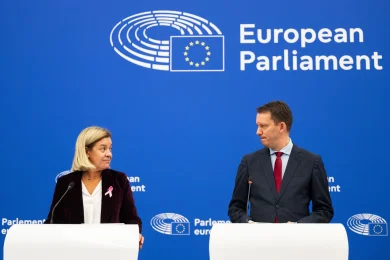
Members of the European Parliament call for limits on EU funding based on performance in the next multiannual budget.


.webp)

Always see our news on Google
The European Parliament calls for limits and guarantees for the expansion of EU funding based on performance in the next multiannual budget, warning about the risks of fraud and loss of transparency. In short The European Parliament adopted the report with 527 votes in favor, 85 against, and 33 abstentions.
MEPs warn that payments not linked to actual costs can increase the risks of errors, double funding, and fraud.
By the end of 2024, the EPPO will manage 307 active cases related to the RRF, with estimated damages of 2.8 billion euros.
The Parliament demands that funding not linked to costs be limited to smaller projects, while large and complex investments should remain cost-based.
MEPs call for complete traceability, transparency regarding final beneficiaries, and stronger parliamentary control. The European Parliament warned on Tuesday against the expansion of EU funding based on performance in the next long-term budget of the Union, if this model is not supported by strict conditions, solid guarantees, and stronger control mechanisms. The report was adopted in plenary with 527 votes in favor, 85 against, and 33 abstentions. MEPs argue that funding in which payments are not linked to actual costs can increase the risks of errors, double funding, and fraud. The performance-based funding model ties payments to the achievement of milestones and targets, not to the reimbursement of eligible costs. The Recovery and Resilience Facility (RRF) was the first large-scale instrument of this kind at the EU level. The Parliament uses the experience of the RRF to identify the risks of this model. The report mentions the low accountability, limited EU oversight of compliance with rules, insufficient transparency regarding final beneficiaries, the low number of cross-border projects, and the inadequate involvement of local and regional authorities in the decision-making process. MEPs note that by the end of 2024, the European Public Prosecutor's Office will manage 307 active cases related to the RRF. The estimated damage to the financial interests of the EU amounts to 2.8 billion euros, representing about 30% of the total fraud detected in EU spending. The Parliament believes that funding not linked to costs should only be used for smaller beneficiaries implementing projects below defined financial thresholds. Large and complex investments should remain cost-based. MEPs insist that the assessment of the achievement of milestones and targets that trigger EU payments should be done by the European Commission. They demand that these milestones and targets be directly linked to the implementation of concrete projects, with measurable results and contributions to EU policy objectives. The report states that the transition to performance-based delivery models requires the development of administrative and technical capacity both at the EU level and at the national level. Monitoring, control, and auditing differ significantly from the requirements used for traditional cost-based instruments. The Parliament warns that the widespread use of funding not linked to costs reduces transparency and traceability of EU funds. MEPs say this could limit the Parliament's ability to control the implementation of the EU budget. MEPs warn that the expansion of these instruments without stronger parliamentary oversight risks shifting the institutional balance towards executive discretion. They demand that any governance model for performance-based instruments involve the Parliament and the Council on an equal footing. The report also calls for strengthened provisions regarding monitoring, reporting, and transparency. MEPs demand complete information regarding the final beneficiaries of EU funds. "The budget of Europe is not an ATM from which money is simply withdrawn and disappears. It is a promise to deliver tangible results and impact in real life. Performance-based budgeting can accelerate necessary reforms, but it must never weaken accountability," said rapporteur Monika Hohlmeier. She stated that when payments are separated from actual costs, transparency and value for money become harder to demonstrate. Hohlmeier called for interoperable digital solutions that make financial flows visible and auditable, with clear criteria for triggering payments, complete audit trails, and real-time traceability down to the final beneficiaries, including contractors and subcontractors. Performance-based instruments change the way the European Union designs and finances policies. They aim to accelerate reforms and focus on results by linking payments to milestones and targets. The RRF was the first large-scale application of this model at the EU level. The European Commission proposed its extension through national and regional partnership plans in the next Multiannual Financial Framework. The model can simplify procedures and direct funding towards results, but it also introduces significant risks for control, transparency, and accountability. The European Court of Auditors has identified weaknesses in the control system of the RRF, including incomplete audit trails, high dependence on national authorities, and uneven quality of controls among member states. For the European Parliament, the debate on the expansion of performance-based funding is linked to democratic control over the EU budget, the capacity for auditing, and the ability to trace the path of European money down to the final beneficiaries.

Latest News
21:18
20:32
20:07
19:52
19:28
See more news
NEWS ON THE SAME TOPICS