The EU directive against violence against women must be transposed by 14 June 2027



Always see our news on Google
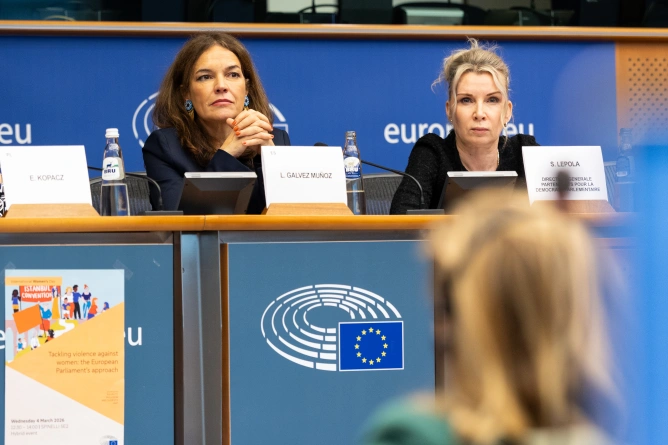
The interparliamentary conference in Brussels brought the implementation of the 2024 directive to the forefront. Romanian legislation on femicide, the French reform of sexual offences and the new Irish committee illustrate different stages and instruments.Member States to which the directive applies have until 14 June 2027 to transpose the directive on combating violence against women and domestic violence. The interparliamentary conference held in Brussels on 18 November discussed the shift from adopting European rules to implementing them. Romania, France and Ireland illustrate different stages of this process through legislation on femicide, changing the definition of sexual offences and creating a parliamentary oversight committee.
In brief
1.The directive imposes rules on certain offences, the protection and support of victims, violence prevention and data collection. The transposition deadline is 14 June 2027.
2.Romania adopted Law No. 53/2026 on preventing and combating femicide and the violence preceding it. The law also includes criminal and procedural amendments.
3.France introduced the lack of consent into the definition of sexual assaults in November 2025. A broader bill on sexual and sexist violence was adopted at first reading by the National Assembly in October 2026.
4.Dáil Éireann approved on 10 November the appointment of Ruth Coppinger to head the committee for the prevention of and fight against domestic, sexual and gender-based violence, effective from 11 November.
5.The European directive requires measures to prevent rape and education on consent. The adopted version leaves the criminal definition of rape to national legislation.
The meeting of the European Parliament was dedicated to the transposition, implementation and parliamentary oversight of the directive adopted in 2024. The programme brought together representatives of the European Parliament and national parliaments, experts and organisations working with victims. The practical question for states is how they will turn European obligations into accessible procedures, services and protection. Denmark benefits from the derogation provided for in the EU treaties, while Ireland participates in applying the directive.
The directive criminalises, among other things, female genital mutilation, forced marriage and certain forms of online violence. It provides for the assessment of protection needs, specialised support, services for victims of sexual violence and reporting mechanisms. States must also organise prevention, professional training and data collection, in accordance with the requirements of the act.
In Romania, the law adopted on 23 April 2026 establishes the framework for preventing femicide and the violence preceding it. It defines femicide, intimate and non-intimate forms, and establishes rules for collecting and analysing information on these acts. The application of the provisions on data collection is scheduled from 1 October 2026.
The law includes amendments to the Criminal Code and procedures, in addition to prevention and monitoring measures. Assessing compatibility with the directive must address the entire set of European obligations, which also cover digital violence, specialised support and victims’ access to justice. The existence of the law on femicide documents a concrete national reform within a broader transposition process.
In France, Law No. 2025-1057 of 6 November 2025 amended the criminal definition of rape and sexual assaults. Consent must be freely and knowingly given, specific, prior to the act and revocable. Silence or the absence of a reaction, considered alone, is insufficient to establish its existence.
Separately, on 13 October 2026, the National Assembly adopted at first reading a broader proposal to combat sexual and sexist violence against women and children. The parliamentary record distinguishes this stage from final adoption. The proposal includes measures concerning the investigation of acts, victim protection and the prevention of secondary victimisation.
In Ireland, the Dáil decision of 10 November concerns the composition and leadership of a specialised parliamentary committee. Its oversight mandate may cover both legislation and the implementation of policies and the operation of victim services. Establishing the committee represents a parliamentary oversight measure, while transposition is carried out through the national acts and measures necessary for each European obligation.
The distinction between criminal definitions and prevention is essential in the case of consent. Article 35 of the directive requires promoting the central role of consent in sexual relations, including through educational and awareness-raising programmes. The European prevention rule can coexist with different national definitions of rape.
By the June 2027 deadline, governments and parliaments must identify which obligations are already covered and where legislative changes, funding or new procedures are needed. For victims, the result will be seen in access to protection, assistance and justice, and in institutions’ ability to respond effectively to reports.
Latest News
11:51
11:44
11:36
11:35
11:30
See more news
NEWS ON THE SAME TOPICS