EIB and BCR Social Finance Announce €100 Million in Loans for Romanian Microenterprises



Always see our news on Google
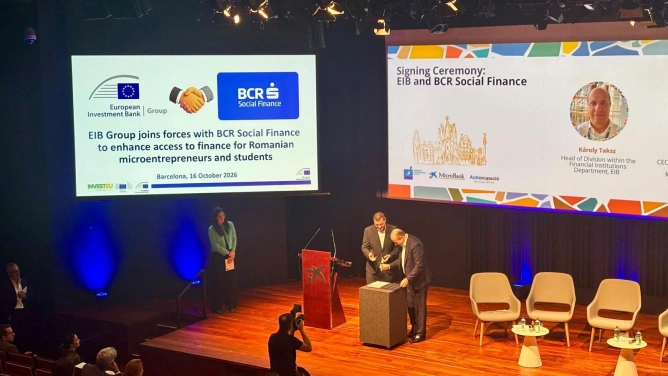
The European Investment Bank (EIB) and BCR Social Finance announced on October 19, 2026, a partnership for €100 million in loans intended for investments by Romanian microenterprises. The European institution is providing a €50 million facility, which the Romanian intermediary is matching with an equal amount from its own resources. The agreement, presented at the annual conference of the European Microfinance Network in Barcelona, aims to offer long-term financing and lower interest rates to firms that face difficulties accessing traditional bank loans.
In brief
1. The EIB–BCR Social Finance partnership aims to provide €100 million in loans: €50 million from the EIB and an equal contribution from the intermediary. The amount represents the announced lending capacity, not money already fully distributed to firms.
2. The operation targets firms with fewer than ten employees and annual turnover or a balance-sheet total of no more than €2 million. BCR Social Finance reviews applications and grants loans for eligible investments; meeting these criteria does not guarantee approval.
3. The EIB’s participation must be reflected in lower interest rates than those that would be available without its support. The announcement does not establish a single interest rate or a loan ceiling for each firm, and the specific conditions must be checked with BCR Social Finance.
4. Separately, the extension of the InvestEU guarantee provided by the European Investment Fund (EIF) is expected to support €100 million in financing for more than 5,300 microentrepreneurs, particularly in rural areas. The number is a target number of beneficiaries, not an outcome already achieved.
5. The EIF mechanism includes an additional €10 million for education and skills. The EIB loan and the EIF guarantee serve different functions and cannot automatically be added together into a total of €210 million in distinct loans; the announced support is not a grant program.
The firms targeted are microenterprises with fewer than ten employees and annual turnover or a balance-sheet total of no more than €2 million, according to the definition used in the EIB’s announcement. The financing is intended for eligible investments, including those for which access to ordinary bank lending is difficult. Businesses will apply for loans from BCR Social Finance, which will assess their creditworthiness and projects, not directly from the EIB.
The public information sheet for EIB project 20250698 records proposed financing of €50 million and a signed contract for €25 million on October 12, 2026. The October 19 announcement presents the entire facility as €50 million. The two figures describe different stages of the operation: announcing the total facility does not prove that it has been fully contracted or drawn down, and loans to final beneficiaries follow their own approval process.
The operation is an intermediated loan intended for multiple beneficiaries, referred to by the EIB as a Multi-Beneficiary Intermediated Loan (MBIL). The European bank provides resources to the local intermediary, which directs them toward approved investments. BCR Social Finance is also responsible for identifying, assessing, and monitoring the environmental, climate, and social risks of the projects, while beneficiaries must comply with applicable national and European legislation.
The EIB’s assessment links microenterprises’ financing difficulties to limited credit histories, insufficient collateral, and the relatively high administrative costs of assessing small loans. Some investments need more time to recover their costs than the maturities available on the market allow. The facility aims to reduce these obstacles through long-term financing and by diversifying the capital sources of BCR Social Finance, an institution that does not take deposits.
The financial advantage of the EIB’s participation must be passed on to firms through lower interest rates compared with the conditions that would be available without its involvement. However, the announcement does not publish a standard rate, a fixed reduction in percentage points, a complete list of eligible expenses, or an application timetable. The intermediary’s offer and the assessment of each application will determine the actual financing and repayment conditions.
The second announced agreement concerns the extension of the InvestEU guarantee between the European Investment Fund and BCR Social Finance. According to the EIB Group, the increase is expected to enable €100 million in financing for more than 5,300 microentrepreneurs in Romania, with a focus on rural areas, as well as an additional €10 million for investments in education and skills development. These amounts and the number of beneficiaries describe the mechanism’s objectives, not loans already granted or grants for pupils and students.
The EIB loan provides resources for lending, while the EIF guarantee covers part of the financing risk, under the terms of the applicable agreement. InvestEU guarantees can facilitate lower costs, longer maturities, and collateral requirements adapted to beneficiaries with limited access to financing. The announcement does not explain to what extent the same loans or firms may be covered by both instruments, so adding them together into a total of €210 million in completely distinct financing is not justified.
BCR Social Finance is a non-bank financial institution with a social mission that finances small businesses, social enterprises, non-governmental organizations, students, and other groups with difficult access to traditional lending. The official BCR Group page identifies Erste Social Finance Holding GmbH, with 51%, and Banca Comercială Română, with 49%, as direct shareholders.
Previous activity provides an indication of the institution’s scale. According to BCR Group’s 2025 results, BCR Social Finance supported more than 2,170 microenterprises, including 1,030 in agribusiness, through €45.2 million in financing. BCR associates these operations with the retention of more than 4,150 jobs; the figures refer to 2025 and do not measure implementation of the new partnership.
Cooperation with the EIB also includes advisory services received through the Social Inclusive Finance Technical Assistance (SIFTA) initiative, within the InvestEU Advisory Hub. The support focused on strengthening microfinance capacity and assessments related to the European Code of Good Conduct for the Provision of Microcredit. Technical assistance helps the institution improve its operations and is distinct from the resources lent to firms.
EIB Vice-President Ioannis Tsakiris presented the agreement as a means of expanding the smallest businesses’ access to long-term financing for investment and development. BCR Social Finance General Manager Ștefan Ionuț Buciuc emphasized that appropriate financing can enable investments that would otherwise be postponed and that the partnership increases the institution’s capacity to reach entrepreneurs and their communities.
The EIB places the project within its objectives of financing businesses and promoting economic and social cohesion. The information sheet states that Romania’s regions, with the exception of Bucharest and Ilfov County, are less developed, to explain the operation’s relevance to cohesion policy. This observation does not in itself exclude financing in Bucharest–Ilfov. For concrete access to loans, entrepreneurs must consult BCR Social Finance’s products and conditions, as it will decide on applications and establish repayment obligations.

Latest News
22:50
22:21
21:50
21:45
21:23
See more news
NEWS ON THE SAME TOPICS



.webp)