EDMO warns that AI images of non-existent supporters of the World Cup are being used for money and online trafficking.



Always see our news on Google
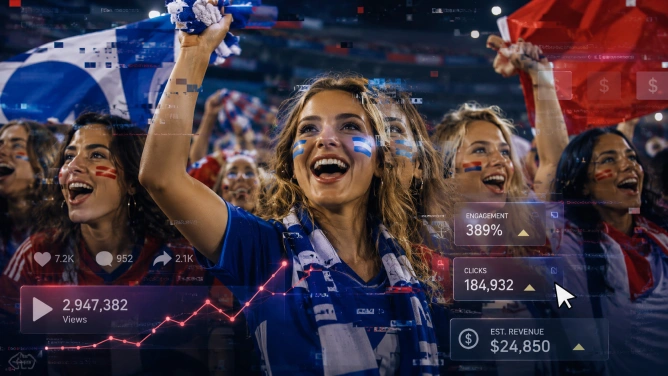
The European Digital Media Observatory warns that the current World Cup is being exploited through a wave of images generated with artificial intelligence, depicting hypersexualized women in national team jerseys. Fact-checkers from Europe have verified images attributed to supporters of Belgium, Germany, Argentina, Switzerland, Mexico, Spain, Brazil, and other teams and found that the individuals do not exist. EDMO states that the images are used for views, shares, monetization revenue, and, in some cases, to direct users to other sites.
The European Digital Media Observatory warns that the current World Cup is also accompanied by a wave of images generated with artificial intelligence, presented as real photographs of supporters of national teams. The images verified by fact-checking organizations in Europe show hypersexualized women with idealized physical features and uniforms of teams such as Belgium, Germany, Argentina, Switzerland, Mexico, Spain, or Brazil.
In short
1. EDMO warns that AI images of non-existent World Cup supporters have gone viral on social platforms.
2. European fact-checkers have verified images attributed to several national teams and found that the individuals do not exist.
3. EDMO states that the main driver of the phenomenon is monetization: views, likes, shares, and traffic to other sites.
4. The observatory criticizes social platforms for failing to limit the monetization of unlabeled AI content on a large scale.
5. The Weekly Pulse edition also mentions other false narratives related to the World Cup, including claims about Ebola, referees, and players.
EDMO describes the phenomenon as part of a broader trend: misinformation follows major events, and global sports competitions provide quick visibility for fabricated content. In the case of the World Cup, unlabeled AI images spread more easily because they capitalize on public interest in teams, supporters, and the excitement of the competition.
The analyzed images have recurring features: large eyes, small noses, sharp chins, full lips, accentuated silhouettes, and national team jerseys. They are designed to quickly attract attention in social feeds, where users often interact with the image before verifying whether the person or scene exists.
EDMO states that the main reason for producing this content is monetization. On social platforms, accounts can earn money or traffic if their posts go viral and gather views, likes, and shares. Some accounts also direct users to other sites, including platforms where explicit content can be further monetized.
The problem is not just the use of artificial intelligence. Content becomes misleading when it is shared without labeling, as it would appear to show real people or real scenes from the World Cup. In this way, the images can confuse the public, clutter the informational space, and make it harder to distinguish between authentic photographs and fabricated images.
EDMO criticizes social platforms for not effectively enforcing policies regarding unlabeled AI content and the monetization of misinformation. The observatory shows that platforms allow the widespread dissemination of images that do not inform the public but exploit users' attention for financial gain.
The effects can be broader than mere confusion. EDMO warns that hypersexualized images can negatively influence young users. Boys may be exposed to unrealistic and superficial expectations about women, while girls may feel pressure from artificially generated beauty standards that are massively promoted online.
The observatory also mentions more serious risks. Previous investigations have shown that AI images can be used not only for traffic and monetization but also to attract users to networks that combine sexualized content with extremist political propaganda, nationalist, or xenophobic.
The Weekly Pulse edition shows that misinformation related to the World Cup is not limited to images of non-existent supporters. EDMO also mentions unlabeled AI content created for humor and traffic, conspiracy theories about players, and sites that imitate well-known publications.
One cited example concerns a false claim about Kylian Mbappé. According to EDMO, an article claimed without verified information that Mbappé had left France because he was sexually harassed by President Emmanuel Macron. The article was published on a site that mimicked Eurosport and claimed to belong to a journalist of the publication, showing signs of a pro-Russian disinformation campaign.
EDMO includes in the same edition a verification regarding a viral claim on TikTok that the United States had closed its borders to travelers from Africa due to the risk of Ebola during the World Cup. The cited verification shows that there is no general closure of borders for African travelers, but only a temporary and limited measure for individuals who have recently been in certain affected countries.
Another case concerns Somali referee Omar Artan. On social media, the idea circulated that, after being denied entry into the United States, Canada had invited him to referee in Vancouver. The verification mentioned by EDMO shows that there is no confirmed assignment for a World Cup match in Canada.
The phenomenon shows how a global sporting event can be simultaneously used for commercial gains, political misinformation, fabricated content, and the exploitation of public emotions. Football offers a huge audience, and AI images, sites that imitate publications, viral posts, and monetized accounts can quickly turn fan attention into money or influence.
EDMO notes that this edition reflects information available as of June 24, 2026. The observatory is hosted by the European University Institute, at the Florence School of Transnational Governance, and brings together European activities for monitoring and fact-checking misinformation.
Latest News
22:52
22:48
22:43
22:38
22:20
See more news
NEWS ON THE SAME TOPICS