Crosetto calls for common rules against hybrid warfare, citing the risk of influencing young people through digital profiling



Always see our news on Google
Italy’s defense minister proposes a coordinated response to disinformation and the use of users’ data for influence operations. The appeal made after the E5 meeting in Paris is a political position; the joint statement does not introduce new rules for platforms.
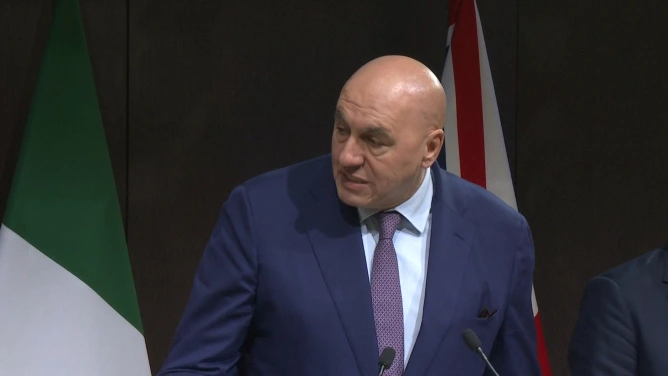
Italian Defense Minister Guido Crosetto called on Monday, October 26, 2026, for the examination of common rules and tools against hybrid warfare, warning in Paris about the use of digital profiling to influence young people. After the meeting of the European E5 format, he argued that the response to disinformation and influence attempts must be built collectively. The intervention was not accompanied by a legislative proposal or the adoption of new obligations for platforms.
In brief
1. Guido Crosetto proposed examining new rules and tools to combat hybrid warfare. He said the issue must remain on the agenda of the E5, Europe, and NATO, without presenting an adoption timetable.
2. The minister warned that data collected about platform users, especially young people, can be exploited to influence opinions. This is his assessment of the risk; the intervention did not identify a specific campaign or responsible platform.
3. The E5 brings together France, Germany, Italy, Poland, and the United Kingdom. The joint statement of October 26 condemns Russia’s hybrid activities and supports a stronger European role in NATO, but does not establish rules on digital profiling.
4. The EU already has coordinated tools for responding to hybrid threats. Primary responsibility lies with the member states; the European framework allows preventive, diplomatic, restrictive, and support measures to be combined.
5. The DSA requires platforms and search engines designated as very large to assess and reduce systemic risks. Platforms may not display profiling-based advertisements using a minor’s data when they know that age with a reasonable degree of certainty. These rules are distinct from Crosetto’s appeal.
The E5 is the defense cooperation format of France, Germany, Italy, Poland, and the United Kingdom. The meeting in the French capital had support for Ukraine, European security, crises in the Middle East, protection of maritime routes, and hybrid threats on its agenda. The format coordinates positions among governments; it is not a legislative institution of the European Union.
In the statement published after the meeting, the Italian Ministry of Defense quotes Crosetto as saying that no European state can face these challenges alone. The minister supported strengthening NATO’s European pillar through cooperation, interoperability, and the development of common capabilities.
Crosetto included cyberattacks, disinformation, and attempts to influence public opinion through sophisticated profiling and analysis tools among the threats discussed. In his remarks at the press conference, he described actions that are difficult to observe and attribute, alongside drone incursions and other security pressures.
His concern regarding young people concerns the information that platform use can reveal about their interests and behavior. The minister argued that profiling can be used to influence how they view the world, society, and democracy, with a degree of influence that families and schools might find difficult to counter. These assessments belong to Crosetto; in his intervention he did not identify a state, platform, or specific campaign demonstrating the mechanism described.
In response to journalists’ questions, the minister said that technological development adds new forms of confrontation to traditional ones and proposed examining additional rules and tools. According to his explanation, the discussion begun in Paris must continue in the format of the five states, at the European level, and within NATO. However, he did not describe the content of any future obligations, a supervisory mechanism, or deadlines for their adoption.
The E5 joint statement has a broader scope. The five states consider Russia the most serious long-term threat to Euro-Atlantic security and stability and denounce violations of allied airspace, sabotage, and hybrid attacks in several areas. The document reaffirms support for Ukraine and the need for a stronger European contribution to collective defense.
The joint text supports the modernization of forces and industrial cooperation in defense, in coordination with the United States and the other allies. EU initiatives should complement NATO and avoid unnecessary duplication of efforts. The document does not establish a program to combat digital profiling; the appeal for new rules and tools was made by Crosetto in his intervention.
According to the Council of the EU, hybrid threats include coordinated, harmful activities planned with the intention of undermining a state, institution, or society by combining multiple means. They may involve information manipulation, cyberattacks, economic pressure, covert political maneuvers, or military threats. Actors may be state or non-state, and the methods are often designed to remain below the threshold of armed conflict.
Primary responsibility for combating these threats lies with the member states. At the European level, the common response framework created in 2022 allows preventive, cooperation, stabilization, restrictive, and support measures to be combined. It works alongside tools against information manipulation and foreign interference and cyber diplomacy mechanisms. On March 16, 2026, the Council reaffirmed the coordinated use of available tools to prevent, deter, and counter hybrid campaigns.
Regarding platforms, the Digital Services Act, DSA, already establishes separate obligations. Online platforms and search engines designated as very large must identify, assess, and reduce systemic risks related to their services, including effects on fundamental rights, civic discourse, elections, and public safety. The assessment must also take account of the intentional manipulation of services, inauthentic accounts, or automated exploitation.
The regulation requires proportionate and effective risk-mitigation measures, while respecting fundamental rights. Commercial profiling and algorithmic recommendations do not, by their mere existence, demonstrate a foreign interference operation. Identifying a hostile campaign requires establishing the actors, methods, and coordination of the actions; DSA obligations do not replace this attribution.
To protect minors, the DSA prohibits platforms from displaying profiling-based advertisements using a user’s personal data when the provider knows with a reasonable degree of certainty that the user is a minor. Compliance with this rule does not require the platform to collect additional personal data to determine age. This is a protection already provided for by law, separate from the political proposals discussed by Crosetto.
Latest News
23:05
22:54
22:36
22:25
21:59
See more news
NEWS ON THE SAME TOPICS
.webp)